
Scene-Aware Voice Cloning, Face-Driven Emotion TTS, and Smarter Real-Time Voice Agents
Today's digest covers multimodal voice synthesis — from scene-adaptive cloning and face-conditioned emotion TTS to a massive multilingual speech LLM and a speculative "heartbeat" reasoning trick for low-latency voice agents.

Figure from From HeyGen.
Today's papers push on a shared theme: speech that knows its context. Whether that context is the visual scene a speaker inhabits, the emotion written on their face, the 202 dialects a model must handle, or the half-finished user utterance a voice agent is still listening to — every paper here argues that static, context-blind audio generation and understanding is no longer good enough.
---
TTS & Voice Cloning
Conditioning voice synthesis on more than just text — scenes, faces, and identity are all fair game now.
Voice cloning has long treated a speaker as a fixed acoustic fingerprint. HeyGen challenges that assumption by asking: what if the environment should also shape how someone sounds? HeyGen Voice decomposes voice into speaker identity, delivery style, and scene acoustics, then conditions generation jointly on a reference voice clip, a target portrait, and a description of the scene. The result is talking-video speech that naturally adapts its prosody and room acoustics to match the depicted setting — something neither pure speaker-adaptation nor scene-acoustics post-processing alone can achieve. The system uses staged training followed by reinforcement optimization to balance these competing objectives.
HeyGen Voice: Scene-Aware Voice Cloning for Talking Videos
HeyGen Voice separates speaker identity from delivery and acoustics in voice cloning, conditioning on reference voice, target image, and scene to produce talking videos where speech adapts naturally to the depicted environment. Unlike prior work that either adds scene acoustics or infers voice from appearance, this multimodal approach unifies speaker fidelity with scene-adaptive prosody through staged training and reinforcement optimization.
Abstract
Most voice-cloning systems are built for audio alone: they copy the reference recording's delivery and acoustics, so a voice cloned on a phone sounds like a phone recording whether the speaker is pictured in a studio, on a street, or in a cathedral. Speech for a talking video should sound like the pictured person speaking in the pictured place. We present HeyGen Voice, a scene-aware voice-cloning model that separates who is speaking from how and where: it keeps the speaker's voice from an everyday recording while the target image sets the delivery and acoustics. Prior image-conditioned TTS does half of this job: it either adds scene acoustics without keeping a specific speaker or infers a voice from a face. HeyGen Voice is a multimodal autoregressive transformer conditioned on the image, speaker and scene captions, and the voice recording, trained in five stages that move from multilingual TTS pretraining through simulated and real cross-scene adaptation to reinforcement and preference optimization. Two clone policies trade scene adaptation against fidelity to the original recording, and an audio anchor holds long scripts in one voice and one acoustic environment. Listeners prefer HeyGen Voice over leading commercial systems across a third-party arena, production votes, and talking-video studies: it ranks first (Elo 1201) on the public Artificial Analysis controlled-voice TTS leaderboard (October 2026); in a blind test, users cloning their own voice chose it over ElevenLabs v4 and Cartesia Sonic 3.6 in 62% and 54% of votes; and volunteers rated talking videos of their own digital twin about 10 to 30 points higher (out of 100) when voiced by HeyGen Voice than by leading commercial alternatives. Try HeyGen Voice and hear samples at https://heygen.com/heygen-voice.
On the expressive side, the University of Information Technology takes a complementary approach: what if a face image — rather than a scene — drives the emotional character of synthesized speech? EmoFI-TTS extracts both emotion category and emotion intensity from a single face image, then uses that signal to modulate TTS output while keeping speaker identity anchored to a reference audio clip. The critical novelty is that intensity modulation is learned without any labeled intensity data, yielding continuous, fine-grained control over how strongly an emotion colors the voice.
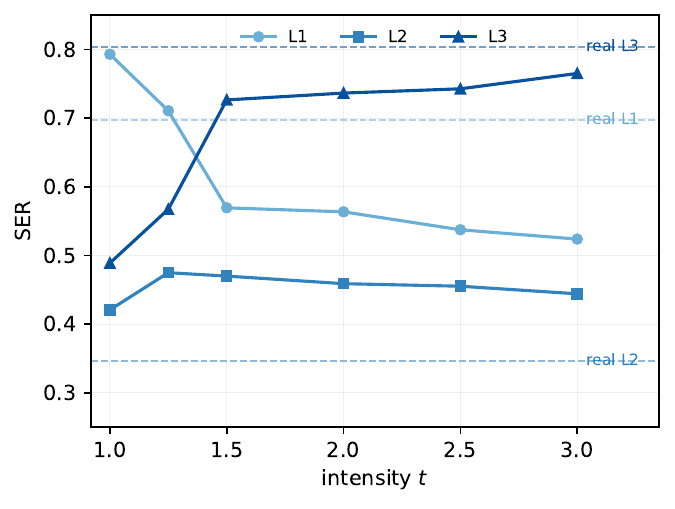
EmoFI-TTS: Face-Conditioned Expressive Voice Synthesis with Intensity Modulation
EmoFI-TTS synthesizes expressive speech conditioned on facial expressions, deriving both emotion category and intensity from a single face image while preserving speaker identity from reference audio. The key novelty is explicit intensity modulation without requiring labeled emotional intensity, enabling continuous fine-grained control over how strongly emotions are expressed in the generated speech.
Abstract
Controlling emotional intensity remains challenging in expressive text-to-speech synthesis, particularly when emotion must be inferred without explicit labels. We propose EmoFI-TTS, a face-conditioned framework that derives emotion category and intensity from a single facial image while extracting speaker characteristics from reference audio. Modality-specific representations are fused to condition a pretrained speech synthesizer, with cross-speaker training encouraging separation of affect and vocal identity. An intensity-conditioned refinement module enhances the generated mel-spectrogram, while interpolation of learned intensity embeddings enables continuous control without additional training. On speaker-disjoint MEAD evaluation, EmoFI-TTS achieves on average 64.4% and 75.2% objective and subjective emotion intensity accuracies, while retaining low word error rate and high naturalness.
---
SpeechLLMs & Spoken Dialogue
Large-scale speech understanding and real-time voice agent efficiency, from two very different angles.
iFlytek's Spark-Audio 1.0 is one of the most ambitious multilingual speech foundation models reported to date. It couples a compact 0.65B audio encoder with a 30B Mixture-of-Experts LLM to cover speech recognition, translation, and open-domain dialogue across 99 languages and 202 dialects — all trained on domestic computing infrastructure. The headline result is competitive benchmark performance achieved with substantially less audio training data than comparable systems, suggesting the MoE backbone is doing heavy lifting in cross-lingual transfer.
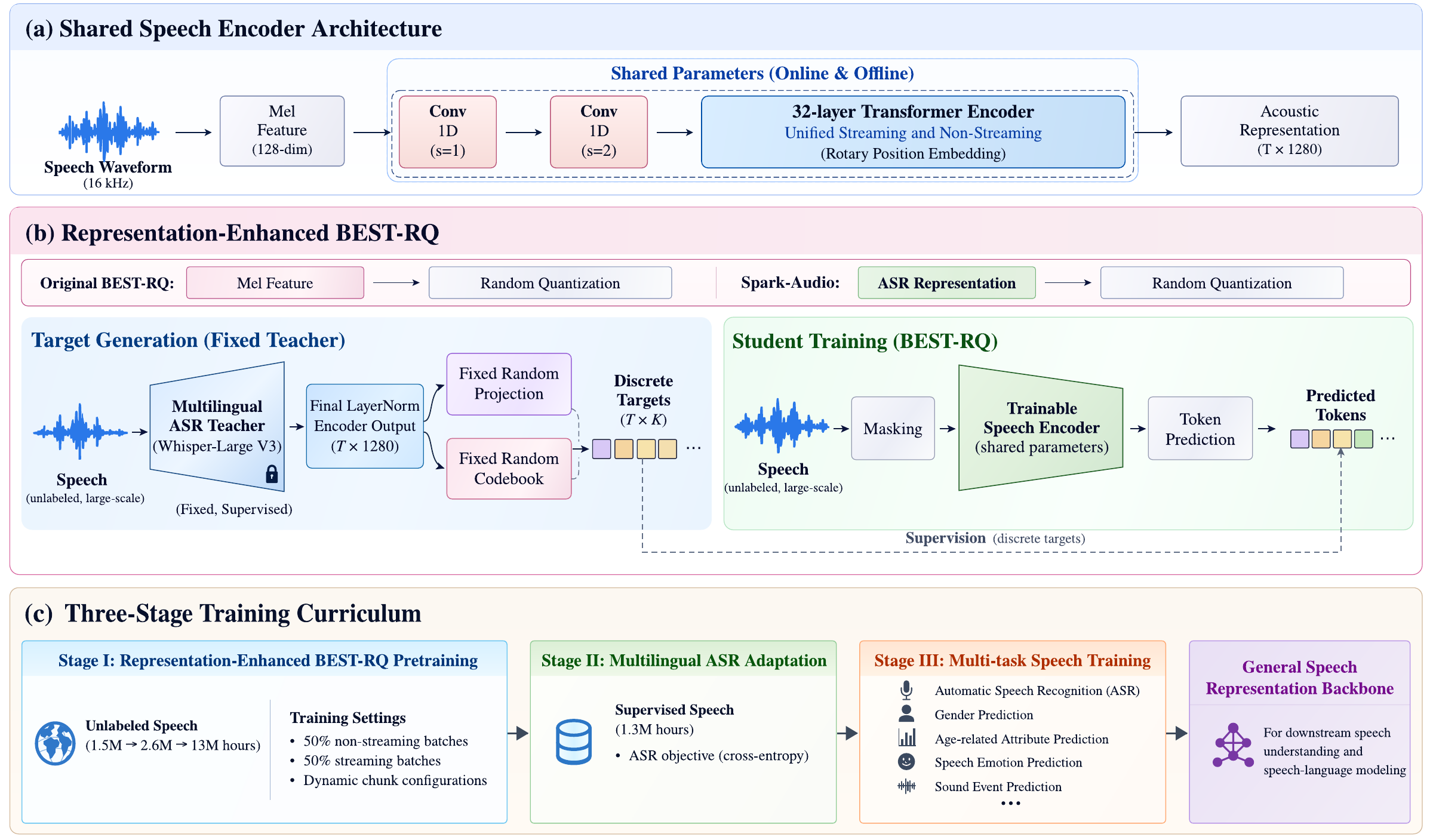
Spark-Audio 1.0 Technical Report
Spark-Audio 1.0 is a speech foundation model that unifies audio understanding with large language model capabilities, supporting multilingual/multi-dialect speech recognition, translation, and dialogue across 99 languages and 202 dialects. The model achieves competitive performance with substantially less audio training data than comparable systems through an efficient 0.65B audio encoder paired with a 30B MoE LLM, trained entirely on domestic computing infrastructure.
Abstract
This paper introduces Spark-Audio 1.0, a speech foundation model trained on domestically produced computing infrastructure. The model accepts text and speech inputs and generates text outputs. It supports multilingual (99 languages) and multi-dialect (202 dialects) speech recognition, speech translation, audio perception and understanding, and both text- and speech-based dialogue, marking a shift from merely ``hearing clearly'' to genuinely ``understanding'' speech. Architecturally, Spark-Audio 1.0 couples a 0.65B-parameter dense audio encoder with a 30B-A3B Mixture-of-Experts (MoE) large language model (LLM). The audio encoder is pretrained with representation-enhanced BEST-RQ and then refined through multi-task supervised training. The audio--LLM is trained through staged pretraining, followed by post-training that combines supervised fine-tuning with on-policy distillation. In total, the model is trained on 13 million hours of audio data together with large-scale text data. We evaluate Spark-Audio 1.0 on mainstream audio and text benchmarks, as well as on in-house test sets drawn from real-world application scenarios. Despite using substantially less audio training data than Qwen3.5-Omni-Flash, Spark-Audio 1.0 achieves comparable performance on most audio and text tasks, outperforms it in multilingual speech recognition, spoken dialogue, and real-world application scenarios, and approaches the performance of larger closed-source models. Nevertheless, there remains room for improvement in instruction following and complex audio reasoning. Finally, the successful training of Spark-Audio 1.0 on domestic hardware, including Huawei Ascend 910B and Hygon BW1000 chips, demonstrates the feasibility of a domestic technical pathway for building speech foundation models.
While Spark-Audio tackles breadth, today's HuggingFace Daily pick tackles latency. Ant International's Heartbeat Thinking addresses a fundamental inefficiency in real-time voice agents: the model sits idle while the user is still speaking, wasting cycles it could spend preparing tool calls. The proposed heartbeat mechanism runs speculative reasoning in the background on partial transcripts, continuously updating tool-call candidates as new speech tokens arrive. The payoff is measurable: higher tool-call coverage and lower end-to-end response latency without changing the underlying LLM.
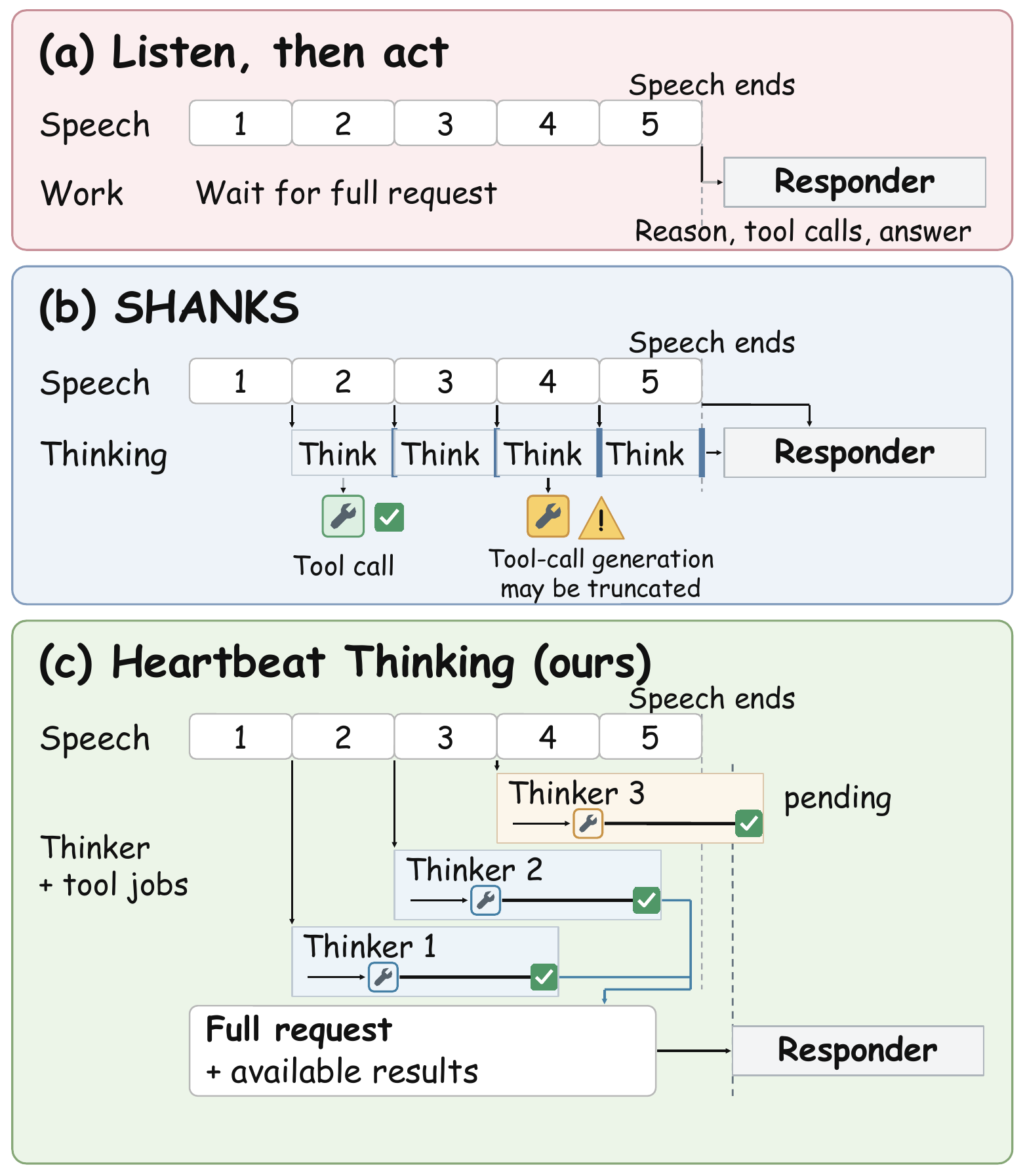
Heartbeat Thinking: Speculative Reasoning and Tool Execution While Listening in Realtime Voice Agents
A heartbeat-style speculative reasoning approach lets voice agents continue preparing tool calls during speech updates, improving coverage and reducing response latency.
Abstract
Tool-using voice agents often leave users waiting after speech ends, even when actionable information arrives earlier in the request. Speculative approaches begin work during speech, but chunk-bounded or interrupt-on-update generation can truncate a tool call before its arguments are complete. This couples computation time to speech updates, limiting useful work completed in advance. We introduce Heartbeat Thinking, which handles updated input through new Thinker invocations while allowing ongoing invocations and dispatched tools to finish. Periodic invocations read the latest partial transcript and a shared record of completed reasoning and tool results. These results help resolve missing arguments and initiate dependent calls, allowing preparation to progress across speech updates. Across SpeechFCEval, FDBench v3, and AudioCRAG, Heartbeat improves aggregate speculative tool coverage or retrieval reuse over a SHANKS-style windowed baseline, with benchmark-dependent effects on final task quality. On FDBench v3, it increases tool coverage by 16 percentage points and reduces mean final-response latency by 36.4\%. The results show that heartbeat thinking paradigm preserving ongoing computation during speech can turn listening time into reusable preparation for faster and more capable voice-agent responses.
Trending on Hugging Face
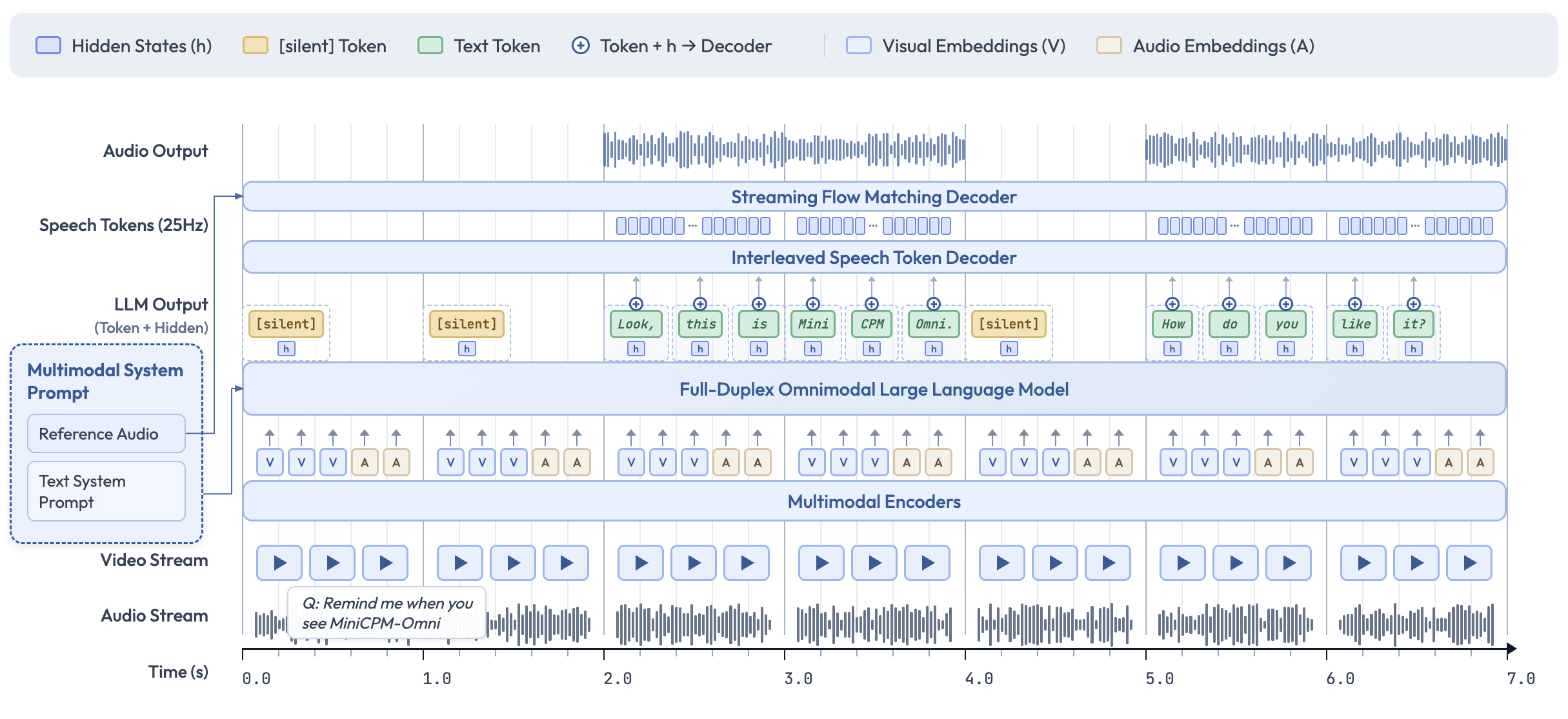
MiniCPM-o 4.5: Towards Real-Time Full-Duplex Omni-Modal Interaction
MiniCPM-o 4.5 enables real-time full-duplex interaction where perception and response happen simultaneously across vision, audio, and speech. Its Omni-Flow framework aligns multimodal signals on a shared timeline, supporting both reactive and proactive behaviors in continuous, streaming conversation.

OmniFlatten: An End-to-end GPT Model for Seamless Voice Conversation
A novel GPT-based model, OmniFlatten, enables real-time natural full-duplex spoken dialogue through a multi-stage post-training technique that integrates speech and text without altering the original model's architecture.

Fish Audio S2 Technical Report
Fish Audio S2 is an open-source text-to-speech system with multi-speaker capabilities, multi-turn generation, and instruction-following control through natural-language descriptions, utilizing a multi-stage training approach and production-ready inference engine.

Qwen3-TTS Technical Report
The Qwen3-TTS series presents advanced multilingual text-to-speech models with voice cloning and controllable speech generation capabilities, utilizing dual-track LM architecture and specialized speech tokenizers for efficient streaming synthesis.