
3D Avatars, Full-Duplex Failures, and the Long-Horizon Speech Challenge
Today's digest spans audio-driven 3D avatar generation, cross-lingual dubbing, simultaneous translation, co-speech gesture synthesis, unified streaming speech LLMs, full-duplex conversational failures, and a new multi-speaker TTS benchmark — a broad sweep of where spoken-language AI is pushing hardest right now.
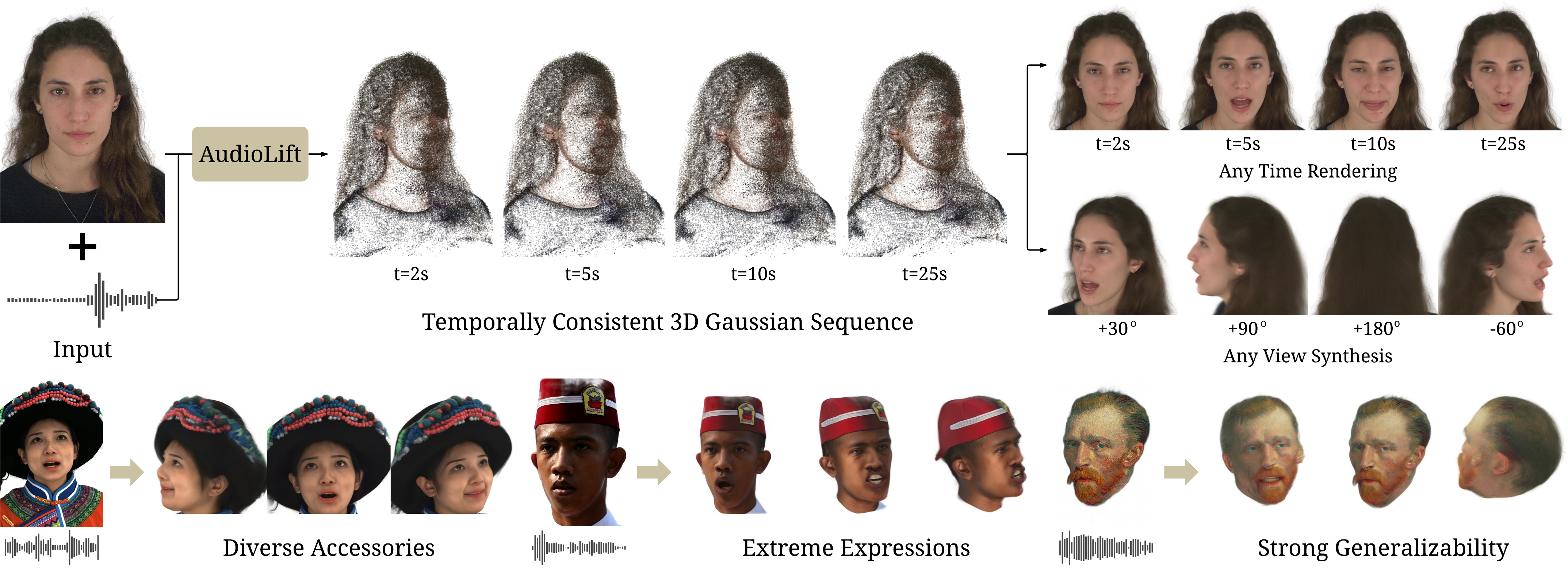
generates a temporally coherent sequence of 3D Gaussian talking avatars from a single portrait and audio. An audio-conditioned video model jointly generates synchronized views, which a robust Gaussian reconstructor lifts into 3D. The resulting avatars support rendering from arbitrary viewpoints at any time while preserving identity and accessories, capturing expressive motion, and generalizing to diverse in-the-wild portraits. From Carnegie Mellon University.
Today's papers share a common thread: the challenge of maintaining coherence — spatial, temporal, linguistic, or conversational — over long horizons. From 3D avatars that stay consistent across 360° views to full-duplex agents that collapse after a few minutes of real dialogue, researchers are stress-testing the limits of current architectures and proposing principled fixes. Eight papers, five themes.
Talking Avatars & Lip Sync
Lifting a single photo into a fully articulated, view-consistent 3D head.
Parametric 3DMM-based talking head methods have long struggled with accessories, extreme expressions, and non-frontal views. AudioLift from CMU sidesteps these constraints entirely by first synthesizing multi-view talking videos from a single portrait and audio signal, then lifting those frames into 3D Gaussian splatting — no per-instance optimization required. The result is a full-head avatar renderable at any azimuth, with faithful preservation of headwear and hair that parametric models routinely mangle.
AudioLift: Audio-Driven Single Image to Full-Head Gaussian Avatar via Multi-view Video Generation
AudioLift generates coherent 3D talking avatars from a single portrait image and audio by using multi-view video generation as an intermediate representation, then lifting frames to Gaussian splatting. Unlike parametric face model approaches, this method captures extreme facial expressions, preserves accessories like headwear, and enables full 360° rendering without per-instance optimization.
Abstract
Existing 3D talking avatar methods mainly rely on parametric face models including 3DMM or FLAME, whose compact motion representations limit their ability to synthesize extreme expressions and to model accessories such as headwear. We introduce AudioLift, a two-stage framework that uses generated multi-view videos as the intermediate representation for audio-driven avatar generation without parametric face models or per-instance optimization. Our framework combines a synchronized multi-view video generation stage with an inconsistency-robust Gaussian reconstruction stage to recover coherent full-head geometry from a single portrait image. Extensive experiments demonstrate that AudioLift produces 3D talking avatars capable of capturing more extreme facial expressions than existing methods, with improved geometric completeness and strong multi-view consistency across the full $360^\circ$ viewing range.
Dubbing & Speech-to-Speech Translation
Aligning what is said, when it is said, and how it looks.
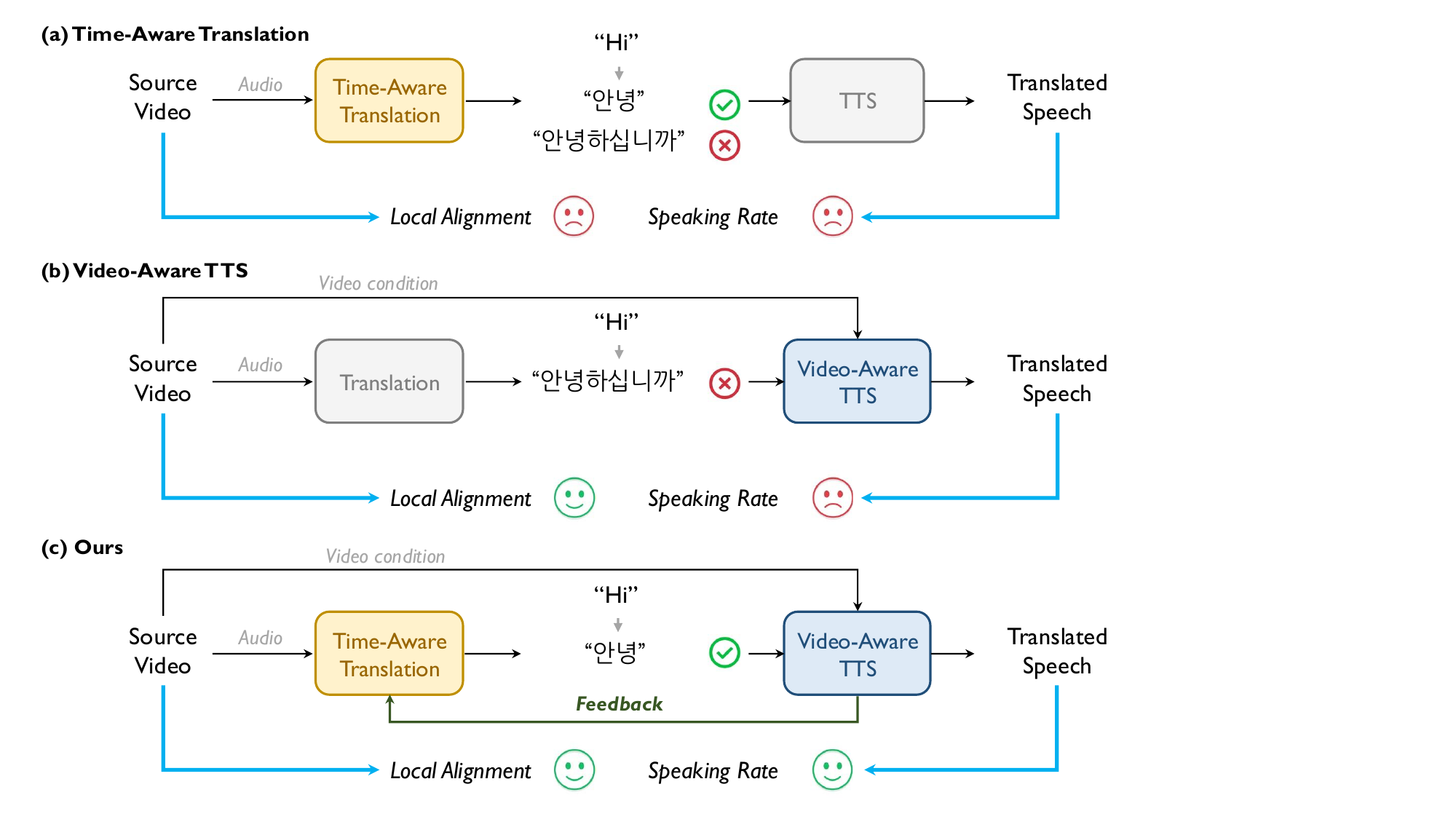
Dubbing is a notoriously multi-objective problem: the translated speech must sound natural, match mouth movements in the source video, and fit within the original segment's duration. X-Dubbing from Korea University addresses this by coupling time-aware speech-to-text translation with video-conditioned TTS in a single end-to-end feedback loop. Rather than trading off visual alignment against fluency in separate stages, the translator learns to prefer scripts that inherently satisfy both temporal and lip-sync constraints — without needing paired dubbing corpora.
X-Dubbing: Speech-to-Speech Translation under Temporal and Visual Constraints
This work addresses cross-lingual dubbing by jointly optimizing time-aware speech-to-text translation and video-conditioned text-to-speech synthesis through end-to-end feedback. Unlike isolated pipelines that trade off precise visual alignment against natural speaking rates, this coupled approach allows the translator to select scripts that inherently satisfy both temporal and visual constraints without requiring paired dubbing data.
Abstract
Cross-lingual dubbing aims to convert source speech into target-language speech that remains synchronized with the original video. The key to this task is to produce a faithful translation that is naturally speakable within the source timing, which is non-trivial because languages differ in duration, rhythm, and articulation. In this paper, we propose X-Dubbing, which formulates the task as a joint problem of time-aware speech-to-text translation and video-aware text-to-speech. Specifically, our method consists of a Dubbing Translator that generates temporally structured scripts and a Voice Actor that renders them in synchrony with the source video, both grounded in a language-agnostic timing budget. We further refine the translator with dubbing-aware feedback from the synthesized speech, encouraging scripts that yield well-synchronized dubbing. This design requires no paired dubbing data, as the two components are trained on speech-text and monolingual audio-visual data respectively. Extensive experiments show that X-Dubbing outperforms recent baselines across diverse metrics, including isochrony and audio-visual correspondence.
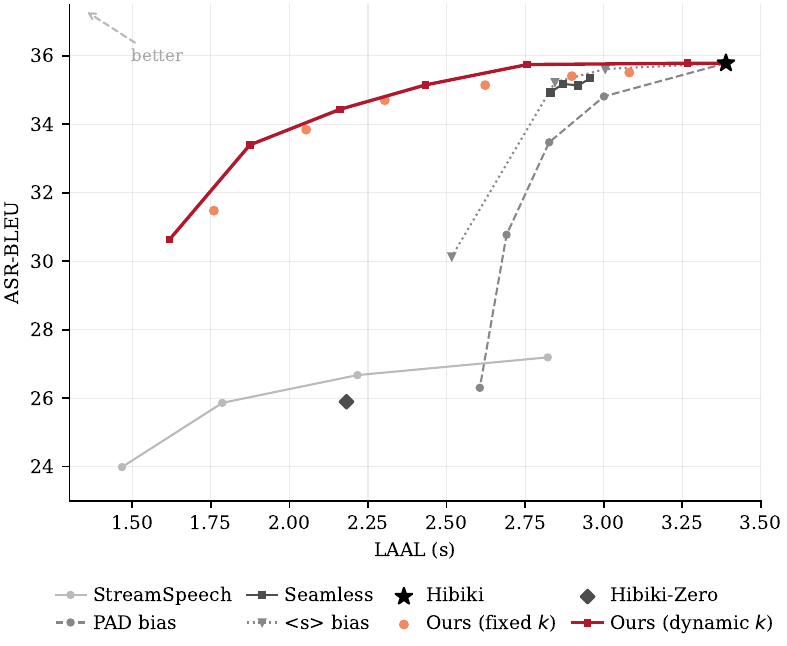
Simultaneous interpretation presents a different latency-quality tension. DIAL-S2ST from KAIST tackles real-time speech-to-speech translation by using self-distillation from lookahead predictions — the model learns to anticipate what a full-context pass would produce, then approximates it with less future input. A single LoRA adapter is scaled continuously across inference-time latency budgets, giving practitioners a knob to turn without retraining. Critically, no paired target data or explicit reward signal is needed.
DIAL-S2ST: Learning Latency Control for Simultaneous Speech-to-Speech Translation
DIAL-S2ST enables flexible latency control in simultaneous speech-to-speech translation through self-distillation from lookahead predictions, eliminating the need for paired target data or explicit reward computation. The approach uses a single LoRA adapter scaled across inference settings, allowing users to adjust the quality-latency trade-off dynamically with minimal adaptation data.
Abstract
We propose DIAL-S2ST, a post-training method for learning inference-time latency control in simultaneous speech-to-speech translation models. Our approach reuses pretrained translation capabilities through self-distillation from lookahead predictions, while limiting the influence of large text distillation losses to account for the imitation gap. This provides supervision for earlier emission without paired target data or reward computation. To make the learned timing adjustable at inference, we jointly train a single LoRA adapter across scales with matched lookahead guidance. Experiments on French-to-English translation with Hibiki demonstrate that only 10 hours of source speech enable this adaptation, providing flexible latency control with a favorable quality-latency trade-off.
Co-Speech Gesture & Motion Generation
Keeping body language coherent across minutes, not seconds.
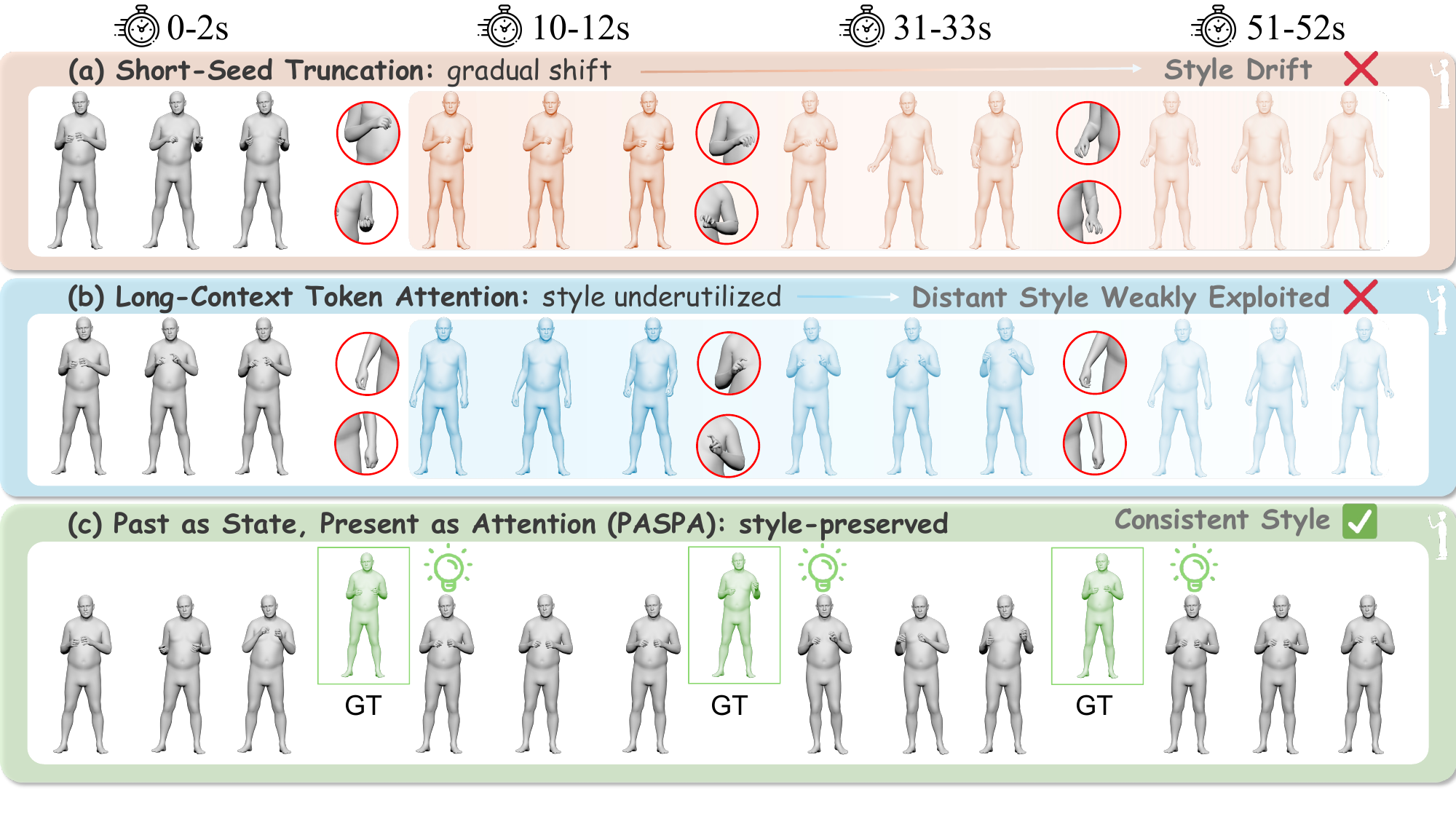
Short-window gesture generators tend to drift stylistically over time; full-history attention approaches are prohibitively expensive. Alibaba's PASPA resolves this with an explicit asymmetry: past motion history is compressed into a compact persistent state, while the present block is modeled with fine-grained attention in a blockwise flow matching framework. State caching keeps inference efficient, and the persistent state enforces long-range stylistic consistency that seeding-based methods cannot maintain.
Past as State, Present as Attention: Persistent-State Blockwise Flow Matching for Long-Horizon Co-Speech Motion Generation
This paper addresses the challenge of maintaining consistent motion style over long horizons in co-speech gesture generation by introducing an asymmetry principle: compressing past history into a persistent state while modeling current dynamics with fine-grained attention. Unlike methods that either drift through short seeding or become costly with full-history tokens, PASPA achieves stable, efficient long-sequence generation through blockwise flow matching with state caching.
Abstract
Co-speech motion generation remains challenging over long horizons due to the need for temporal coherence and consistent style. Existing methods typically generate long motions segment by segment, either conditioning on a short seed of recent frames, which gradually drifts, or retaining ever-longer explicit histories, which are costly to maintain and hard to learn from limited data. We trace these limitations to a key asymmetry between past and present: past motion carries slowly varying style that should be compactly summarized, whereas the current segment exhibits fast-changing local dynamics that require fine-grained modeling. This asymmetry motivates a simple Past-As-State, Present-as-Attention principle for long-horizon co-speech motion generation. Following this principle, we propose PASPA, which summarizes past history with an inter-block persistent state and models the current segment with intra-block bidirectional self-attention. We instantiate PASPA within a blockwise flow matching framework, with multi-block supervision for effective training over variable histories, prefill-decode state caching for efficient rollout, and hybrid classifier-free guidance for enhanced history and speech conditioning. Extensive public-benchmark experiments show that PASPA achieves state-of-the-art FGD performance and preserves motion style across long-sequence generation.
SpeechLLMs & Full-Duplex Voice Agents
Unifying ASR and TTS in one model — and surviving a long conversation.
The USC team's Uni-Stream demonstrates that a single streaming language model can handle real-time ASR and TTS jointly through two-stage training, matching task-specific baselines. An intriguing finding: even under unified training, speech and text representations occupy distinct latent feature spaces, suggesting the model internalizes a soft modality boundary rather than collapsing them.
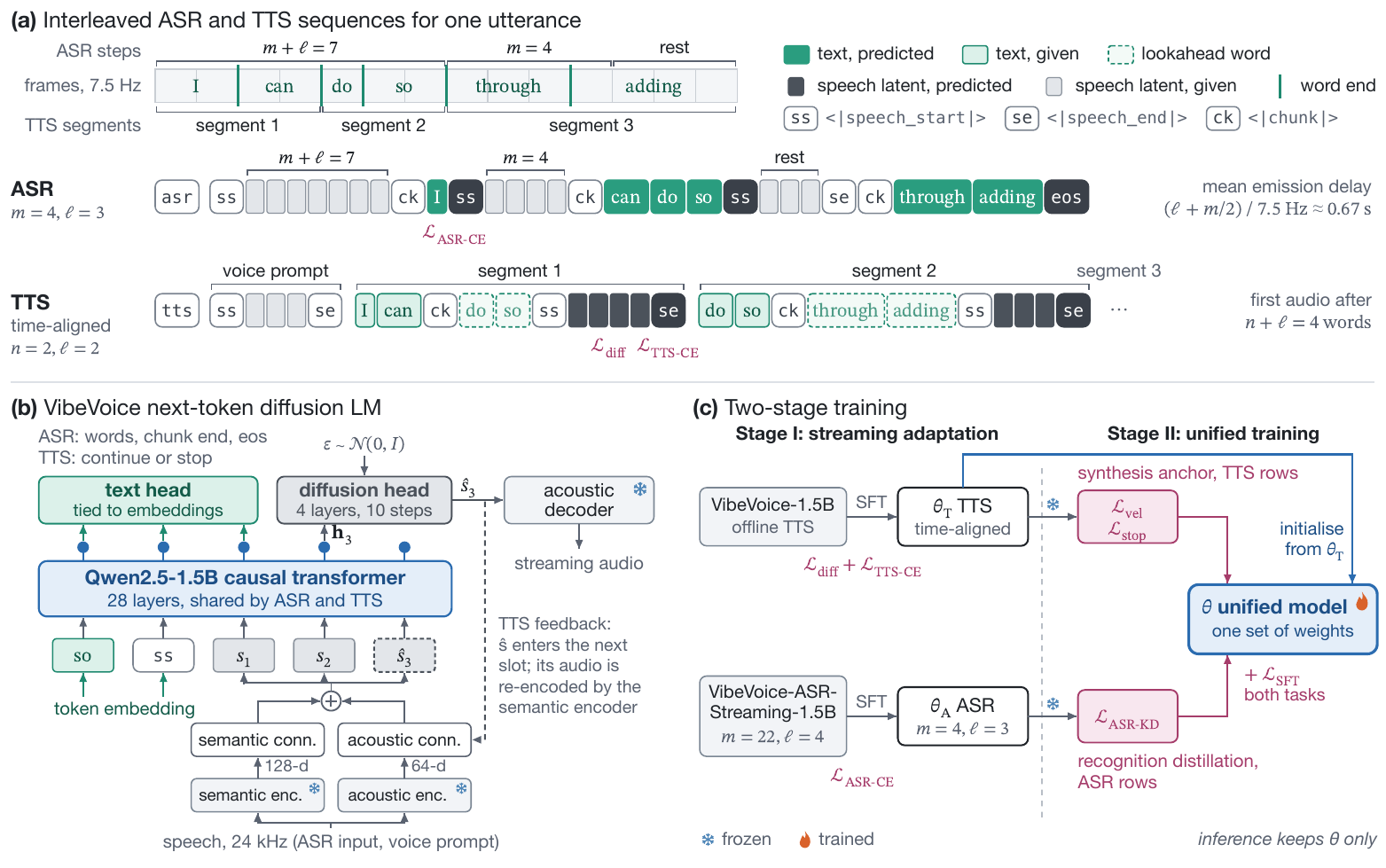
Uni-Stream: A Unified Streaming Speech Language Model for Speech Synthesis and Recognition
Uni-Stream is a unified streaming speech language model that jointly supports real-time speech recognition and synthesis within a single architecture. The work demonstrates that task-specific performance can be matched through two-stage training, while revealing that speech and text representations occupy distinct latent feature spaces even under unified training.
Abstract
Unified streaming speech language models aim to support speech recognition and synthesis within a single model, enabling real-time human-computer interaction. However, jointly supporting these two directions of speech-text conversion while preserving task-specific performance remains challenging. We propose Uni-Stream, a unified streaming speech language model built on compact pretrained speech models. Uni-Stream processes interleaved text and speech in a streaming format and achieves performance comparable to task-specific models through two-stage training. We also develop a data annotation pipeline for streaming training and will publicly release the generated transcriptions and word-level timestamps. We further examine Uni-Stream's representations across tasks and modalities and find that speech and text residence in distinct latent feature space even when trained in a unified model architecture, while representations within each modality become more task-dependent in later layers.
Full-duplex models — which listen and speak simultaneously — are celebrated for their conversational naturalness, but a paper from Kyung Hee University reveals a critical blind spot: these systems catastrophically collapse within minutes of real conversation due to context-window exhaustion, a failure mode entirely invisible to short-turn benchmarks. The authors diagnose two specific culprits — Initialization-Anchor Eviction (the model loses its grounding tokens) and self-reinforcing repetition (degenerate output that compounds itself) — and apply retraining-free fixes that extend coherent dialogue to hour-long interactions.
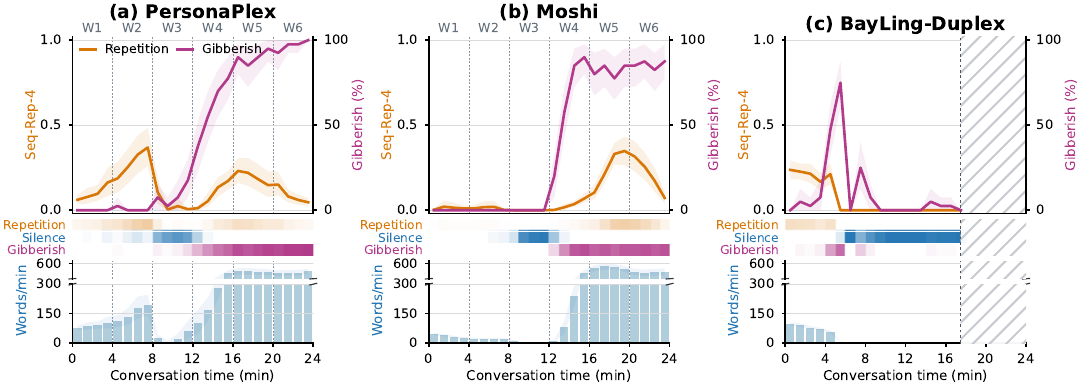
Why Full-Duplex Speech Models Collapse in Long Conversations
Full-duplex speech models that listen and speak simultaneously promise natural conversation, but this paper reveals they catastrophically collapse within minutes due to context-window exhaustion—a failure mode invisible to existing short-turn benchmarks. The work diagnoses two specific mechanisms (Initialization-Anchor Eviction and self-reinforcing repetition) and applies minimal, retraining-free fixes that extend coherent dialogue to hour-long interactions.
Abstract
Full-duplex speech models listen and speak at the same time, which makes them promising for natural, open-ended conversation. But can they sustain a coherent conversation for tens of minutes? Because they generate a token every frame, even while listening, they exhaust their context windows within minutes. Yet existing benchmarks evaluate only single turns or a few conversational rounds, too short to expose the long-horizon problem. We introduce the Full-Duplex Long-Horizon Benchmark (FD-LHB), which tests five recent full-duplex models on long replayed conversations and in live conversation with an LLM partner. Every evaluated model eventually either degrades or exhausts its context. Models that keep the full history often degrade before their context runs out, while sliding-window models still fall into repetition, silence, and gibberish. For sliding-window models, we identify two contributing mechanisms. Gibberish and silence are linked to Initialization-Anchor Eviction, where the sliding window discards the first KV entry. Repetition is also reinforced by the model's own recent outputs. Guided by this diagnosis, we apply two simple fixes: Initialization-Anchor Pinning (IAP) keeps that first entry, and Duplex Repetition Penalty (DRP) discourages echoing while guarding against prolonged silence. Together, they support the diagnosis and, without retraining, substantially reduce conversational collapse in replays of up to an hour while running in real time.
A related problem in the counseling domain: KAIST's CounselPlex targets stressor blindness, where real-time dialogue systems lose track of the seeker's underlying problem as conversations deepen. The model maintains an explicit stressor state updated during silence/pauses and injected into the attention mechanism during listening windows, ensuring the system remains therapeutically grounded throughout multi-turn exchanges — a form of long-range semantic memory built directly into the full-duplex loop.
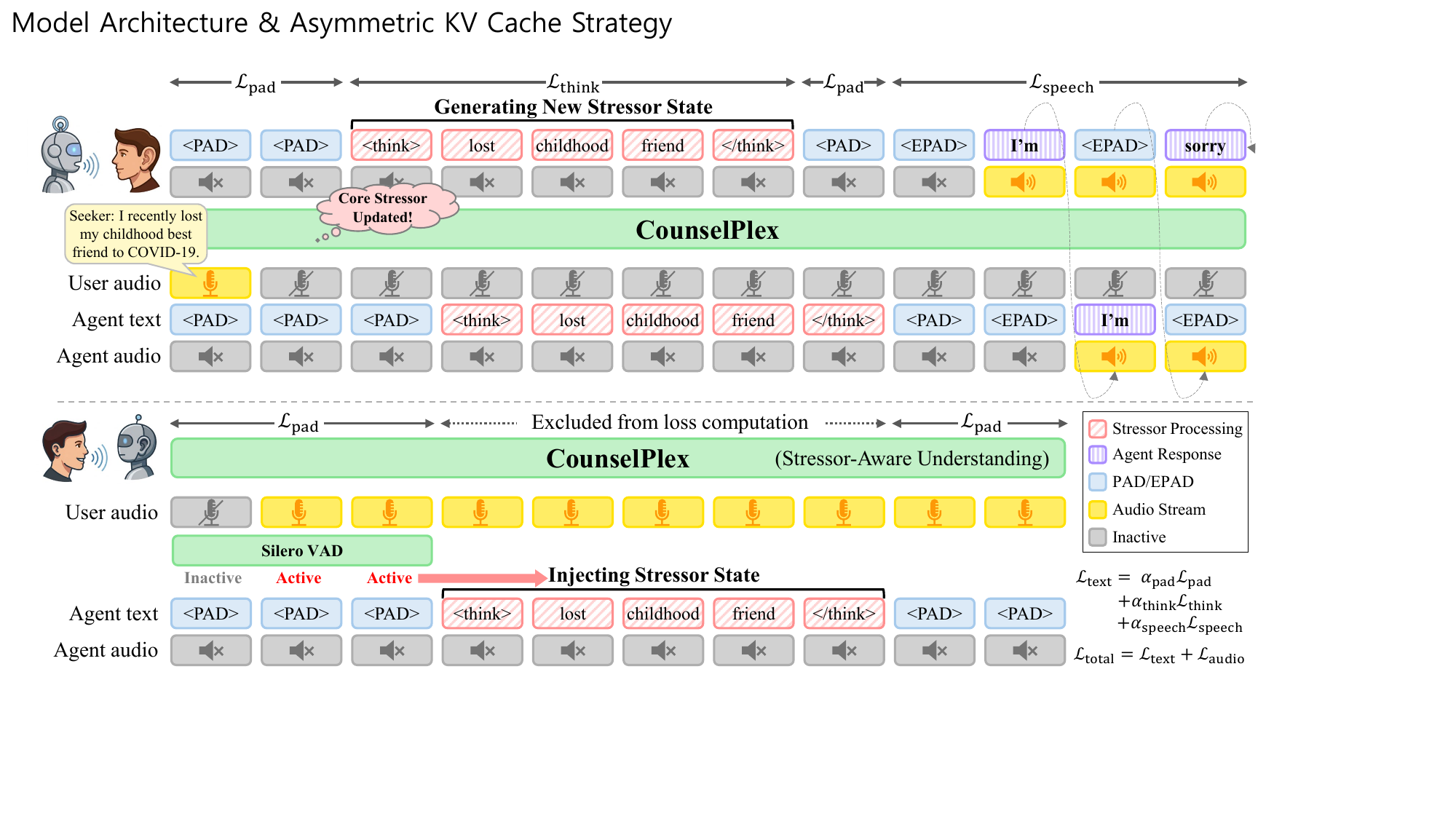
CounselPlex: A Stressor-Aware Full-Duplex Counseling Model
This work presents a full-duplex counseling model that addresses "stressor blindness"—the tendency of real-time dialogue systems to lose sight of the seeker's underlying problem during multi-turn conversations. CounselPlex maintains an explicit stressor state that is updated during pauses and injected into the model's attention during listening, ensuring therapeutic grounding even as conversations deepen.
Abstract
Full-duplex speech models can listen and speak at the same time, enabling natural, low-latency interaction. In counseling, however, these models often focus on the latest utterance and lose track of the seeker's underlying problem. We call this failure Stressor Blindness. We propose CounselPlex, a stressor-aware full-duplex framework that uses two operations. CounselPlex updates a short stressor state during seeker silence and injects this state into <PAD> positions while listening. We also introduce RoPE Position Shift Augmentation (RPSA), which broadens positional coverage during training and improves performance at longer turn depths in our evaluation. LLM-judge evaluations show improved counseling quality and stressor grounding over strong baselines.
TTS Evaluation & Benchmarks
Measuring synthesis quality beyond single-sentence, single-speaker paradigms.
Standard TTS benchmarks were designed for single-utterance, single-speaker evaluation — a poor fit for modern applications like audiobook narration or scripted drama production. DRAMA-Eval from Shenzhen Pimei Technology fills this gap with a benchmark covering context-aware, multi-turn, multi-speaker speech generation. Evaluation combines acoustic fidelity metrics, sentence-level execution scoring, and long-range coherence assessment via LLM-as-a-Judge, all grounded in structured script contexts that reflect real production workflows.
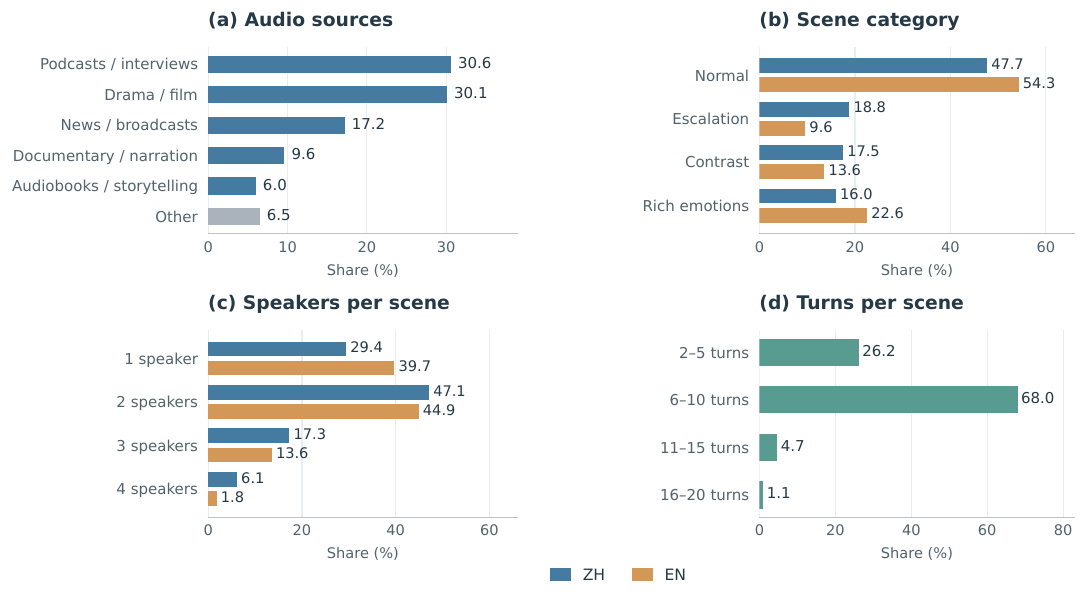
DRAMA-Eval: A Benchmark for Context-Aware, Multi-Turn, Multi-Speaker Speech Generation
DRAMA-Eval is a comprehensive benchmark for evaluating modern speech synthesis beyond traditional TTS, handling context-aware, multi-turn, and multi-speaker generation for audiobook and drama production. It provides unified assessment of acoustic fidelity, sentence-level execution, and long-range coherence using structured script contexts and LLM-as-a-Judge evaluation.
Abstract
Recent advances in speech generation are shifting toward context-aware, multi-turn, and multi-speaker synthesis. While these capabilities are in high demand for applications such as audiobook and audio drama production, evaluation has not kept pace with these advances. Beyond traditional zero-shot Text-to-Speech (TTS), modern systems in this domain primarily fall into three categories: instruction-controllable generation models, multi-turn dialogue models, and the audio branches of audio-visual generation models. However, existing benchmarks evaluate these paradigms in isolation, failing to provide a unified assessment of context modeling, instruction following, and multi-speaker generation. Meanwhile, recent progress in audio understanding models has made it feasible to evaluate such complex scenarios using LLM-as-a-Judge approaches. To bridge this gap, we introduce DRAMA-Eval, a comprehensive benchmark for evaluating such systems. DRAMA-Eval utilizes structured script contexts and offers a holistic evaluation framework covering objective, local, and global aspects of generation quality, enabling the assessment of acoustic fidelity, sentence-level execution, and long-range coherence. We benchmark leading open-source and commercial models on a human?verified dataset. The results reveal critical weaknesses in long-range speaker consistency and implicit instruction following that require deep contextual understanding. To facilitate reproducible research, we release a 12-hour bilingual (Chinese-English) test set of manually corrected real-world scripts, accompanied by ground-truth audio, evaluation code, and benchmark results.
Trending on Hugging Face
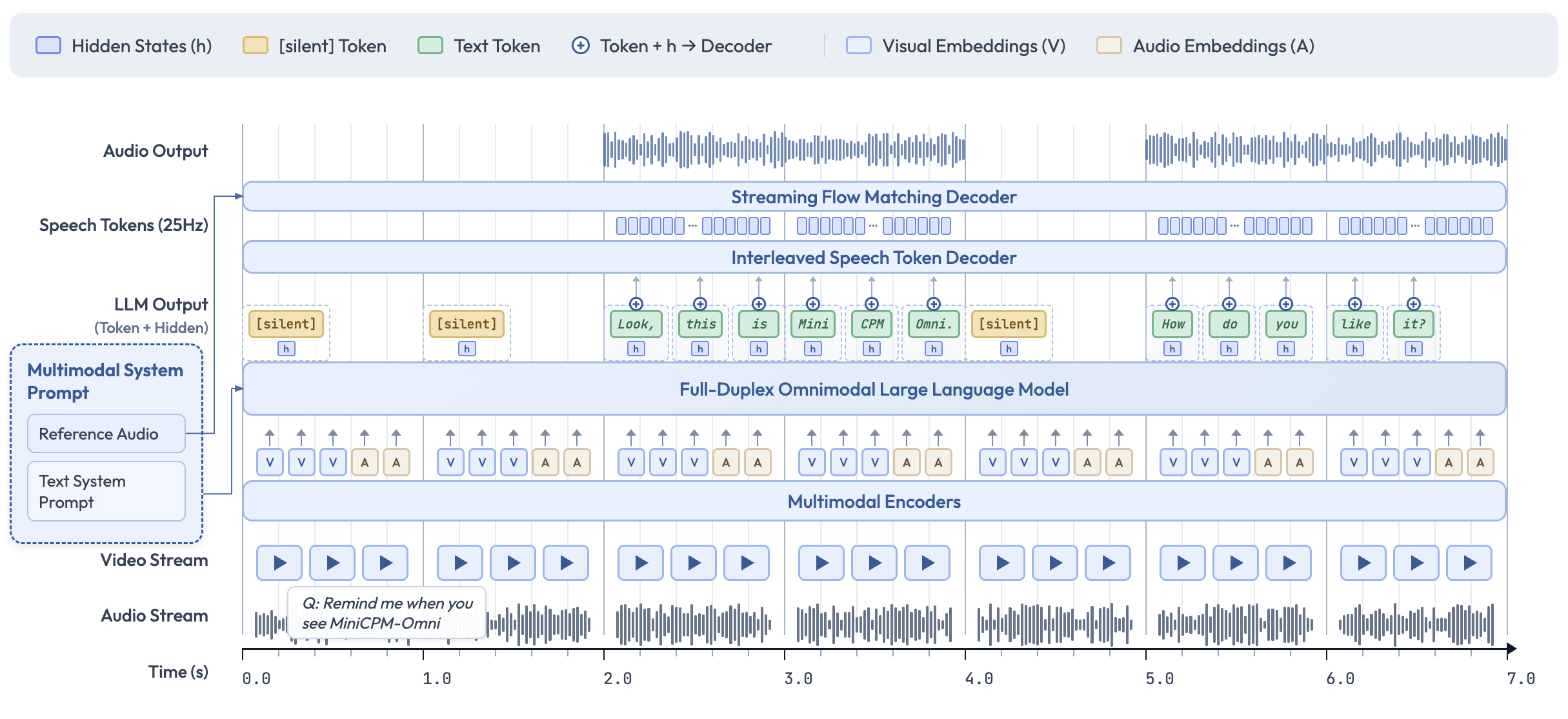
MiniCPM-o 4.5: Towards Real-Time Full-Duplex Omni-Modal Interaction
MiniCPM-o 4.5 enables real-time full-duplex interaction where perception and response happen simultaneously across vision, audio, and speech. Its Omni-Flow framework aligns multimodal signals on a shared timeline, supporting both reactive and proactive behaviors in continuous, streaming conversation.

OmniFlatten: An End-to-end GPT Model for Seamless Voice Conversation
A novel GPT-based model, OmniFlatten, enables real-time natural full-duplex spoken dialogue through a multi-stage post-training technique that integrates speech and text without altering the original model's architecture.

VoiceMem: Streaming Dual-Brain Memory for Real-Time Interaction
VoiceMem introduces a dual-brain streaming memory architecture for speech language models that improves retrieval accuracy, emotional personalization, and real-time efficiency.

Qwen3-TTS Technical Report
The Qwen3-TTS series presents advanced multilingual text-to-speech models with voice cloning and controllable speech generation capabilities, utilizing dual-track LM architecture and specialized speech tokenizers for efficient streaming synthesis.

Fish Audio S2 Technical Report
Fish Audio S2 is an open-source text-to-speech system with multi-speaker capabilities, multi-turn generation, and instruction-following control through natural-language descriptions, utilizing a multi-stage training approach and production-ready inference engine.