
Full-Duplex Dialogue, Expressive TTS, and Anime Blendshapes
Today's digest covers turn-taking mechanics in full-duplex speech models, expressive and efficient TTS advances, early tool-calling in spoken dialogue, multilingual ASR expansion, and neural blendshape generation for anime characters.
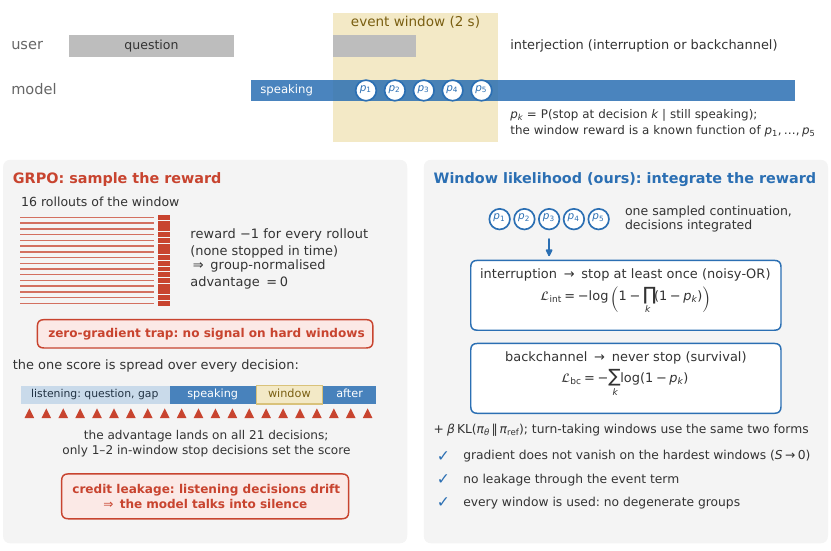
One event window, two ways to learn from it. Top: the user interjects while the model is speaking; inside the 2-s window the model makes a few binary stop decisions $p_1, ,p_K$, and the window reward is a known function of them. Left (GRPO): 16 sampled rollouts, one score each, spread over every decision in the rollout. Right (window likelihood): one sampled continuation; the expected reward is computed from its $p_k$ in closed form and maximised as a likelihood. From Tencent.
October 27 brings a dense slate spanning the full conversational AI stack: two papers sharpen turn-taking in full-duplex dialogue, three push the boundaries of expressive and efficient TTS, one targets early action in spoken dialogue agents, one addresses catastrophic forgetting in multilingual ASR, and one tackles the long-standing problem of blendshape generation for anime-style avatars. Here's what's worth your attention today.
TTS & Voice Synthesis
From vision-pretrained diffusion priors to sub-20M parameter bilingual cloning and counter-textual delivery repair.
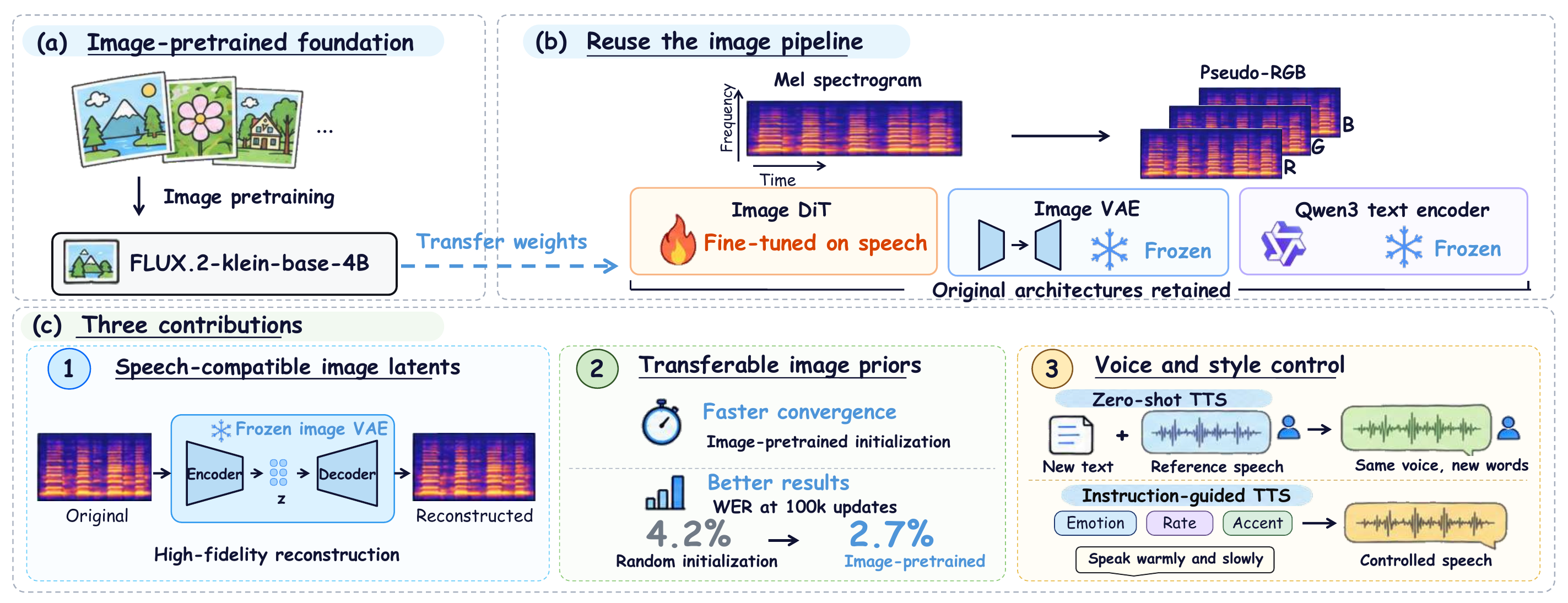
Cross-modal transfer is rarely this clean. ImageTTS from Microsoft Research Asia takes FLUX.2 — a pretrained image diffusion transformer — and repurposes it wholesale for speech synthesis by converting mel-spectrograms into pseudo-RGB images. The frozen image VAE handles representation transfer while the pretrained DiT supplies the generative prior, and the result outperforms speech-native baselines on both zero-shot cloning and instruction-guided synthesis with faster convergence.
ImageTTS: Repurposing Pretrained Image Diffusion Transformers for Speech Synthesis
ImageTTS repurposes a pretrained image diffusion model (FLUX.2) for speech synthesis by converting spectrograms to pseudo-RGB and leveraging the frozen image VAE for representation transfer and the pretrained DiT for generative-prior transfer. This approach demonstrates that vision-pretrained models can achieve better linguistic fidelity and speaker identity preservation while accelerating convergence, outperforming speech-native baselines on zero-shot and instruction-guided synthesis tasks.
Abstract
Pretrained image-generation models have been successfully repurposed for various downstream visual tasks. Whether their learned representations and generative priors can transfer beyond vision to other modalities remains largely unresolved, particularly for speech synthesis, which requires linguistic fidelity and preservation of speaker identity from a short reference. We present ImageTTS, which repurposes FLUX.2 for speech synthesis by encoding pseudo-RGB log-mel spectrograms with its frozen image VAE and adapting only its pretrained Diffusion Transformer (DiT) using conditional latent flow matching. This formulation disentangles two forms of vision-to-speech transfer: representation transfer through the image VAE and generative-prior transfer through DiT initialization. The frozen image VAE largely preserves intelligibility and speaker identity with 0.99 STOI and 0.95 speaker similarity, while image-pretrained DiT initialization accelerates convergence and improves linguistic accuracy, reducing WER from 4.2\% to 2.7\% at 100k matched updates relative to random initialization. The same framework supports both zero-shot and instruction-guided TTS and, when scaled to 100K hours of speech data, achieves 1.12\% WER on Seed-TTS test-en and a Style-ACC of 0.66 on CapSpeech, outperforming speech-native baselines trained on comparable data across both tasks. These results suggest that pretrained image models can transfer beyond architectural reuse, supplying useful latent representations and generative priors for intelligible and controllable speech synthesis.
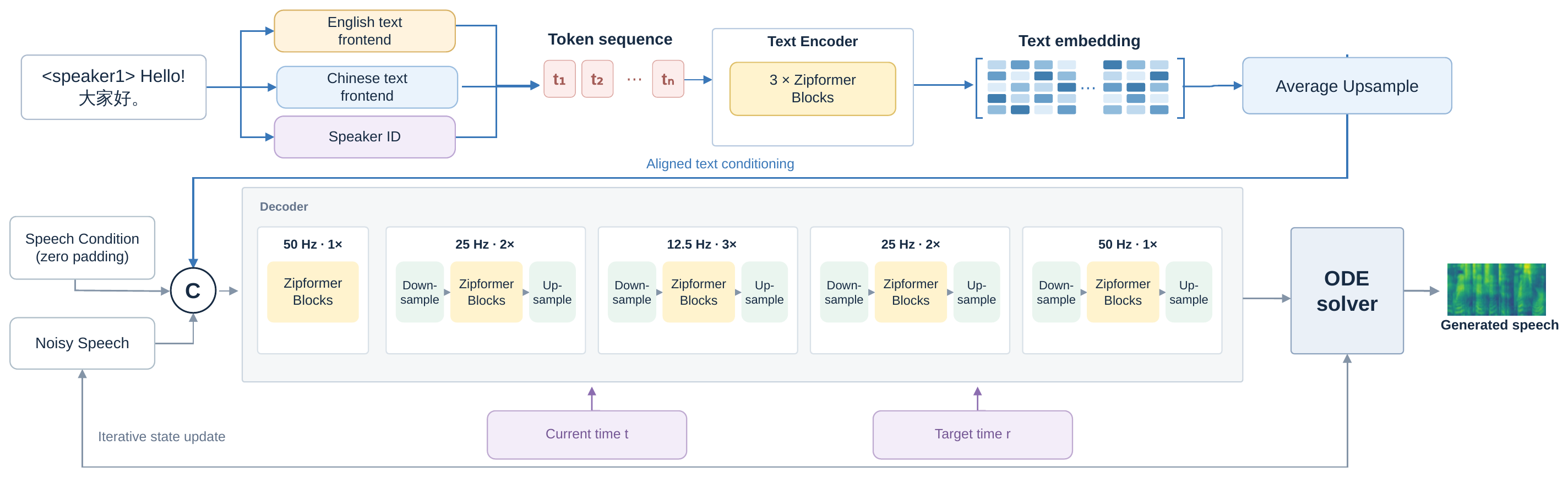
On the efficiency end, LeanTTS from Zhejiang University squeezes a full-stack bilingual TTS system into just 18.9M parameters — 86% smaller than comparable prior work. Flow-matching and lightweight decoding keep it at real-time CPU inference speeds while covering both Mandarin and English zero-shot speaker cloning and voice customization. It's a strong existence proof that architectural compression doesn't have to sacrifice the full feature set.
LeanTTS: Efficient Full-Stack Bilingual TTS for Zero-Shot Cloning and Voice Customization
LeanTTS is a compact bilingual text-to-speech system enabling both zero-shot speaker cloning and voice customization with just 18.9M parameters—86% smaller than prior work. The paper demonstrates that aggressive architectural compression through flow-matching and lightweight decoding can achieve real-time CPU inference while maintaining competitive quality on Mandarin and English.
Abstract
While recent advances in text-to-speech (TTS) synthesis have substantially improved speech quality and modeling flexibility, the development of lightweight and computationally efficient systems remains comparatively underexplored. We present LeanTTS, a bilingual complete synthesis stack that supports two complementary regimes: reference-prompt zero-shot cloning for unseen speakers and token-conditioned customization for recurring voices. LeanTTS combines a compact Mandarin polyphone front end, a structurally compressed flow-matching acoustic model, and a lightweight Vocos decoder with four-step MeanFlow generation. The resulting system contains 18.9M learned parameters, 86.12% fewer than the 136.2M-parameter ZipVoice-Vocos pipeline. On Seed-TTS-Eval, its zero-shot mode obtains 2.02 CER/62.3 SIM on Mandarin and 2.32 WER/48.3 SIM on English, exposing the quality-size trade-off under aggressive compression. With token-conditioned customized voices, the same system reaches 1.57 CER/77.2 SIM on Mandarin and 1.93 WER/76.6 SIM on English, with UTMOS scores of 3.03 and 4.33, respectively. It further achieves mean/P90 CPU RTFs of 0.049/0.061, establishing a sub-20M operating point for bilingual personalization and real-time CPU deployment. Audio demos are available at https://github.com/notlu/leantts.
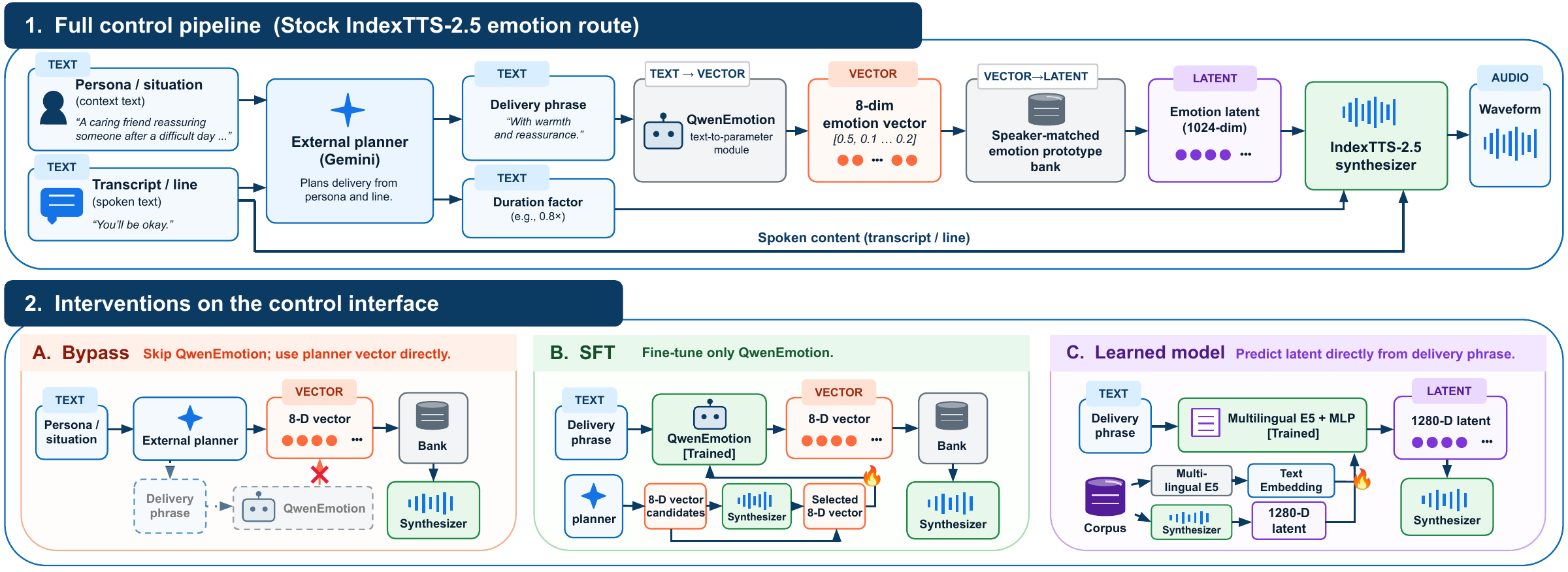
Perhaps the most diagnostically interesting TTS work today comes from Carnegie Mellon. When a persona's intended emotional delivery contradicts the lexical sentiment of the text — sarcasm, ironic cheerfulness, bitter calm — chain-of-thought TTS systems tend to fail silently. This paper introduces a bilingual benchmark that traces delivery intent through planner outputs, emotion vectors, and rendered waveforms to pinpoint exactly where the signal breaks down, then demonstrates that learned repair at the plan-to-synthesis interface can recover counter-textual delivery.
When the Persona Contradicts the Line: Diagnosing Plan-to-Synthesis Failures in Chain-of-Thought TTS
This work diagnoses where emotion and persona intent are lost in chain-of-thought TTS systems when vocal delivery must contradict lexical sentiment. By introducing a bilingual benchmark tracing delivery signals across planner outputs, emotion vectors, and rendered waveforms, it pinpoints failures at each stage and shows learned repair at the plan-to-synthesis interface can recover counter-textual delivery—offering fine-grained insight into alignment in expressive speech synthesis.
Abstract
Chain-of-thought TTS systems rely on language-model planners to translate persona and context into vocal delivery, but it is unclear where this intent is lost when the requested affect conflicts with lexical sentiment. We introduce a bilingual Japanese--English persona--line conflict benchmark in which each item pairs one line with congruent and conflicting personas and pre-declares the expected acoustic direction. We probe this direction in the planner-generated delivery phrase, the planner-written emotion vector, the QwenEmotion-generated vector, and the rendered waveform. Planner outputs are usually direction-correct, while downstream agreement can be substantially lower. Bypassing QwenEmotion provides only modest gains over the full planner-controlled Base. Supervising QwenEmotion raises the direction rate to 75% in Japanese and 84% in English. A learned text-to-latent interface reaches the highest English rate of 89% and the highest Japanese arousal rate of 88%. These results show that learned repair of the plan-to-synthesis interface can recover counter-textual delivery, although its effect differs across languages and acoustic axes.
Full-Duplex Speech & Spoken Dialogue
Fixing long-session drift, rethinking reward integration for turn-taking, and knowing when to act before a turn ends.
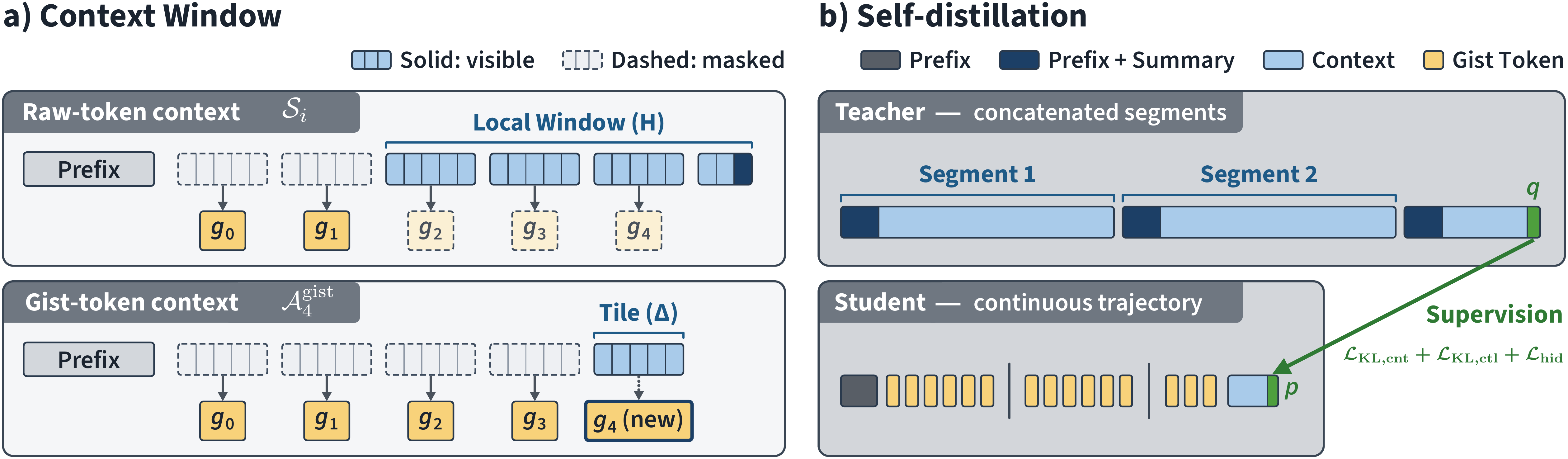
Full-duplex speech models degrade over long conversations — context windows fill up, distributions shift, and quality quietly erodes. Seoul National University's paper is the first to systematically diagnose this via a closed-loop evaluation framework, then propose two complementary fixes: LoRA adaptation via self-distillation to stabilize model behavior, and a two-resolution context architecture that compresses distant history while keeping recent interactions at full resolution. The result is stable long-session performance with a 90% reduction in memory overhead.
Diagnosing and Mitigating Long-Session Degradation in Full-Duplex Speech Models
This paper identifies and addresses performance degradation in full-duplex speech models over long conversations. It introduces a closed-loop evaluation framework to diagnose degradation and proposes LoRA adaptation via self-distillation plus a two-resolution context architecture that compresses history while preserving recent interactions—achieving stable performance and 90% reduction in memory overhead.
Abstract
End-to-end full-duplex spoken dialogue models enable natural, real-time spoken interactions with interruptions, backchannels, and overlapping speech. Prior evaluations have assessed diverse interaction capabilities and identified some degradation patterns across conversational turns. However, how model behavior evolves over extended sessions remains insufficiently understood. In this work, we address this gap by systematically characterizing long-session degradation and developing efficient methods to mitigate it. We introduce a closed-loop evaluation framework for long-session stability and apply it to several publicly available full-duplex speech models, revealing degradation over time in responsiveness, spoken content quality, and voice consistency. To mitigate this degradation, we propose a self-distillation-based training framework for lightweight LoRA adaptation that improves long-session stability with a small amount of additional training. We further introduce a two-resolution context (TRC) architecture that preserves recent interactions in full detail while compressing older interaction history into key-value representations. We evaluate our methods on three models with distinct architectures, assessing long-session stability, information retention, and computational efficiency. Across all three models, we show that LoRA adaptation mitigates performance degradation over ten-minute sessions, while adding TRC extends these gains beyond the training session length and reduces KV-cache growth by more than 90%.
Turn-taking training in full-duplex models has a subtle but serious flaw: standard GRPO-style whole-rollout sampling creates zero-gradient traps and credit leakage when the model needs to distinguish user interruptions (yield) from backchannels (hold). Tencent's paper replaces sampling with window likelihood — a closed-form integration over stop decisions within decision windows — eliminating both failure modes and substantially improving turn-taking accuracy across multiple models without inducing spurious floor-reopenings.
Integrate the Reward, Don't Sample It: Window Likelihood for Interruptions and Backchannels in Full-Duplex Speech Models
This paper solves a critical problem in full-duplex dialogue: training models to correctly yield on user interruptions while holding through backchannels. Instead of GRPO's whole-rollout sampling, the authors propose window likelihood, which integrates closed-form over stop decisions within decision windows to eliminate zero-gradient traps and credit leakage, substantially improving turn-taking accuracy across multiple models without inducing spurious floor-reopenings.
Abstract
A full-duplex spoken dialogue model must yield when the user cuts in and hold when the user merely backchannels. Sequence-level RL with a timing reward (GRPO) is the usual recipe; we test its whole-rollout form on four open models and find two failures. A binary window reward gives zero advantage on exactly the windows that most need learning (a zero-gradient trap), and the one score per rollout is spread over listening-state decisions the reward is not written in terms of (credit leakage), so the model talks into silence or stops answering. Both come from sampling a reward that is a known function of a few binary control decisions. We propose \emph{window likelihood} (\WL): sample a continuation per window, but integrate in closed form over the stop decisions it visits and maximise the log-probability of acting correctly---a noisy-OR for yielding, a survival product for holding. On HumDial-FDBench, \WL\ gives the best yield/hold F1 on all six structurally different open models we post-train, exceeds Kyutai's released GRPO checkpoints (trained on different data), and adds no re-opening of the floor on any model.
Latency in spoken dialogue agents is often framed as a generation problem, but there's an earlier bottleneck: waiting for a user's turn to finish before calling a tool. Nanyang Technological University's work finds the earliest actionable point in partial spoken input at which a complete tool call can be grounded, using a synthetic data pipeline to provide chunk-level supervision. Models trained this way make causal decisions on when to act — not just what to do — cutting round-trip latency without sacrificing correctness.
Heard Enough to Act: Early Tool Calling in Spoken Dialogue Systems
This work identifies the earliest point at which partial spoken input grounds a complete tool call, enabling latency reduction in dialogue agents. The key innovation is a synthetic pipeline that provides finest-grain actionable-point supervision, allowing models to make causal, chunk-level decisions on when to call tools rather than waiting for turn completion.
Abstract
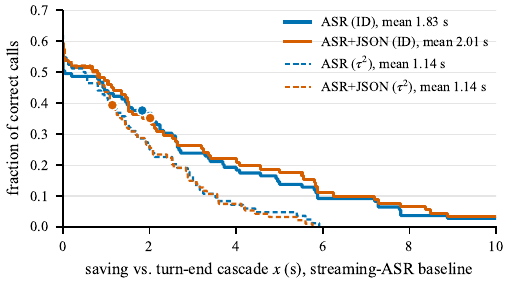
Latency-sensitive spoken agents must know not only which tool to call, but also when they have heard enough to act. Waiting for the turn to complete delays execution even when the request is already actionable. However, neither existing spoken agents nor spoken dialogue corpora define the earliest point at which a request becomes actionable. We introduce a synthetic spoken-dialogue pipeline that provides earliest-actionable-point supervision, marking when the observed speech grounds a tool and its required arguments. Through controlled task generation, speech synthesis and alignment, and gated annotation, we construct 26,694 dialogues totaling 786 hours across 48 domains, with disjoint training and test argument values. We additionally create an audio rendering of $τ^2$-bench for external evaluation. We train an omni-modal language model on this corpus, enabling causal, chunk-level decisions and partial-transcript generation for downstream call completion. The model achieves tool-state macro-F1 scores of 0.48 and 0.47 on held-out dialogues and the external benchmark, respectively. For correct calls, the estimated mean lead over a turn-end cascade, using the same formatter, is 1.8-2.0 seconds in-domain and 1.1 seconds on $τ^2$-bench. These results demonstrate a data-driven path toward spoken agents that act while listening. We will open-source the pipeline and the training scripts.
ASR & SpeechLLM Architectures
Expanding multilingual coverage without paying the catastrophic forgetting tax.
Adding a new language to a speech-LLM ASR system should not come at the cost of every language it already knows, yet naive fine-tuning reliably produces that outcome. The University of Edinburgh's Preserve to Expand identifies source-aware adapter merging strategies that carefully compose parameter updates to balance new language acquisition with source-language retention — outperforming both standard fine-tuning and naive merging baselines. The key insight is that which updates you merge, and how, matters as much as the fine-tuning procedure itself.
Preserve to Expand: Source-Aware Adaptation and Model Merging for Multilingual LLM-Based ASR
This paper tackles multilingual ASR expansion in speech-LLM systems, where adapting to new languages risks catastrophic forgetting of previously supported languages. The key contribution is identifying source-aware adapter merging strategies that balance new language acquisition with source-language retention—outperforming standard fine-tuning and naive merging approaches through careful update composition.
Abstract
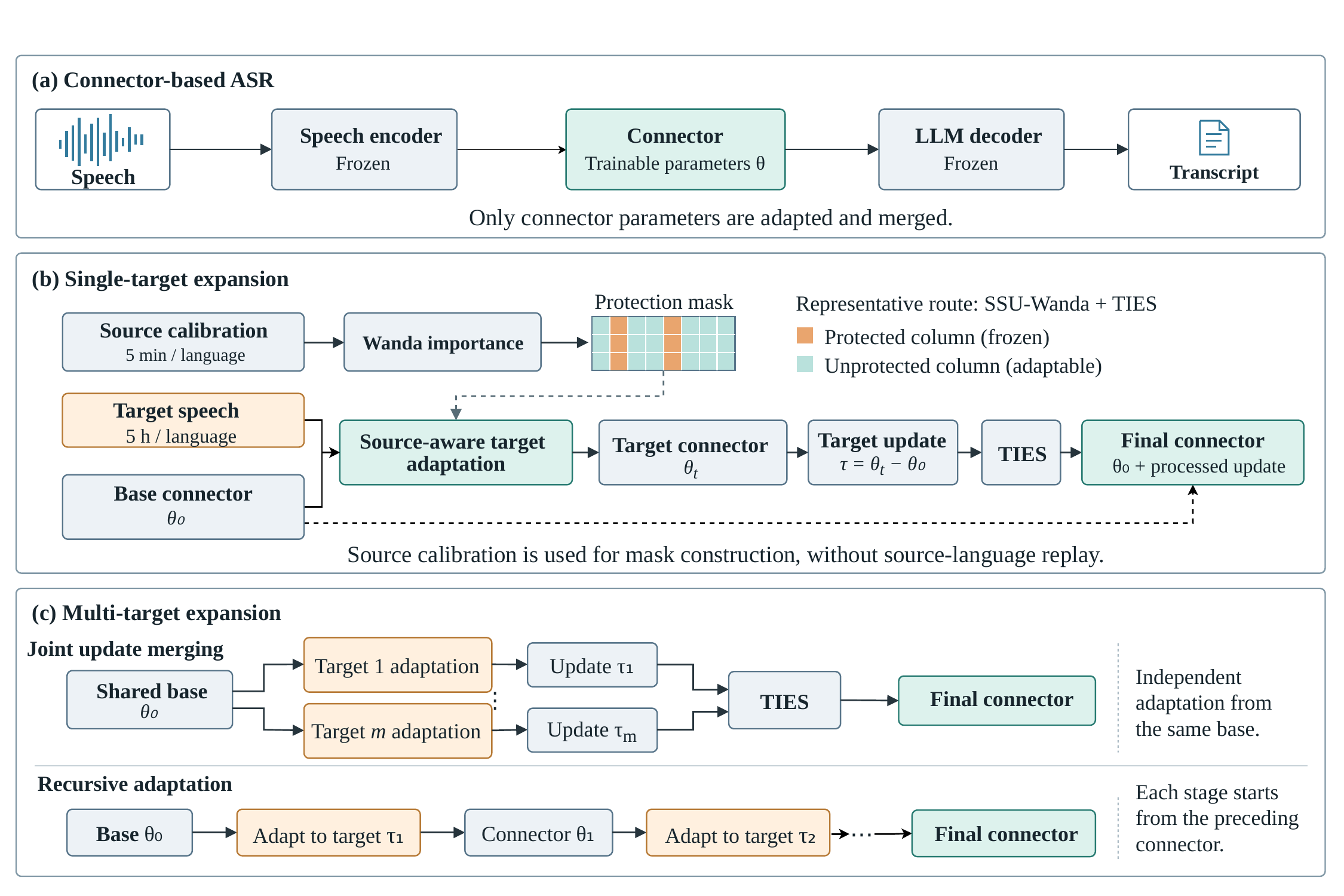
Expanding multilingual ASR systems to new languages is challenging when adaptation must preserve previously supported languages without replaying source-language training data. We study this problem in connector-based Speech LLMs, where a trainable connector maps speech representations into a frozen large language model. We evaluate target-update construction and merging strategies for adapting the connector while preserving source-language performance. In single-target expansion, target-only fine-tuning and standard TIES merging learn new languages but cause severe source-language forgetting, while SSU-Wanda+TIES gives the best source-preserving trade-off. In multi-target expansion, update merging provides stable source retention, whereas recursive expansion can improve target adaptation under favorable orders but is highly order-sensitive. These results show that multilingual ASR expansion requires balancing target acquisition, source retention, and interactions among target-language updates.
Talking Avatars & Blendshape Animation
ARKit-compatible facial expressions for anime characters with disconnected geometry.
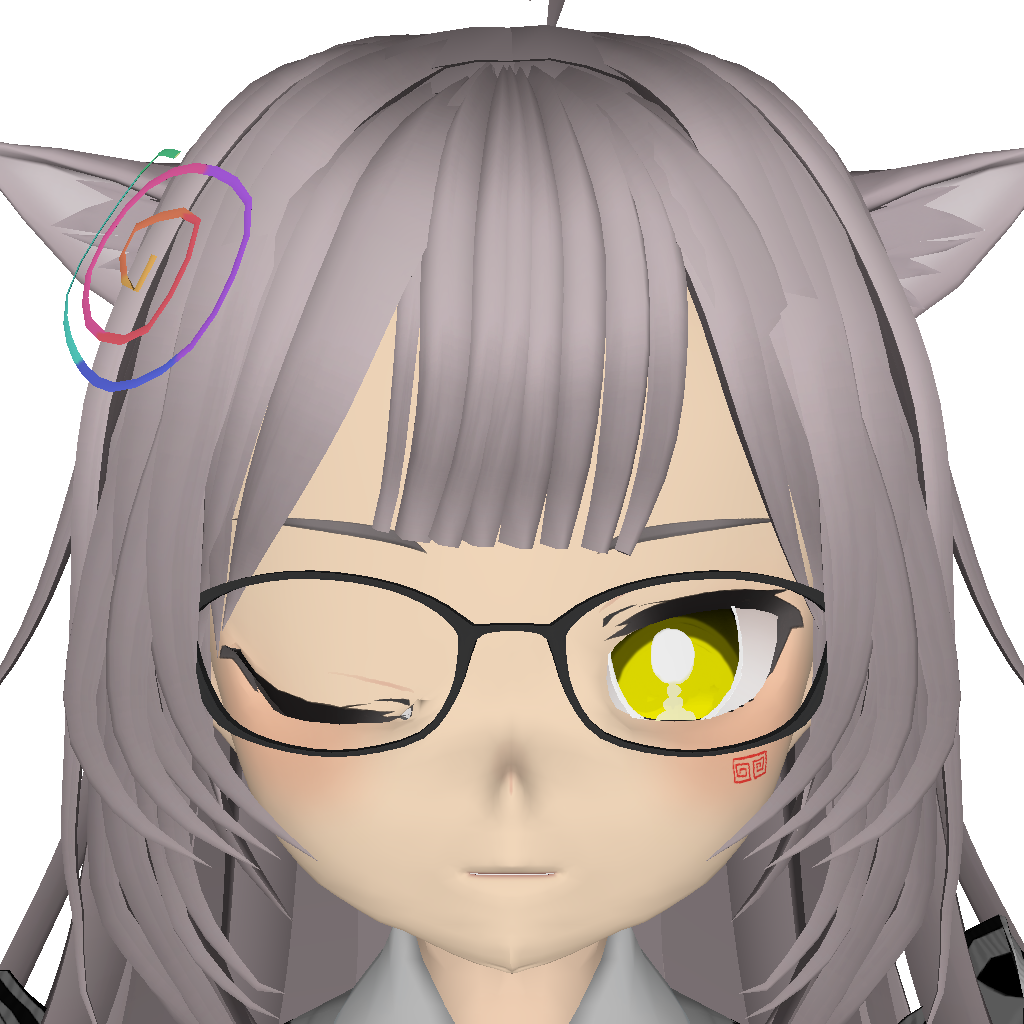
Generating ARKit- or MediaPipe-compatible blendshapes for anime-style 3D characters is harder than it looks: anime rigs routinely have disconnected geometry (separate eyes, hair, accessories) that breaks the continuous-mesh assumptions most prior methods rely on. This independent work from Pramook Khungurn addresses this with topology-agnostic neural deformation fields featuring per-part specialization and bilateral symmetry enhancement — a simpler, more practical pipeline targeted directly at the character-creator community.
Blendshape Generation for Models with Disconnected Parts: Adding ARKit/MediaPipe Blendshapes to Anime-Style Character Models
This work generates facial expression blendshapes for anime-style 3D character models with multiple disconnected parts, a scenario poorly addressed by prior work. Using topology-agnostic neural deformation fields with per-part specialization and bilateral symmetry enhancement, it delivers a simpler, more practical solution for the character creator community than recent neural methods.
Abstract
Blendshape generation for 3D models has been extensively researched, but very few works address generating blendshapes for models with multiple disconnected parts. We present a case study of generating fixed facial expression blendshapes for commercial anime-style 3D character models with up to 11 parts per face. To make sure that our system can handle models in a way that is agnostic to topology, we train neural networks to generate deformation fields around the input meshes. We employ at least one network to independently process each part, and the relative positions of their outputs are coordinated by having each network also process the geometry of an anchor part. We use two mechanisms to improve accuracy: having the networks predict whether the output displacement is zero or not, and classifying blendshapes into different size groups and dedicating a network to each group. We also introduce a method to improve blendshape quality by enhancing bilateral symmetry. Our method is simpler than recent neural-network-based works and solves a real problem of the user community of these models.
Trending on Hugging Face

OmniFlatten: An End-to-end GPT Model for Seamless Voice Conversation
A novel GPT-based model, OmniFlatten, enables real-time natural full-duplex spoken dialogue through a multi-stage post-training technique that integrates speech and text without altering the original model's architecture.

VoiceMem: Streaming Dual-Brain Memory for Real-Time Interaction
VoiceMem introduces a dual-brain streaming memory architecture for speech language models that improves retrieval accuracy, emotional personalization, and real-time efficiency.

Qwen3-TTS Technical Report
The Qwen3-TTS series presents advanced multilingual text-to-speech models with voice cloning and controllable speech generation capabilities, utilizing dual-track LM architecture and specialized speech tokenizers for efficient streaming synthesis.

Fish Audio S2 Technical Report
Fish Audio S2 is an open-source text-to-speech system with multi-speaker capabilities, multi-turn generation, and instruction-following control through natural-language descriptions, utilizing a multi-stage training approach and production-ready inference engine.

VibeVoice Technical Report
VibeVoice synthesizes long-form multi-speaker speech using next-token diffusion and a highly efficient continuous speech tokenizer, achieving superior performance and fidelity.