
TTS Control, Smarter Voice Agents, and Identity-Preserving Video
Today's digest covers emphasis control and prompt selection for TTS, interpretability of voice-cloning models, turn detection and end-of-turn training for voice agents, real-time speaker anonymization, identity-preserving face video super-resolution, and efficient spoken dialogue via compressed speech tokens.

Four heavy-degradation examples: id00068/047, id00109/013, id00456/050, and id00560/010. We show GT, degraded input, FlashVSR, SeedVR2, SVFR, InstantRestore, FaceMe, RGFVR, and . Labels report per-frame ArcFace ID-GT/ID-alb; GT shows the album ceiling. Table~ reports all 14 baselines on 91 test identities. From Purdue University.
Today's papers push TTS controllability in several new directions — from DPO-driven emphasis to low-resource Irish — while the voice-agent side gets sharper turn detection and a long-overdue look at training-data genre. Rounding things out: a streaming anonymization pipeline, identity-preserving face video restoration, and a Hugging Face pick on compressing speech tokens for faster dialogue models.
TTS & Voice Synthesis
Fine-grained control, smarter prompt selection, mechanistic interpretability, and low-resource adaptation.
Expressive TTS has long struggled with word-level emphasis because labelling prosodic emphasis at scale is expensive. Carnegie Mellon's EmpDPO sidesteps manual annotation entirely by pairing supervised fine-tuning with direct preference optimization, using an off-the-shelf emphasis detector as the only training signal. The result is fine-grained, word-level emphasis control retrofitted onto pretrained multilingual models with just a few thousand preference pairs — and naturalness is preserved throughout.
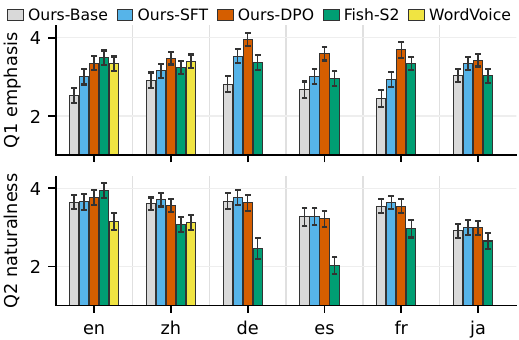
EmpDPO: Enabling Emphasis Control in TTS via Direct Preference Optimization
This paper retrofits emphasis control to pretrained multilingual TTS models without manual annotation by combining supervised fine-tuning with direct preference optimization (DPO), using an off-the-shelf emphasis detector as the sole training signal. The key innovation is leveraging DPO's sample efficiency to achieve fine-grained word-level emphasis control with only a few thousand preference pairs, while preserving naturalness and speech quality.
Abstract
Word-level emphasis conveys meaning that text alone cannot express and is therefore essential for a practical text-to-speech (TTS) system. In this work, we study how to add emphasis control post hoc to a pretrained TTS model that has never been trained with emphasis annotations. We present EmpDPO, a simple, efficient, and effective two-stage recipe that adds emphasis control to a multilingual zero-shot diffusion TTS model through supervised fine-tuning followed by direct preference optimization (DPO). The training signals for both stages come from an off-the-shelf multilingual emphasis detector, so that no manual emphasis annotation or task-specific reward design is needed. We find that DPO can substantially strengthen emphasis control with only a few thousand preference pairs and training steps. Objective and subjective evaluations against strong public systems show that our model produces perceptible emphasis while preserving naturalness and overall quality.
Choosing the right audio prompt can make or break a zero-shot TTS system, yet most work focuses on model architecture rather than prompt quality. Meta AI's paper systematically studies what makes a good audio prompt by analysing synthesis outputs from multiple models across hundreds of thousands of candidates, then trains a lightweight selector network that ranks prompts from synthesis outcomes — matching the intelligibility gains of expensive multi-synthesis probing, but at zero generation cost at selection time.
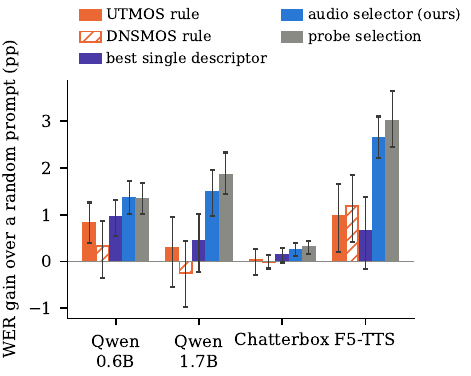
What Makes a Good Audio Prompt for Zero-Shot TTS? Learning Prompt Selection from Synthesis Outcomes
This paper investigates what makes a good audio prompt for zero-shot TTS by analyzing outputs from multiple models across hundreds of thousands of candidate prompts. Rather than proposing a new TTS architecture, it trains a lightweight selector network that learns to rank prompts directly from synthesis outcomes, achieving comparable intelligibility gains to expensive multi-synthesis probing without any generation at selection time.
Abstract
Zero-shot text-to-speech (TTS) models clone a target voice from a short reference clip, commonly referred to as the prompt. In practice, the prompt has to be cut from a longer recording of the speaker, so which part to use must be chosen. To understand what makes a good prompt, we analyze hundreds of thousands of outputs synthesized by four TTS models from candidate prompts of YouTube recordings. The choice of prompt substantially changes intelligibility, naturalness and speaker similarity. Standard predicted-quality scores capture mainly the naturalness part but miss most of the intelligibility gain. We find that the models largely agree on which prompt yields the highest measured speaker similarity, but much less on which prompt yields intelligible speech. We propose a small network that learns from the outputs a TTS model produced to rank a recording's candidate prompts from their audio alone. Without synthesizing anything at selection time, it picks prompts that lower the word error rate on held-out recordings by a third (Qwen3-TTS) to two fifths (F5-TTS) relative to a randomly chosen prompt, more than predicted quality achieves and nearly as much as synthesizing a dozen test sentences from every candidate first.
What do autoregressive voice-cloning models actually encode internally? UT Austin applies a mechanistic interpretability toolkit — sparse autoencoders, PCA, and probing/steering — to uncover which acoustic concepts (pitch, energy, accent, speaker traits) are encoded and where. A key finding is that interpretability results vary substantially across extraction methods and TTS architectures, and that sparse autoencoders can surface novel acoustic phenomena beyond the concepts researchers set out to find.
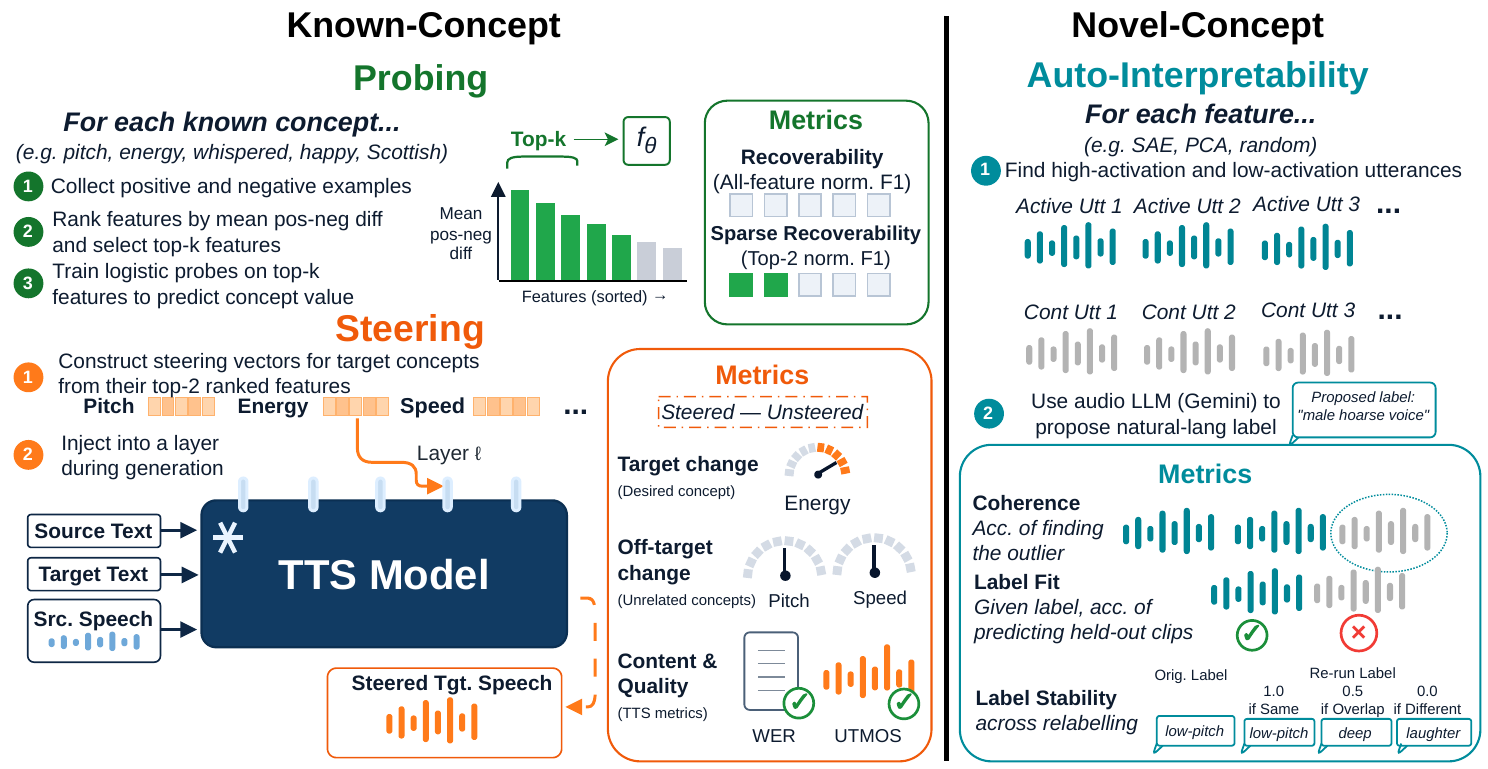
Discovering Interpretable Acoustic Features in Autoregressive Voice-Cloning TTS Models
This work introduces a feature-based interpretability framework for autoregressive voice-cloning TTS models, combining sparse autoencoders, PCA, and probing/steering techniques to discover which acoustic concepts (pitch, energy, accent, speaker traits) these models encode. It uniquely reveals that interpretability findings vary significantly across extraction methods and TTS architectures, with sparse autoencoders proving effective for discovering novel acoustic phenomena beyond known concepts.
Abstract
Voice-cloning TTS models synthesize an unseen speaker's voice from brief speech prompts, but it remains unclear which acoustic properties they represent and use. We introduce a feature-based interpretability framework for autoregressive voice-cloning TTS models, analyzing features from sparse autoencoders (SAEs), PCA, and random directions via sparse probing, steering, and quantitative auto-interpretability. We focus on Qwen3-TTS and extend probing and steering to $5$ additional models to test generalization across architectures. These models encode concepts like pitch, energy, noise, and accent, but sparse prediction and steering are effective only for some concepts. Strong probing does not always translate to steering or vice-versa. SAEs are useful for sparse probing of human-labelled concepts and novel-concept discovery, while PCA is competitive for dense probing and steering. Auto-interpretability finds $684$ automatically validated SAE features in Qwen3-TTS covering speaker clusters, speaking style, and recording conditions beyond known concepts. Overall, we perform a comprehensive interpretability study of autoregressive voice-cloning TTS models.
Irish (Gaeilge) is a particularly challenging low-resource language for TTS because transcribed speech is scarce and pronunciation rules are complex. This independent work compiles Wiktionary pronunciation records into a phoneme-level critic and uses it as a verifier during fine-tuning of a large pretrained TTS model, achieving substantial accuracy improvements and demonstrating that linguistic documentation can substitute for large speech corpora.
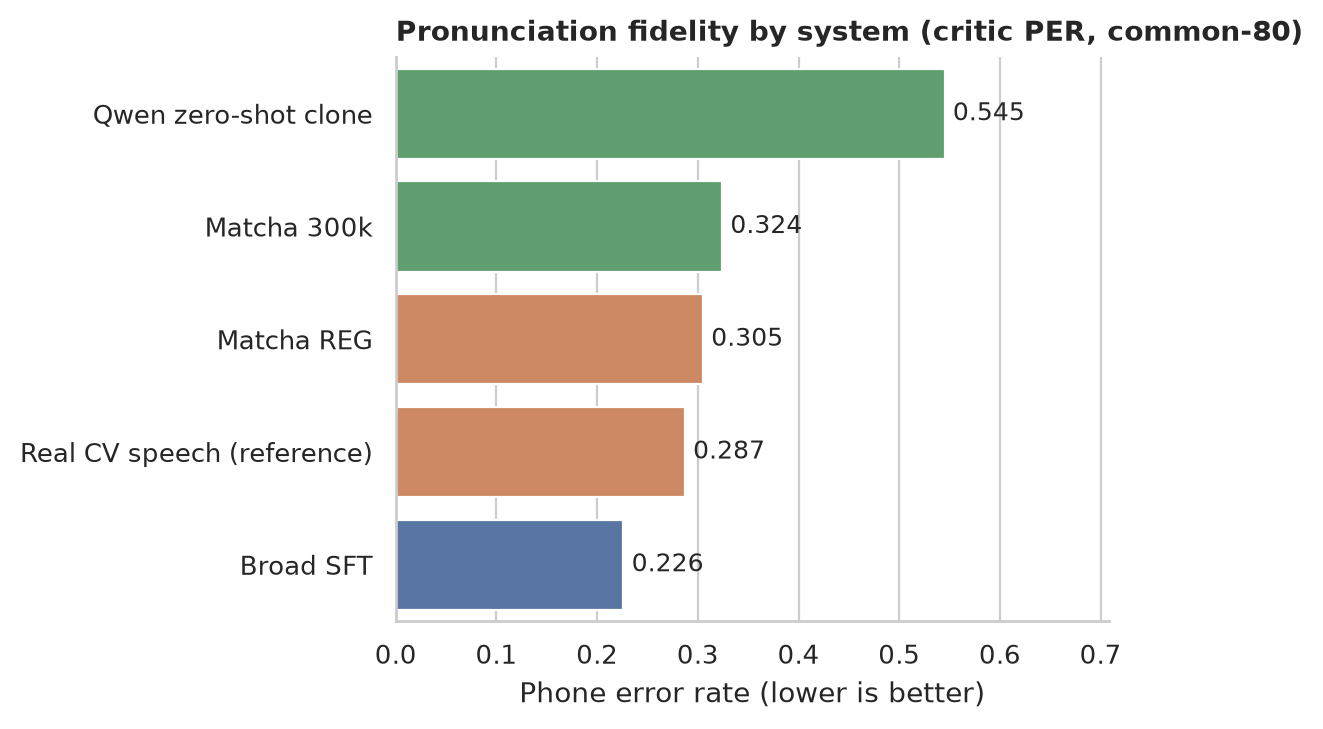
Pronunciation-Supervised Text-to-Speech for Irish (Gaeilge)
This work adapts a large pretrained text-to-speech model to Irish, a low-resource language, by leveraging pronunciation documentation as a verifier during fine-tuning rather than relying solely on limited speech data. The approach compiles Wiktionary pronunciation records into a phoneme-level critic, achieving substantial improvements in accuracy and demonstrating how linguistic expertise can supervise speech synthesis when transcribed speech is scarce.
Abstract
Speech technology for Irish must be built from very little transcribed speech, yet the language's pronunciation is thoroughly documented in dictionaries and dialect descriptions. We ask whether that documentation can supervise the adaptation of a large pretrained text-to-speech model to a language it was never trained on. We adapt Qwen3-TTS to Irish using 12.8 hours of crowdsourced Common Voice speech, correcting two defects in the vendor fine-tuning script that training loss does not reveal (Appendix A), and reach character error rate (CER) 0.225 on held-out cross-corpus text, against 0.397 for an exhaustively tuned from-scratch system and 0.437 for zero-shot cloning. We then compile the Wiktionary pronunciation record into a lexicon and a phoneme critic, and use that critic as the verifier in one round of rejection fine-tuning: CER 0.159 cross-corpus and 0.067 in-domain, with the voice still anonymous across all 202 training speakers. The same critic explains why the voice cannot yet be steered to a minority dialect: 229 of 12,311 training clips lean Ulster against 8,451 Munster. Pronunciation documentation, converted into a verifier, is a practical lever for low-resource speech synthesis, and a way to measure what the available data cannot support.
Voice Agents & Spoken Dialogue
Turn detection, end-of-turn training data, real-time anonymization, and efficient spoken dialogue.
Knowing when to respond — especially in multi-speaker environments — is one of the hardest open problems in voice agents. Tianjin University's SpeakerTurn framework tackles target-speaker turn detection by jointly predicting transcript and turn state conditioned on speaker identity, distinguishing five states: complete, incomplete, backchannel, wait, and target-absent. The paper also evaluates whether chain-of-thought reasoning improves speaker-conditioned interaction decisions.
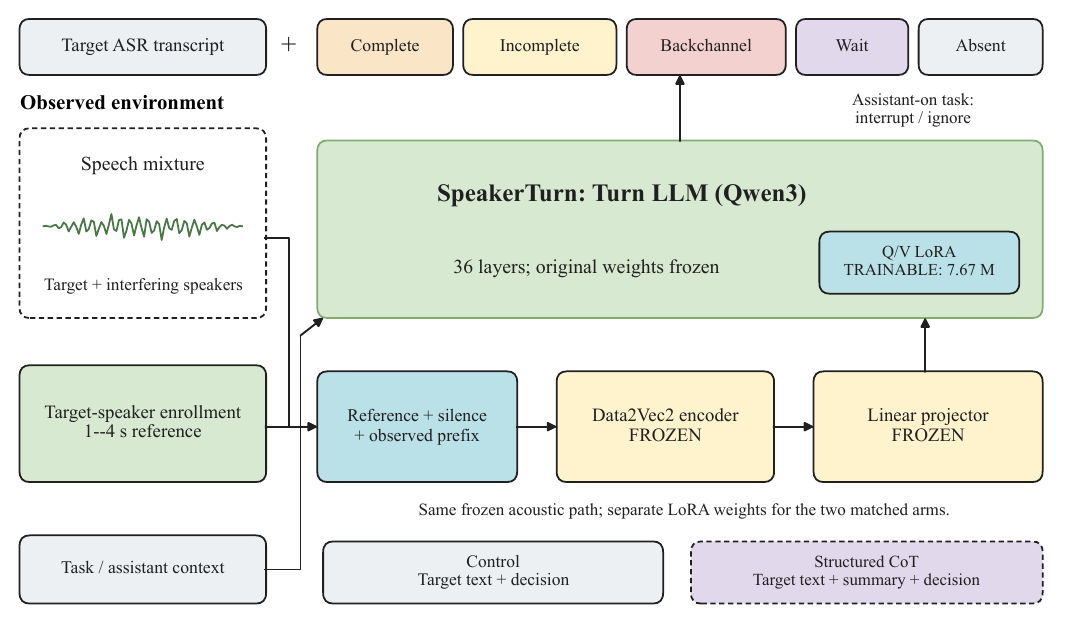
SpeakerTurn: Target-Speaker Semantic Turn Detection in Multi-Speaker Environments
This paper tackles target-speaker turn detection in multi-speaker environments by jointly predicting both transcript and turn state conditioned on speaker identity, moving beyond semantic completeness alone. The framework distinguishes five turn states (complete, incomplete, backchannel, wait, target-absent) while maintaining recognition accuracy, with an examination of whether chain-of-thought reasoning improves speaker-conditioned interaction decisions.
Abstract
Semantic completeness alone cannot determine when an assistant should respond in a multi-speaker environment: a completed utterance may belong to an interfering speaker, while the designated user is still speaking, acknowledging, or requesting time. We therefore study semantic turn inference conditioned on speaker identity. We propose SpeakerTurn, a framework that jointly predicts the target transcript and turn state from a speech mixture and an independent target-speaker reference. Built on CocktailASR-1, it links semantic decisions to the corresponding target content through joint supervision, distinguishing complete, incomplete, backchannel, wait, and target-absent states, with a separate interruption task. We also examine whether structured chain-of-thought (CoT) supervision improves decisions by representing speaker presence and semantic cues. On a synthetic multi-speaker test set, SpeakerTurn achieves five-state macro F1 of 0.811 and target-transcription character error rate (CER) of 4.20%, correctly resolving all ten reference-swapped interruption pairs. Joint-format transcription and native-interface recognition nevertheless behave differently, and CoT improves validation transcription without improving turn macro F1. These results show why target attribution, semantic turn discrimination, and recognition retention require separate assessment when adapting speech language models for speaker-conditioned interaction.
Google Research takes a step back to ask a deceptively simple question: does the genre of training speech matter for end-of-turn detectors? The answer is a clear yes — conversational multi-turn data substantially outperforms single-turn human-machine corpora, especially for natural mid-turn pauses and hesitations that are nearly absent in single-turn speech. This has immediate practical implications for anyone assembling training sets for spoken dialogue systems.
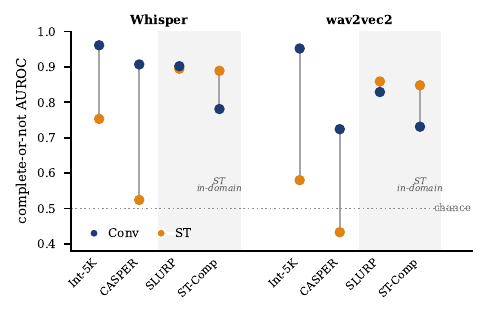
The Importance of Speech Genre for End-of-Turn Detector Training
This paper isolates speech genre as a critical but overlooked factor in training end-of-turn detectors for dialogue systems, demonstrating that conversational multi-turn data substantially outperforms single-turn human-machine corpora—particularly for handling natural mid-turn pauses and hesitations that rarely occur in single-turn speech.
Abstract
End-of-turn (EoT) detection has been studied mostly through features, models, and modalities, while the speech genre of the training data has drawn far less attention. We isolate this factor. Using one reproducible annotation pipeline, we build a matched pair of corpora, multi-turn human-human conversational and single-turn human-machine, and train the same streaming ConvLSTM EoT detector on each. Across four test sets the conversational model reaches up to +0.45 higher F1, driven by fewer false alarms on the mid-turn pauses and hesitations that are rare in single-turn corpora. This conversational-training effect is not specific to frame-level decoding. Under a matched complete-or-not test it also appears at the utterance level, across two encoders, but only on conversational test data. Testing only on single-turn speech, as most prior work does, therefore hides the benefit of conversational training data. Against open-source baselines, our 1.8M-parameter model attains the highest F1 on every test set.
Voice anonymization typically stops at the speaker identity, leaving personally identifiable information in the transcript untouched. University of Maryland's cascaded streaming system chains ASR → NLP → TTS to simultaneously anonymize speaker voice and scrub PII from content in real time, achieving competitive voice-privacy performance under a 717 ms latency budget — a meaningful step toward holistic privacy protection for spoken communication.

Toward Complete Speaker Anonymization: a Streaming Cascaded System for Voice Privacy and PII Removal
A cascaded streaming system that chains ASR, NLP, and TTS to achieve speaker anonymization and PII removal in real-time. This approach achieves competitive voice privacy performance with streaming constraints (717ms latency) by leveraging recent advances in speech and language processing, extending content protection beyond voice alone.
Abstract
We present a cascade streaming voice privacy system, consisting of ASR, NLP, and TTS modules. By leveraging recent improvements in all three aspects of speech and language processing, we show that such a system is capable of achieving a result comparable to state-of-the-art offline voice privacy systems, while providing controllable capabilities of content protection beyond voice. With an estimated utterance-onset end-to-end latency of 717 ms, the presented system preserves speech content with 11% WER on Librispeech, while detecting PII with a 69% SLU F1 score and achieving up to 47.66% EER against a semi-informed attacker.
Digital Humans & Face Video
Identity-preserving restoration and efficient spoken dialogue token compression.
Restoring severely degraded face video while keeping the person's identity intact is a hard problem that standard super-resolution methods sidestep by working only from the degraded frames themselves. Purdue's AlbumVSR conditions a streaming diffusion transformer on reference photos drawn from a personal album, using those external identity cues to faithfully recover facial details. It outperforms 14 baseline methods on identity-disjoint benchmarks — a strong result given that the reference photos come from entirely separate identities at test time.
AlbumVSR: Identity-Preserving Face Video Super-Resolution from a Personal Photo Album
AlbumVSR restores high-quality identity-preserving face videos from severe degradation by conditioning a streaming diffusion transformer on reference photos from a personal album. Unlike standard restoration methods, it leverages identity cues from external photos to faithfully recover facial details and identity similarity, outperforming 14 baseline methods on identity-disjoint benchmarks.
Abstract
Severe blur, downsampling, noise, and compression can erase the identity cues needed to faithfully restore a person's face. We therefore use photographs of the same person as an external source of identity. AlbumVSR conditions a frozen, one-step streaming diffusion transformer on a personal album. We use four MagFace/CLIP set tokens to encode the album, and 64 texture tokens which come from a fused UV atlas rendered at the current window's estimated face pose. These tokens are appended to the transformer's cached cross-attention context. On an identity-disjoint VoxCeleb2 benchmark with heavy synthetic degradation, AlbumVSR raises ArcFace similarity to the ground truth from 0.586 to 0.670 and face PSNR from 24.98 to 26.71 dB. On the 91 test identities, its mean identity similarity is higher than that of all 14 baselines.
From today's Hugging Face Daily tab: the Chinese Academy of Sciences introduces CoSTA (Compressed Speech Token Adaptation), which decouples generation and synthesis token spaces so that spoken dialogue models can run faster without sacrificing quality or compatibility. By compressing the token representation used during generation, CoSTA reduces the computational burden of autoregressive speech decoding while keeping the synthesis pathway intact.
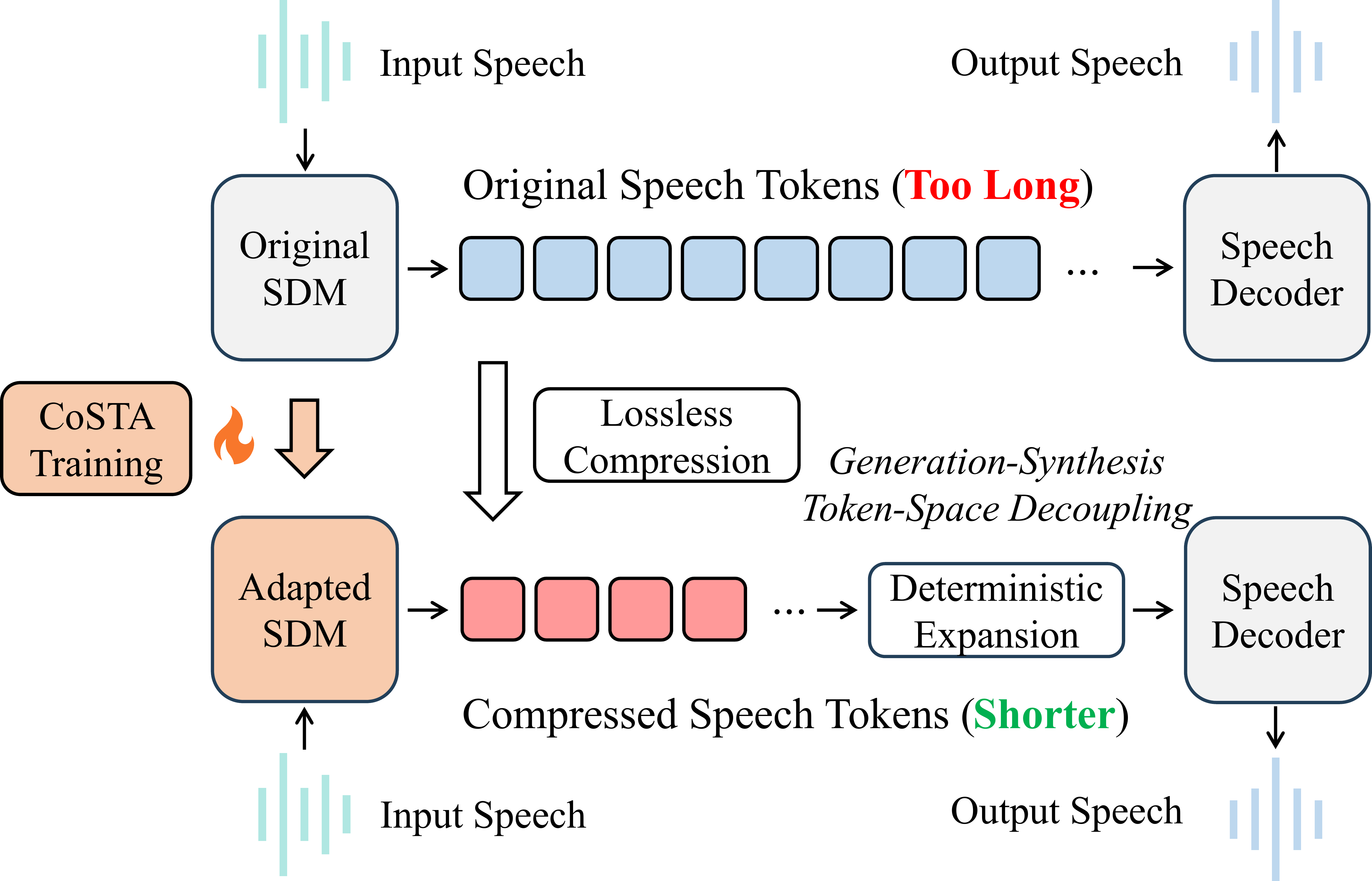
CoSTA: Compressed Speech Token Adaptation for Efficient Spoken Dialogue Models
CoSTA decouples generation and synthesis token spaces to accelerate spoken dialogue models while preserving quality and compatibility.
Abstract
Spoken Dialogue Models (SDMs) typically share a speech-token space for generation and synthesis, leading to long autoregressive sequences and costly inference. Lower-rate speech tokenizers shorten sequences but may introduce compression-quality trade-offs and costly replacement without breaking this coupling. To address this limitation, we propose CoSTA, a compatibility-preserving post-hoc framework that decouples generation and synthesis token spaces while retaining the original speech tokenizer and decoder. CoSTA extends the generation token space with compressed representations via mean-initialized vocabulary extension, pronunciation adaptation, and dialogue adaptation, followed by deterministic expansion back to the original speech-token space before synthesis. On bilingual speech-dialogue benchmarks, CoSTA achieves approximately 1.7times expanded speech-token generation speed, lower full-response latency, and higher throughput while preserving response quality. Analyses show more sustained interaction under limited budgets and a practical trade-off among compression, decoding efficiency, and quality. Further experiments demonstrate cross-architecture transfer and complementarity to low-rate tokenization.
Trending on Hugging Face

OmniFlatten: An End-to-end GPT Model for Seamless Voice Conversation
A novel GPT-based model, OmniFlatten, enables real-time natural full-duplex spoken dialogue through a multi-stage post-training technique that integrates speech and text without altering the original model's architecture.

VoiceMem: Streaming Dual-Brain Memory for Real-Time Interaction
VoiceMem introduces a dual-brain streaming memory architecture for speech language models that improves retrieval accuracy, emotional personalization, and real-time efficiency.

Qwen3-TTS Technical Report
The Qwen3-TTS series presents advanced multilingual text-to-speech models with voice cloning and controllable speech generation capabilities, utilizing dual-track LM architecture and specialized speech tokenizers for efficient streaming synthesis.

IndexTTS: An Industrial-Level Controllable and Efficient Zero-Shot Text-To-Speech System
IndexTTS, an enhanced text-to-speech system combining XTTS and Tortoise models, offers improved naturalness, enhanced voice cloning, and controllable usage through hybrid character-pinyin modeling and optimized vector quantization.