
Dubbing, Digital Humans, and Spoken LLMs: Eight Papers Pushing Audio-Visual AI Forward
Today's digest covers a wave of advances in video dubbing, talking-head generation, speech-to-speech translation, oral animation evaluation, generative spoken language models, real-time voice benchmarking, and Arabic voice anonymization — a broad sweep across the audio-visual AI stack.
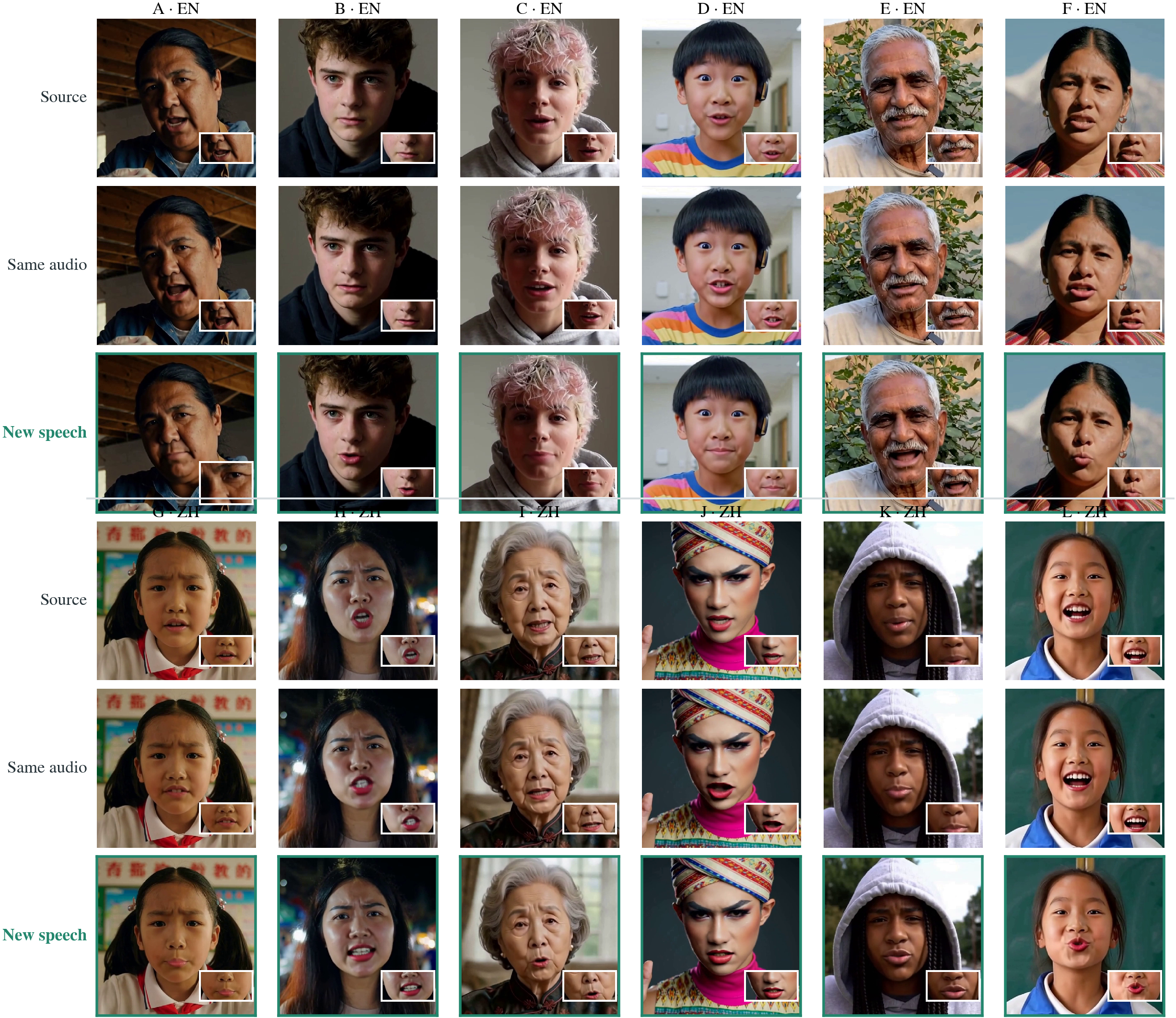
Held-out multilingual examples. Twelve mechanically selected cases (six English and six Chinese) are shown at matched times. Rows contain the source, same-audio edit, and replacement-speech edit; insets enlarge the mouth, and green borders identify replacement-speech outputs. From KAUST.
Today's eight papers span the full audio-visual pipeline — from the subtle problem of getting a dubbed mouth to stop fighting its source video, to benchmarking whether real-time voice assistants can whisper on command. Alibaba drops two TaoMate entries, Meta AI pushes generative spoken LMs toward text-level competence, and CMU tackles a chronically underserved language in voice conversion. Let's dig in.
Talking Avatars, Lip-Sync & Video Dubbing
From replacement-aware diffusion to timeline-preserving translation, this cluster reframes dubbing as a precision audio-visual alignment problem.
A persistent failure mode in video dubbing is that the source mouth region actively resists being overwritten — the model tries to reconstruct what was already there while simultaneously being told to match new speech. KAUST's VidDub attacks this directly with replacement-aware training supervision: reconstruction losses on the source mouth are masked whenever the speech is unpaired, leaving audio-visual sync as the sole mouth-region objective. Paired with a two-step distilled diffusion model for fast inference, the result is tighter lip sync and better visual quality with speaker identity and background cleanly preserved.
VidDub: Replacement-Aware Distillation for Two-Step Video Dubbing
VidDub introduces replacement-aware training supervision that prevents the source mouth from conflicting with target speech during video dubbing, combined with a two-step distilled diffusion model for efficient inference. By masking source-mouth reconstruction losses for unpaired speech and using audio-visual sync as the sole mouth supervision, the method achieves superior lip synchronization and visual quality while preserving speaker identity and background in a highly compressed model.
Abstract
Video dubbing aims to synthesize lip movements that match target speech while preserving the speaker identity, head pose, and background of a source video. Existing editors are predominantly trained via self-reconstruction under original paired audio, even though the source mouth becomes a conflicting target when driving speech is replaced. We introduce replacement-aware cross-audio supervision: paired-audio samples use full-frame reconstruction, whereas unpaired replacement-audio samples mask out source-mouth reconstruction losses and supervise the mouth solely through audio-visual synchronization while preserving unmasked facial regions and background. Because offline dubbing provides the complete source video and target speech beforehand, we present VidDub, a full-context diffusion editor distilled into two denoising steps (2 NFE). Our replacement-aware teacher first learns accurate lip synchronization without regressing toward conflicting source mouth movements. Matched trajectory regression then transfers the teacher's CFG-guided trajectories to a two-step student, and distribution matching distillation recovers visual quality after step compression. We will release the curated training dataset, VidDub-Bench, fixed paired- and cross-audio evaluation manifests, preprocessing outputs, and unified evaluation code. Across three training seeds, masking out conflicting source-mouth reconstruction improves cross-audio Sync-C by 0.833; the final two-step model combines strong lip synchronization with superior visual quality, identity preservation, and visual speech recognition across four benchmarks.
Still on the Alibaba TaoMate family, TaoMate-FVSR (today's Hugging Face Daily pick) targets a different failure mode: blurry, poorly-resolved facial regions that plague AI-generated talking-head videos. Rather than treating restoration as pure super-resolution, TaoMate-FVSR folds audio guidance directly into the restoration pipeline so that facial detail and audio-visual synchronization are jointly recovered — a setup that also naturally supports visual dubbing when the audio track is swapped out.
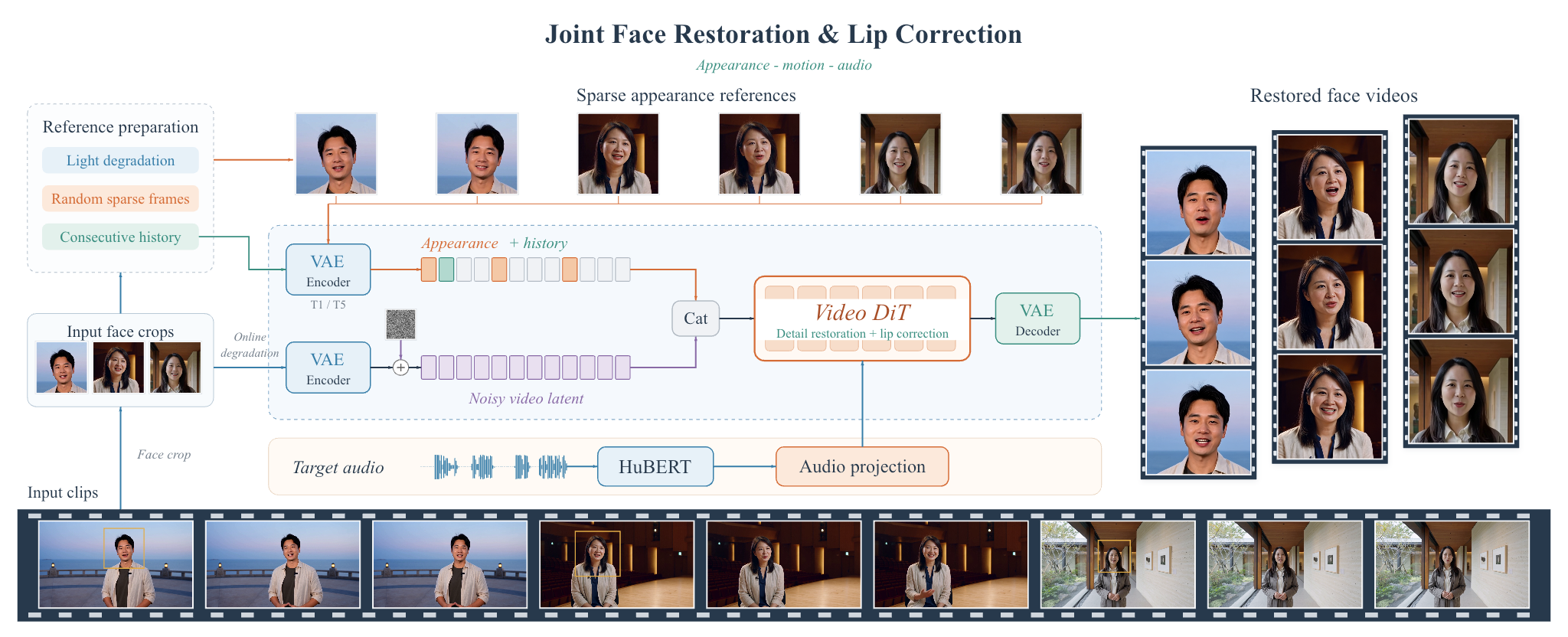
TaoMate-FVSR:Audio-Guided Facial Video Restoration
This paper tackles the problem of poorly-resolved facial regions in AI-generated talking-head videos by introducing audio guidance into video restoration. Unlike standard super-resolution, the method jointly restores facial detail and ensures audio-visual synchronization, supporting visual dubbing when audio is replaced.
Abstract
AI-generated videos often depict people within detailed scenes while leaving their small facial regions poorly resolved. Visual super-resolution can sharpen these regions without resolving whether the recovered lips and teeth agree with the spoken audio. We present an audio-guided facial video restoration framework that addresses this ambiguity within a reference-guided video flow model. Source--noise mixing initializes reconstruction from a partially preserved observation, and structured reference injection separates appearance anchors from continuous motion context. Training combines restoration of degraded images and videos with correction of degraded dubbed sources under target audio. Appearance and synchronization supervision allow the model to recover facial detail and support visual dubbing when the audio is replaced. On talking-head restoration benchmarks, our method achieves the best paired perceptual similarity and synchronization scores among the compared restoration methods. Component comparisons examine audio conditioning, the reconstruction formulation, and reference injection. Native AIGC examples further illustrate the recovery of lip contours, dental structure, and surrounding facial texture in scene-level footage. injection. Native AIGC examples further illustrate the recovery of lip contours, dental structure, and surrounding facial texture in scene-level footage.
The sibling paper, TaoMate-HD from Alibaba, zooms out to the hour-long streaming scenario. Generating high-resolution audio-video in real time is computationally brutal; TaoMate-HD sidesteps brute-force generation with a progressive-resolution autoregressive scheme that first sketches coarse video structure across chunks, then refines to full resolution. Continuation training keeps audio coherent across text script updates, enabling substantial speedups while sustaining conversational-length synthesis.

TaoMate-HD: Progressive-Resolution Autoregressive Audio-Video Generation
TaoMate-HD enables efficient high-resolution audio-video generation for streaming digital humans by progressively refining coarse video structure to high resolution across chunks, while leveraging continuation training to maintain audio coherence across text updates. The approach achieves substantial speedups over direct generation while supporting hour-long conversational video synthesis.
Abstract
Streaming digital humans produce detailed video while continuing speech as new text arrives. High-resolution denoising is costly, and text updates can cause repeated or interrupted speech. We present TaoMate-HD, an autoregressive model for high-resolution audio-video streaming. For each short segment, or chunk, two denoising steps establish coarse video structure at low resolution. A final step refines the video to high resolution, with audio generated throughout the same trajectory. Each stage passes its audiovisual predictions to the same stage of the next chunk as history. Across text updates, the model retains this history to infer what has already been spoken. Continuation training utilizes asymmetric text conditioning, with separate text windows for generation and distillation. Experiments show a 1.6x speedup over direct high-resolution generation with the same model and hardware. Optimized stage-parallel deployment provides a further 1.9x overall speedup over serial progressive generation. Our continuation training reduces character error rate by 11.18 percentage points relative to the baseline. The model also supports hour-long audiovisual generation. Our project page is https://taoliveaigc.github.io/TaoMate-HD.
Cross-lingual dubbing demands more than good lip sync — the translated speech must land at exactly the same temporal moments as the original, including pauses. The University of Texas at Austin frames this as timeline-preserving speech-to-speech translation and trains an end-to-end autoregressive model on duration-matched aligned pairs. The training recipe combines supervised curriculum learning with reinforcement learning, achieving strong temporal alignment without any inference-time frame-level timing control.
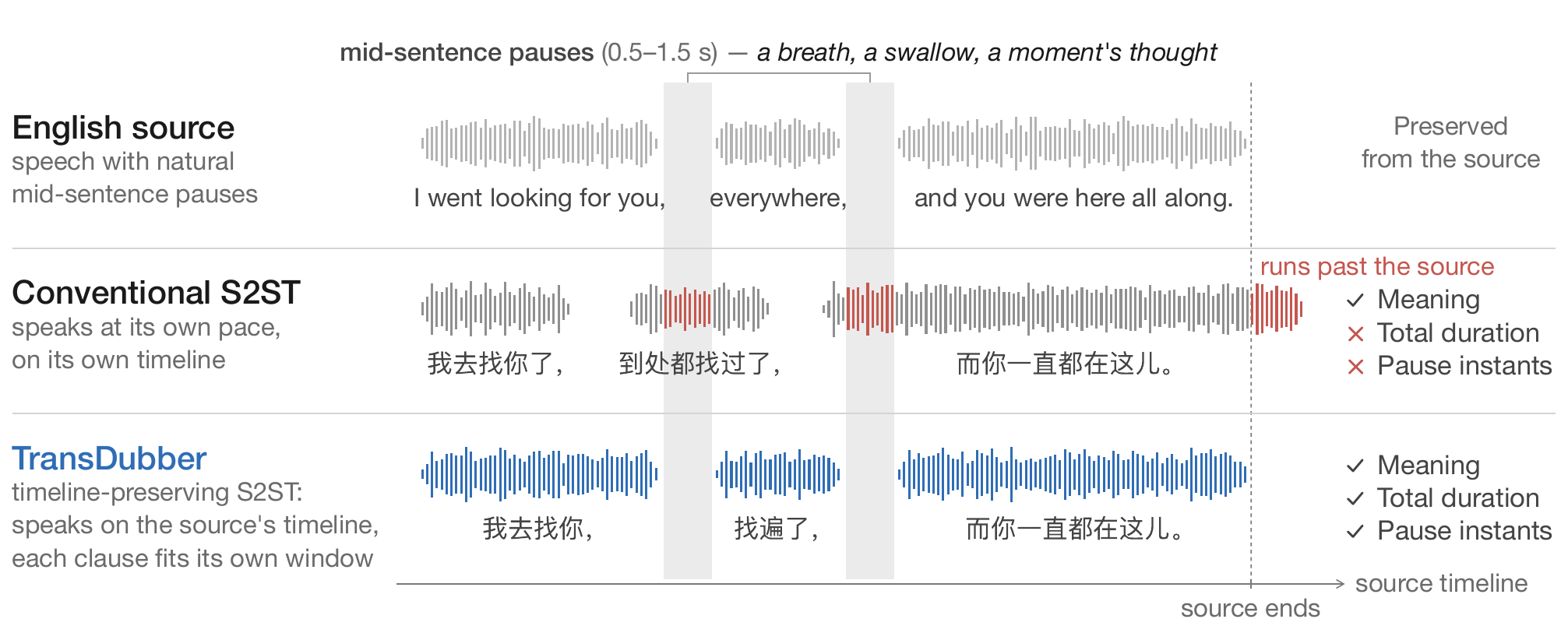
Learning Timeline-Preserving Speech-to-Speech Translation
This work addresses timeline-preserving speech-to-speech translation, where pauses and speech must occur at the same temporal moments as the source speech—critical for dubbing applications. It trains an end-to-end autoregressive system on duration-matched aligned pairs using supervised curriculum learning combined with reinforcement learning, achieving significantly improved temporal alignment without inference-time frame-level timing control.
Abstract
Speech-to-speech translation (S2ST) increasingly preserves what is said and how it sounds, but not necessarily when speech and silence occur. For dubbing and other temporally grounded applications, matching total duration is not enough: speech and pauses must also occur at corresponding moments. We formulate timeline-preserving S2ST, which aims to preserve the source endpoint and salient internal pauses on a shared absolute timeline. We present TransDubber, an end-to-end autoregressive system that learns this temporal structure directly from aligned target waveforms, without inference-time frame-level timing control or post-hoc temporal correction. To provide this supervision, we construct 642K exactly duration-matched English-Chinese speech pairs by translating and synthesizing target speech on source-defined temporal scaffolds. Training combines a progressive supervised curriculum with verifier-guided reinforcement learning to balance translation quality and temporal alignment. On a 4,353-utterance test set spanning read and spontaneous speech, TransDubber increases the proportion of translations within 2% of the source duration from 25.6% to 61.5% and pause-alignment F1 from 0.118 to 0.550 compared with UniSS, while maintaining competitive translation quality. Our analysis shows that aligned supervision establishes timeline following, while reinforcement learning refines temporal precision and partially offsets the translation-quality cost of strict synchronization. Together, these results demonstrate the effectiveness of our data and training framework for timeline-preserving S2ST. Audio samples, code, datasets, and pretrained models are available at https://zhishengzheng.com/transdubber/.
Evaluating oral animation quality has long relied on hand-crafted landmark coordinates or costly perceptual studies. Yonsei University proposes Fréchet Oral Distance (FOD), a learned, coordinate-free metric built on an Oral Motion Encoder trained on synthetic articulatory data. FOD yields reproducible cross-model rankings that correlate with human preference and generalizes across 2D and 3D animation architectures — a much-needed infrastructure contribution for the field.
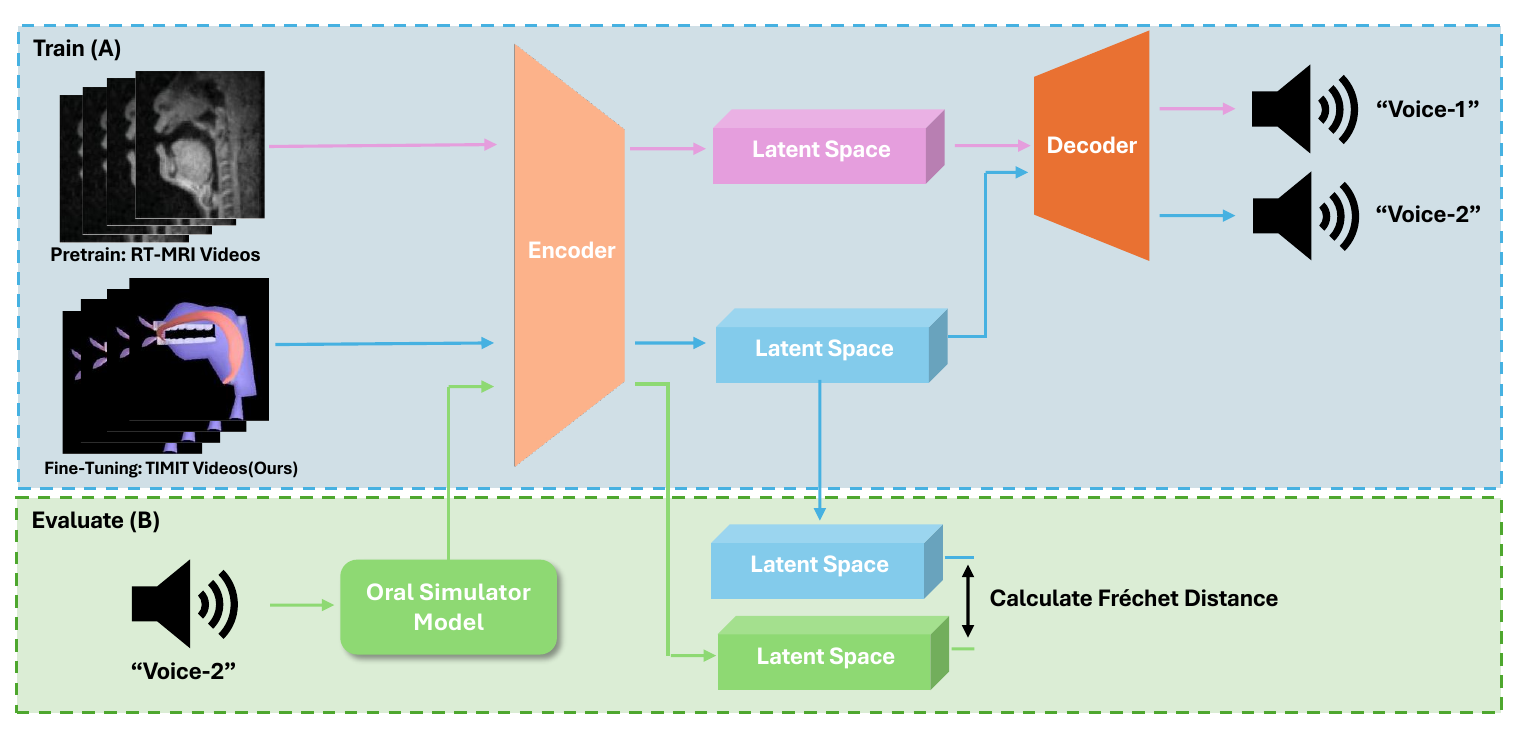
Fréchet Oral Distance: A Coordinate-Free Metric and Benchmark for Speech-Driven Oral Animation
This work introduces Fréchet Oral Distance (FOD), a learned metric for objectively evaluating speech-driven oral animation quality without relying on hand-crafted coordinates or subjective assessment. By training an Oral Motion Encoder on synthetic articulatory data, FOD provides reproducible cross-model benchmarking that aligns with human preference while supporting diverse 2D/3D animation architectures.
Abstract
Recently, speech-driven facial and oral animation technologies have been used in various fields such as education, speech therapy, and healthcare. But methods to objectively evaluate the quality of generated results are still limited. Accordingly, we propose the Fréchet Oral Distance (FOD), which uses embeddings from an Oral Motion Encoder (OME) and a TIMIT-Vis reference distribution. In experiments, FOD reproduced model rankings similar to the coordinate-based metric, Lip Vertex Error (LVE), and showed trends consistent with user preference. Our framework provides objective and reproducible benchmarking without relying on expensive equipment or subjective evaluation, and it can be extended to compare a variety of 2D/3D models.
SpeechLLMs & Spoken Dialogue
Meta AI narrows the speech-text LM gap through multi-stream discrete units; a community benchmark stress-tests seven real-time voice systems simultaneously.
Single-stream discrete speech representations have been the backbone of generative spoken language models, but they compress diverse linguistic signals into one bottleneck. Meta AI's GSLM2 breaks that assumption: SpidR 2.0 learns multiple complementary discrete unit streams at different abstraction levels, and the resulting multi-stream design yields substantially better linguistic competence and data-scaling efficiency, meaningfully closing the gap with text-based LMs.
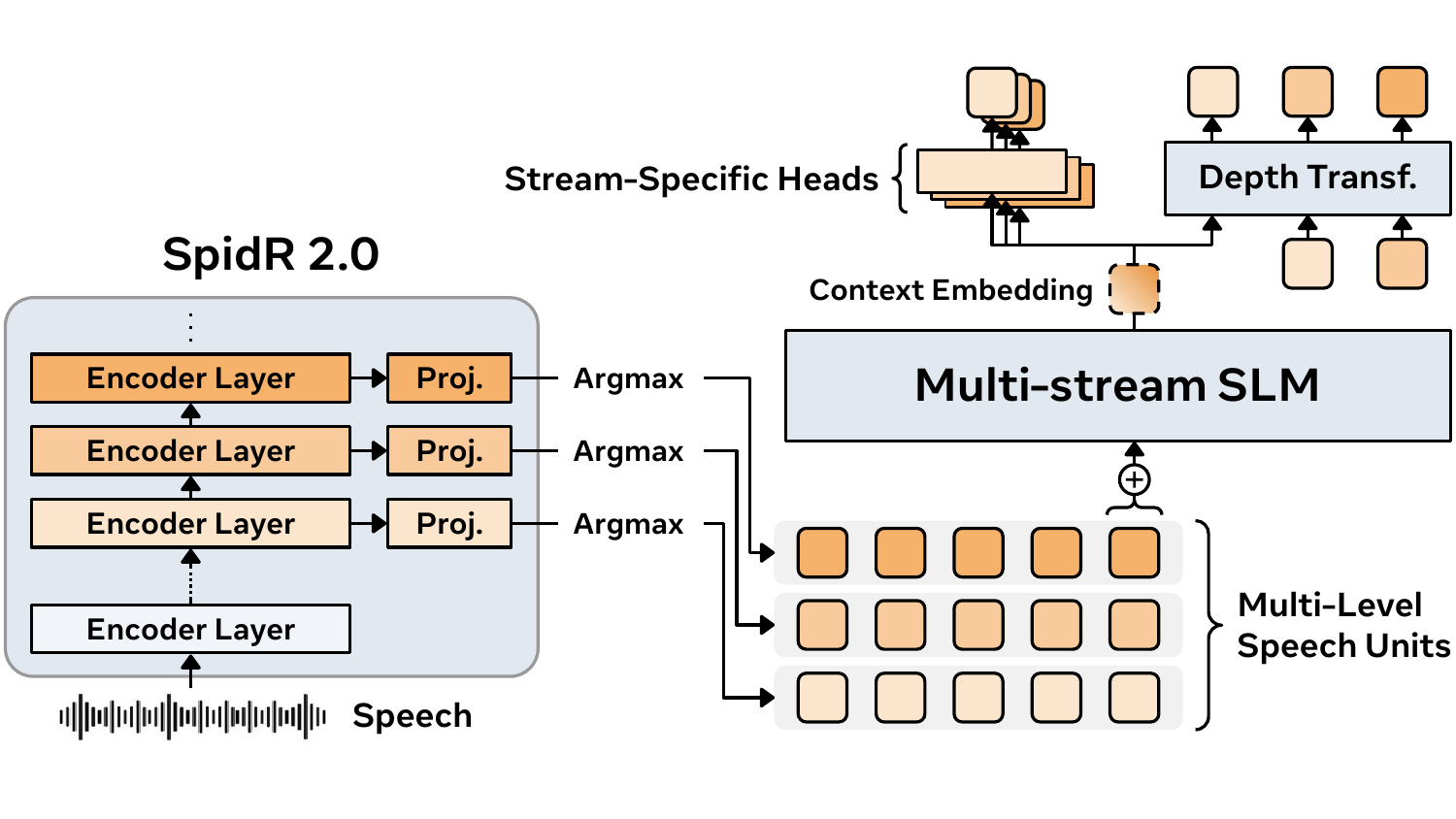
GSLM2: Multi-Stream Speech Representation Learning and Generative Spoken Language Modeling
This work advances generative spoken language models by learning multiple complementary streams of discrete speech units at different abstraction levels through SpidR 2.0, departing from single-stream approaches. The multi-stream design and improved unit quality enable substantially better linguistic competence and data scaling efficiency, narrowing the performance gap between speech and text-based language models.
Abstract
Generative spoken language models (SLMs) offer a route to learning linguistic structure purely from speech, yet they lag far behind text-based models in both capability and data scaling efficiency. We identify two bottlenecks underlying this gap: the limited linguistic quality of existing speech units and the reliance on a single stream of discrete units to represent speech. Multiple codebooks are widely used to encode acoustic features but rarely to represent speech semantics. We present GSLM2, which learns and models complementary properties of speech at multiple levels of abstraction. Its encoder, SpidR 2.0, uses self-supervised learning with differentiable prediction heads to induce high-quality discrete units at multiple levels. A multi-stream SLM then jointly models these units using a shared temporal backbone, stream-specific predictors, and an autoregressive head that captures cross-stream dependencies. Across training data sizes and model scales, up to 6M hours and 6.5B parameters, GSLM2 consistently improves linguistic competence while scaling more efficiently with data. As a result, it substantially narrows the gap between spoken and text-based LMs; across read and conversational speech domains, we shrink the gap by about two orders of magnitude on sWuggy, sBLIMP, and tSC, while also outperforming competitive speech-text systems on all three tasks. We open-source the training code and model checkpoints at https://github.com/facebookresearch/gslm2.
Knowing how well a real-time voice system performs on one dimension is easy; knowing where it wins and loses across all interactive dimensions simultaneously is much harder. InteractionBench from the Open Research Community solves this by feeding identical audio inputs to seven live voice systems and measuring conversational timing, spoken-task accuracy, whisper/volume control, and factual grounding in a single unified pass. The results expose sharp cross-system trade-offs and protocol differences between hosted and open full-duplex models that siloed benchmarks would miss entirely.

InteractionBench: Measuring Timing, Task Accuracy, Whisper and Volume, and Grounding in Real-Time Voice Systems
InteractionBench is a unified benchmark that simultaneously measures conversational timing, spoken-task accuracy, whisper/volume control, and factual grounding across seven real-time voice systems using identical audio inputs. Unlike prior work that isolates individual capabilities, it reveals cross-system trade-offs and protocol differences in how hosted versus open full-duplex models handle interactive dimensions.
Abstract
Most benchmarks for real-time voice systems focus on one aspect, such as turn-taking, instruction following, paralinguistic control, or conversational memory, each with its own data and set of systems. We present InteractionBench, a benchmark and evaluation harness that measures four dimensions on the same systems from the same recorded user audio: conversational timing, spoken-task accuracy, whisper and volume, and groundedness in conversations of more than twenty turns. The benchmark contains 221 items per system in thirteen scenarios. Before any system runs, we fix the expected floor-control actions for spoken tasks by rule and take the expected answers from scripted dialogues. We score whispering from the audio signal. We evaluate GPT-Live, GPT-Realtime, Gemini Live, Moshi, PersonaPlex, Freeze-Omni, and a turn-based cascade in 1,519 graded runs. Among the six full-duplex systems, timing and spoken-task accuracy are rank-correlated ($ρ= 0.83$), while the cascade has the highest spoken-task score (38/50) and the second-lowest timing score. No system corrects a user's grammar within the required window. Only Gemini Live whispers on most requests (8/10). Hosted systems pass 67-88% of groundedness probes, compared with 14-35% for open full-duplex models. Timing is measured where the client hears each system, so the timing of hosted systems includes network delay: for GPT-Live, whose server reports its own clock, removing a delay of about 1.5 s lowers its timing score from 86% to 56%. We also document where the protocol differs across systems, including the text instructions.
Voice Conversion & Anonymization
CMU brings zero-shot voice anonymization to Arabic, a language where dialectal variation and code-switching make the problem substantially harder.
Existing zero-shot voice conversion models were built almost exclusively on high-resource languages, leaving Arabic — with its rich dialectal landscape and frequent code-switching — largely unaddressed. Carnegie Mellon's EZ-Ar-VC closes that gap by training a target-language-adapted model on diverse Arabic speech. The system achieves robust anonymization while preserving pronunciation and naturalness, with particular strength precisely where prior work collapses: across dialects and mid-sentence language switches.

EZ-Ar-VC: Robust Arabic Voice Anonymization with Generalization across Dialects and Code-Switching
This work addresses voice anonymization for Arabic speech, a language notably underserved by existing zero-shot voice conversion models. By training a target-language-adapted model on diverse Arabic speech, the paper achieves robust anonymization while preserving pronunciation and naturalness, with particular strength in handling dialectal variation and code-switching—critical challenges for Arabic voice conversion that prior work has largely overlooked.
Abstract
Voice conversion (VC) models can be used to anonymize speech data while preserving naturalness. Existing models, however, are mainly optimized for English and other high-resource languages, and they fail to generalize well to Arabic due to its distinct phonology. In this work, we comprehensively evaluate existing zero-shot VC systems for Arabic speech, identifying limitations in pronunciation preservation. We then train an Arabic-centric model based on EZ-VC on diverse Arabic speech, and demonstrate strong performance in intelligibility, naturalness, and pronunciation preservation, while maintaining high speaker dissimilarity. Through subjective evaluation, we further demonstrate its robustness to code-switching and cross-dialectal conversion, as well as its generalization to Arabic dialects with limited representation in the training data. Our findings highlight the limitations of zero-shot VC and the importance of target-language adaptation for robust voice anonymization.
Trending on Hugging Face
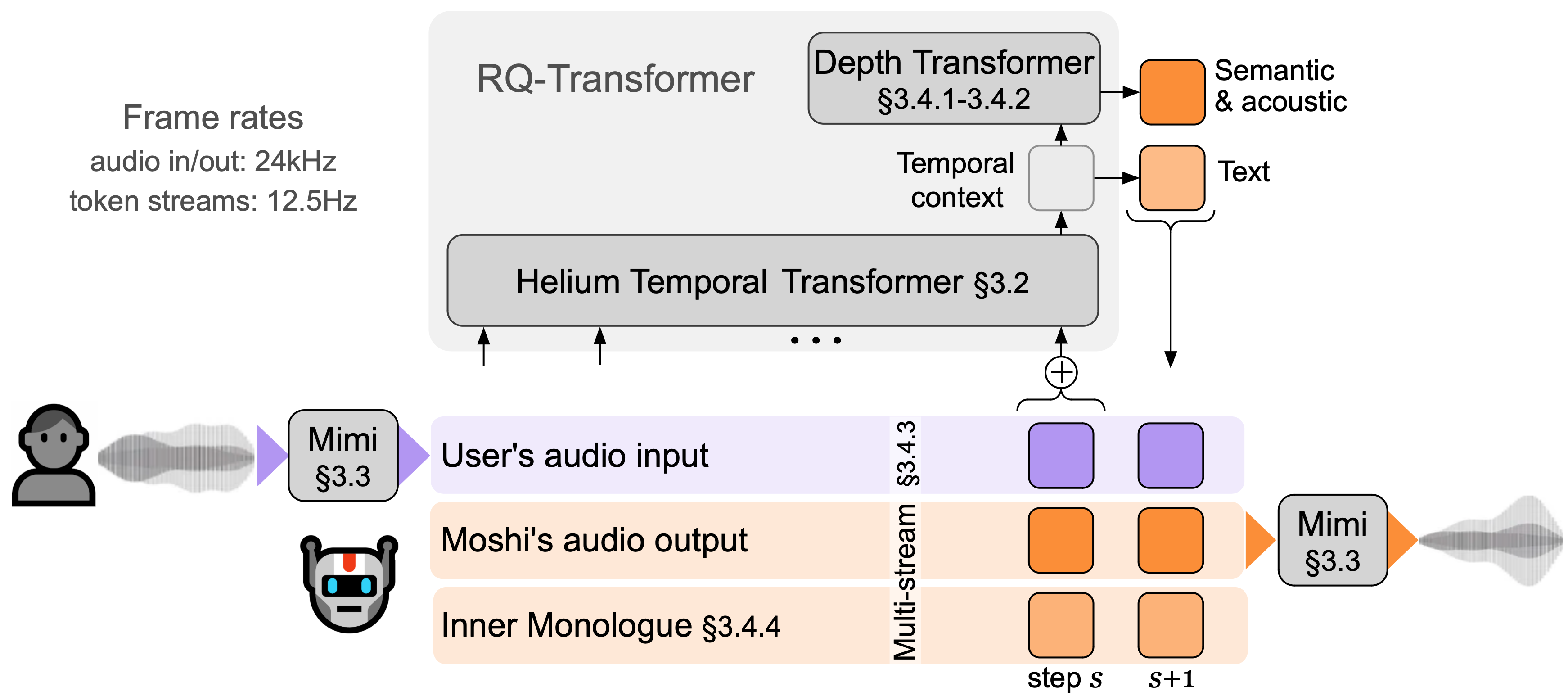
Moshi: a speech-text foundation model for real-time dialogue
A speech-text foundation model for real-time dialogue via end-to-end speech-to-speech generation instead of cascaded components. By jointly modeling overlapping audio streams with text-token prediction, it achieves 200ms latency while preserving emotion and handling natural conversational dynamics like interruptions.

OmniFlatten: An End-to-end GPT Model for Seamless Voice Conversation
A novel GPT-based model, OmniFlatten, enables real-time natural full-duplex spoken dialogue through a multi-stage post-training technique that integrates speech and text without altering the original model's architecture.

Qwen3-TTS Technical Report
The Qwen3-TTS series presents advanced multilingual text-to-speech models with voice cloning and controllable speech generation capabilities, utilizing dual-track LM architecture and specialized speech tokenizers for efficient streaming synthesis.

IndexTTS: An Industrial-Level Controllable and Efficient Zero-Shot Text-To-Speech System
IndexTTS, an enhanced text-to-speech system combining XTTS and Tortoise models, offers improved naturalness, enhanced voice cloning, and controllable usage through hybrid character-pinyin modeling and optimized vector quantization.