
Expressive Dubbing, Streaming ASR, and Smarter Speech Translation
Today's digest covers expressive speech-to-speech translation and video dubbing, real-time streaming ASR and speech LLM benchmarks, and pronunciation-controlled TTS for logographic languages.
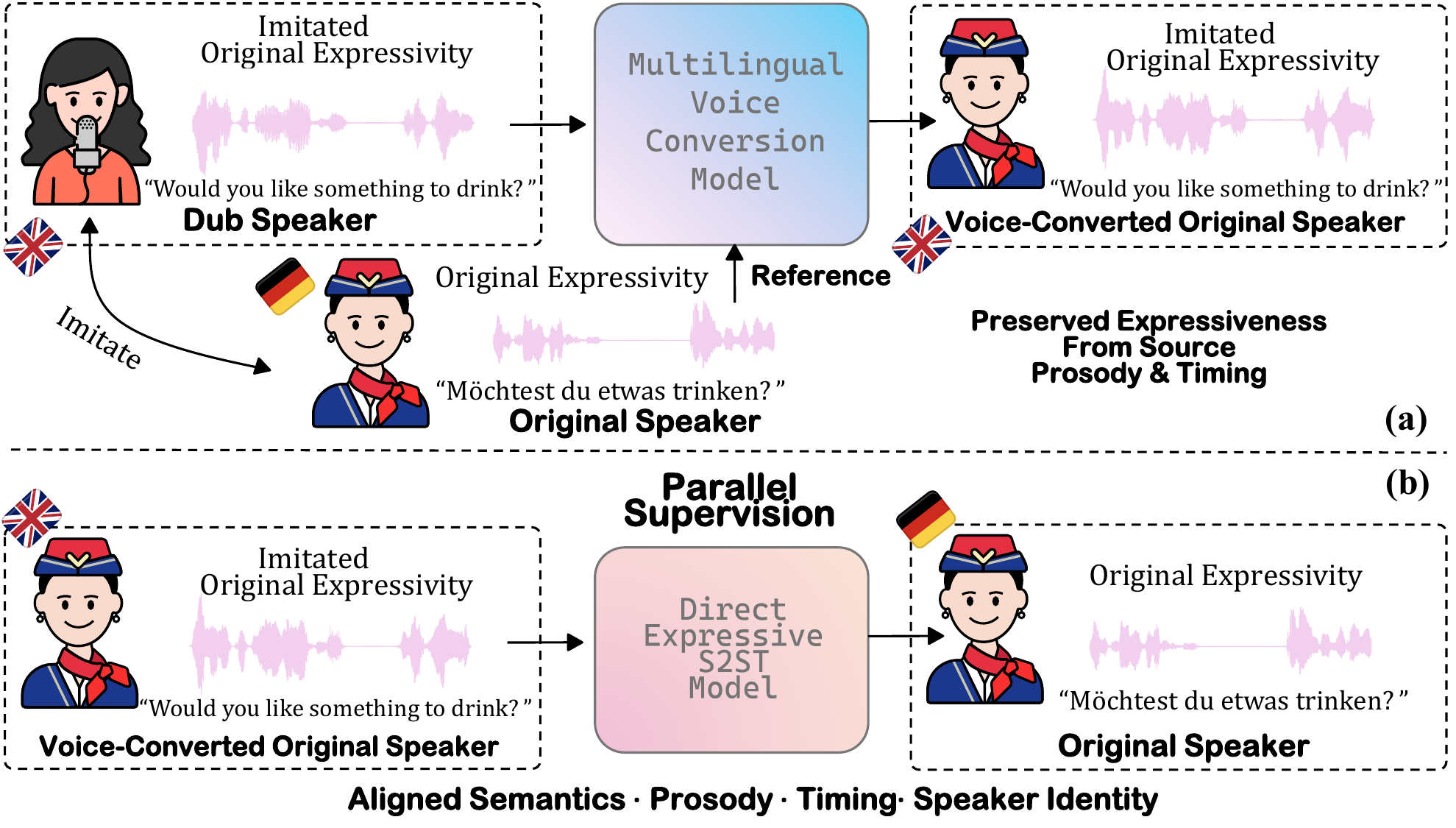
Overview of the holistic parallel supervision: (a) Construction; (b) Parallel Supervision; (c) DirectS2ST. From Carnegie Mellon University.
Today's papers push hard on two fronts: making spoken translation and dubbing more expressive and natural, and making speech systems genuinely real-time — whether that's streaming ASR, simultaneous translation, or benchmarking speech LLMs on live audio. Rounding things out is a TTS paper tackling the thorny polyphony problem in Japanese. Six papers across three themes.
Speech-to-Speech Translation & Video Dubbing
Preserving speaker expressiveness end-to-end — from live simultaneous translation to frame-perfect video dubbing.
One of the thorniest problems in speech-to-speech (S2ST) translation is not just getting the words right, but carrying over the how — the prosody, timing, and speaker identity that make speech feel alive. CMU takes this head-on by constructing holistic parallel training data that jointly aligns source and target speech across content, prosody, timing, and speaker identity, blending professional dubbing with multilingual voice conversion. The approach is validated on an end-to-end DirectS2ST system and shows significant gains in expressive realization over existing methods.
Holistic Parallel Supervision for Expressive Speech to Speech Translation
This work addresses expressiveness in speech-to-speech translation by constructing training data that jointly aligns source and target speech across content, prosody, timing, and speaker identity—combining professional dubbing with multilingual voice conversion. The systematic holistic parallel supervision approach is validated on an end-to-end DirectS2ST system, showing significant improvements in expressive realization compared to existing methods.
Abstract
Expressiveness is central to speech-to-speech translation (S2ST), yet existing datasets rarely align source and target speech jointly in content, prosody, timing, and speaker identity. Consequently, current systems often rely on indirect conditioning or transfer mechanisms. To obtain this supervision, we introduce a training-data construction strategy that combines professional dubbing, which provides human-performed correspondence in content, prosody, and timing, with multilingual voice conversion to reduce speaker mismatch. We evaluate this supervision using existing expressive S2ST systems and DirectS2ST, an end-to-end method developed in this work that predicts the complete target-speech representation directly from source speech. Experiments on English-German and English-Spanish show that holistic parallel supervision improves expressive realization across all evaluated systems. DirectS2ST exhibits the largest gains in content, prosody, timing, speaker similarity, and human-rated expressiveness. To our knowledge, this work provides the first systematic investigation of holistic parallel supervision for expressive S2ST.
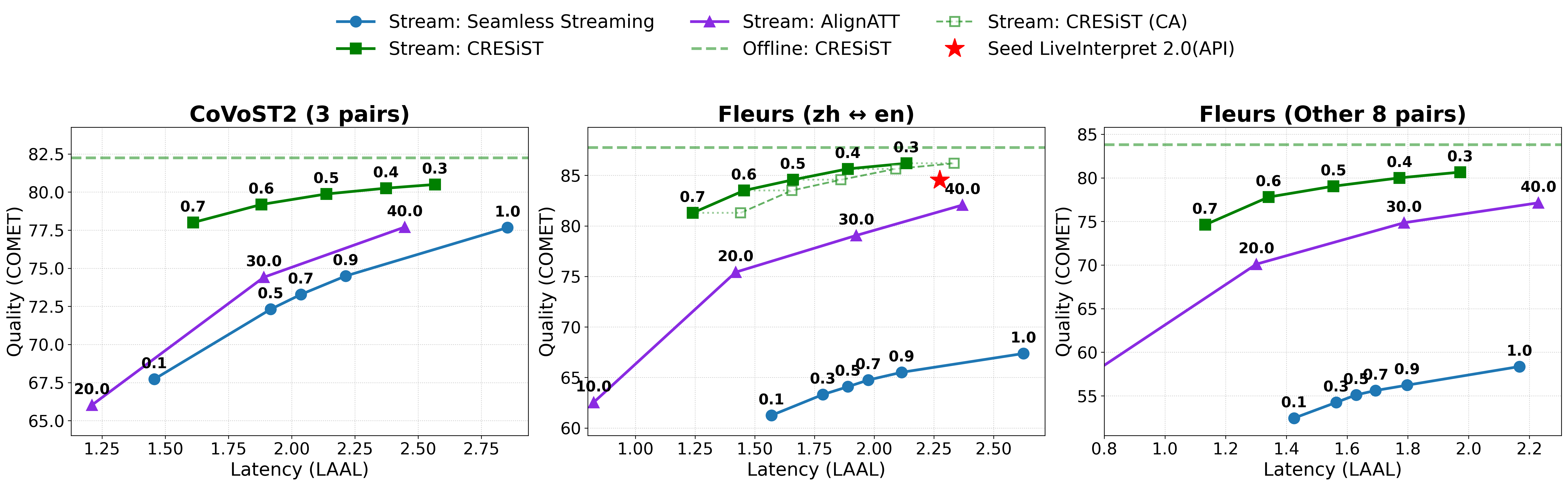
Simultaneous speech translation demands a different kind of discipline: committing to output tokens before the sentence is finished, with no second chances. Alibaba's CRESiST proposes an interleaved read-write framework that fully reuses KV cache across streaming steps and runs on an LLM backbone — eliminating rigid offline alignment entirely. The core novelty is an Actor-Critic self-enhancement pipeline that learns optimal streaming read/write policies dynamically, reaching state-of-the-art quality-latency trade-offs without any external segmentation module.
CRESiST: Self-Enhancing Explorative Policy Learning for Simultaneous Speech Translation
This work proposes an interleaved read-write framework for simultaneous speech translation that leverages full KV cache reuse and an LLM backbone to eliminate rigid offline alignments. A novel Actor-Critic self-enhancement pipeline learns optimal streaming policies dynamically, achieving state-of-the-art quality-latency trade-offs without external segmentation.
Abstract
Simultaneous Speech Translation (SimulST) requires balancing translation quality and latency. While Large Language Models (LLMs) excel in offline translation, current LLM-based SimulST systems predominantly rely on prefix-incremental generation. This paradigm suffers from redundant Key-Value cache recomputation and necessitates external Voice Activity Detection to process unbounded streams. To overcome these bottlenecks, we propose an end-to-end interleaved read-write framework built upon an omni-modal LLM. By interleaving speech chunks and text tokens, our architecture achieves full KV cache reuse, natively supporting segmentation-free, infinite-length inference. Furthermore, to learn optimal streaming policies without rigid offline alignments, we introduce a novel Actor-Critic self-enhancement pipeline. An RNN-T Actor dynamically samples read-write trajectories, while an LLM-based Critic evaluates these paths via intrinsic semantic and latency rewards, distilling the optimal policy back to the Actor. Extensive experiments on sentence-level (FLEURS, CoVoST2) and document-level (MuST-C, ACL 60/60) benchmarks demonstrate that our model establishes new state-of-the-art quality-latency Pareto frontiers, substantially outperforming existing cascaded and static-alignment baselines.
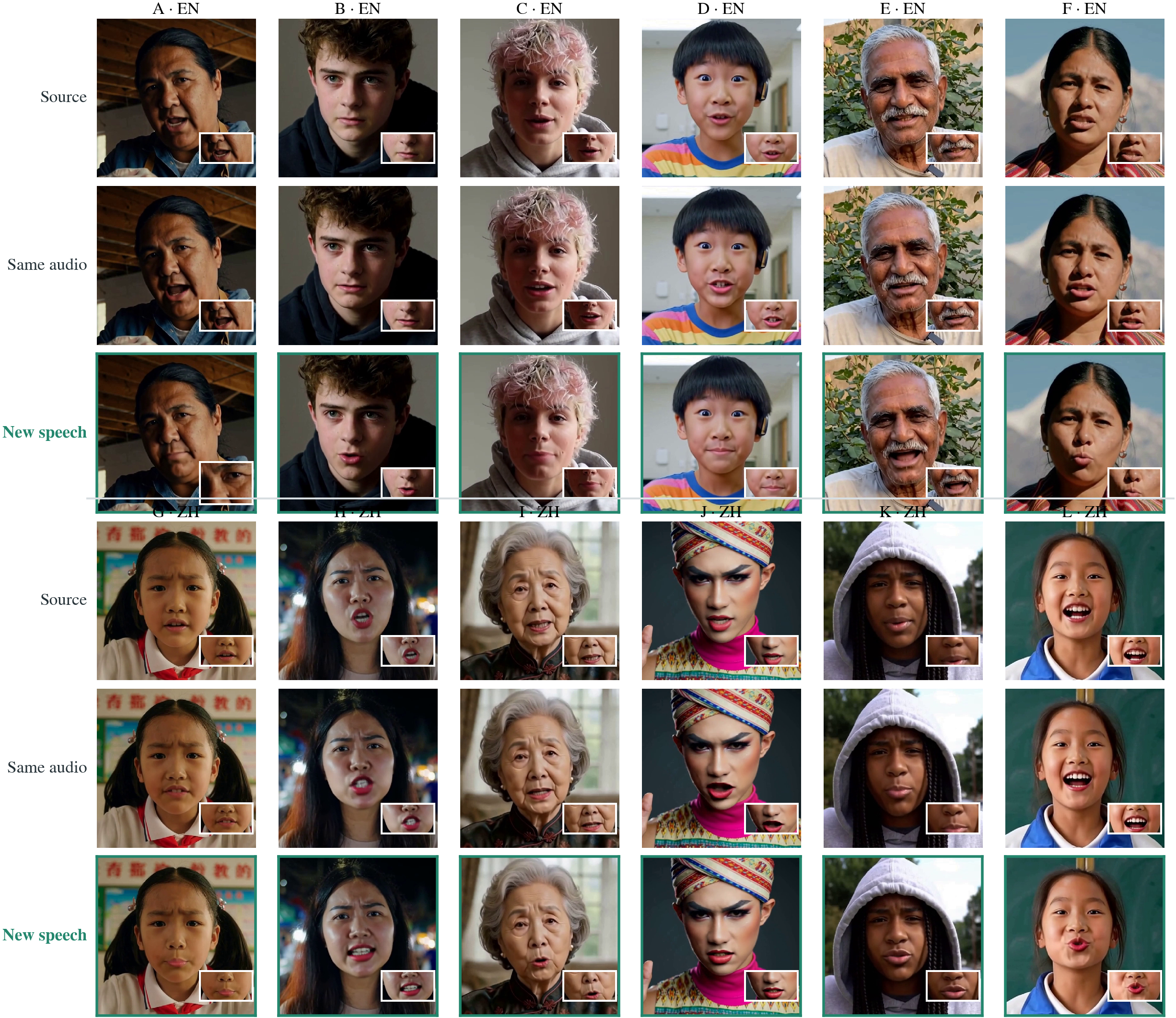
Crossing into the visual domain, Tencent's VidDub (from today's Hugging Face Daily tab 🤗) addresses a subtle failure mode in diffusion-based video dubbing: when the source video's mouth movements are used as a conditioning target, they conflict with the new audio being dubbed in. VidDub sidesteps this with replacement-aware cross-audio supervision in a two-step diffusion pipeline, achieving strong lip synchronization without sacrificing visual fidelity.
VidDub: Replacement-Aware Distillation for Two-Step Video Dubbing
VidDub is a two-step diffusion video dubbing model that uses replacement-aware cross-audio supervision to avoid conflicting source-mouth targets and achieves strong lip synchronization with high visual fidelity.
Abstract
Video dubbing aims to synthesize lip movements that match target speech while preserving the speaker identity, head pose, and background of a source video. Existing editors are predominantly trained via self-reconstruction under original paired audio, even though the source mouth becomes a conflicting target when driving speech is replaced. We introduce replacement-aware cross-audio supervision: paired-audio samples use full-frame reconstruction, whereas unpaired replacement-audio samples mask out source-mouth reconstruction losses and supervise the mouth solely through audio-visual synchronization while preserving unmasked facial regions and background. Because offline dubbing provides the complete source video and target speech beforehand, we present VidDub, a full-context diffusion editor distilled into two denoising steps (2 NFE). Our replacement-aware teacher first learns accurate lip synchronization without regressing toward conflicting source mouth movements. Matched trajectory regression then transfers the teacher's CFG-guided trajectories to a two-step student, and distribution matching distillation recovers visual quality after step compression. We will release the curated training dataset, VidDub-Bench, fixed paired- and cross-audio evaluation manifests, preprocessing outputs, and unified evaluation code. Across three training seeds, masking out conflicting source-mouth reconstruction improves cross-audio Sync-C by 0.833; the final two-step model combines strong lip synchronization with superior visual quality, identity preservation, and visual speech recognition across four benchmarks.
SpeechLLMs & Streaming Voice Agents
Benchmarking and deploying speech models that act on audio as it arrives, not after it's done.
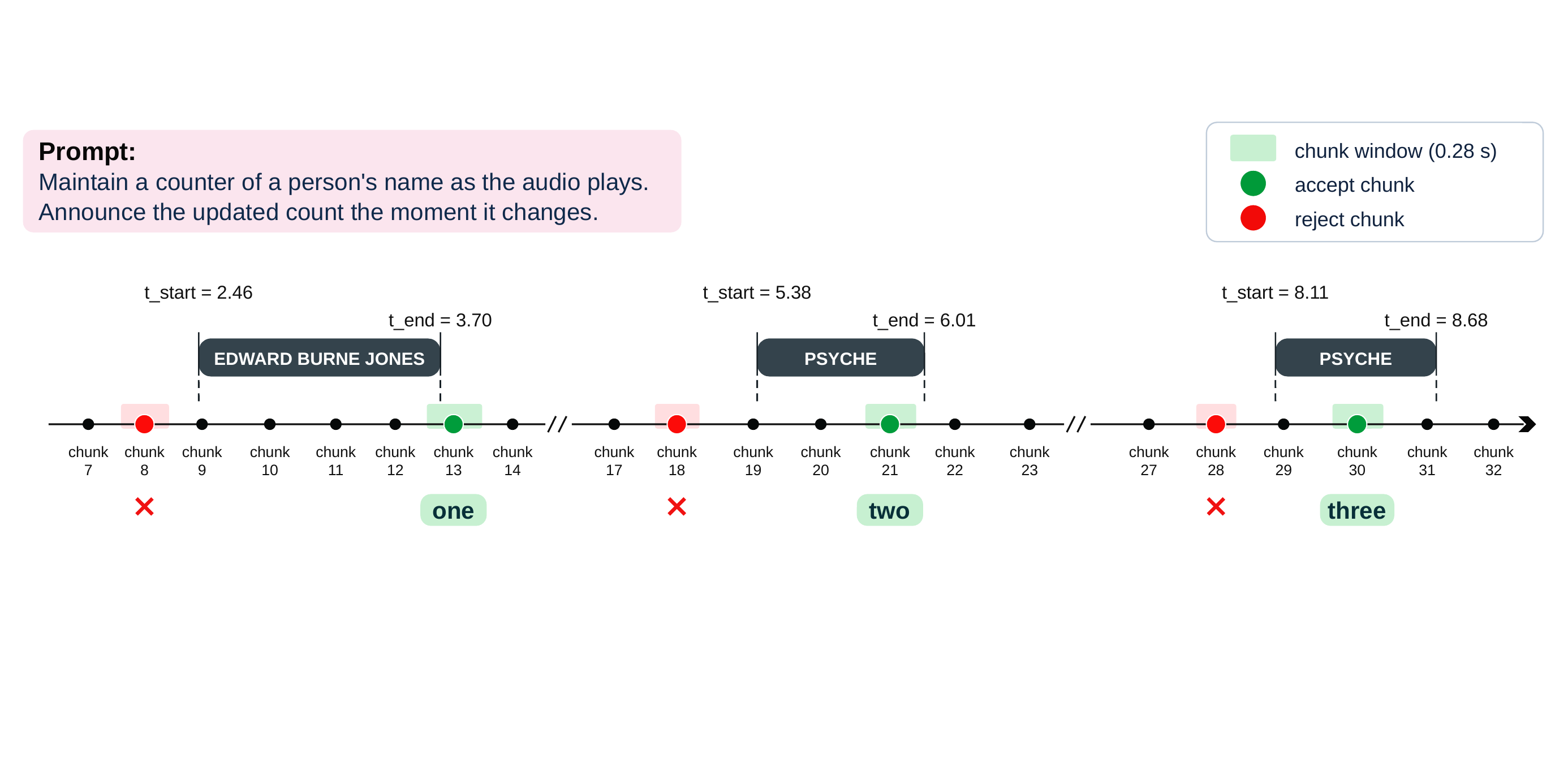
For speech LLMs to work in real-world voice agents, they need to reason over audio that is still arriving — not a neatly packaged utterance. Tsinghua University addresses this evaluation gap with LibriSpeech-Real-QA, a benchmark that tasks models with answering questions based on continuously arriving audio chunks. Tasks like counting named entities as speech streams in real-time probe capabilities that existing offline evaluations completely miss. The paper also provides baseline models and evaluation protocols to seed future work.
LibriSpeech-Real-QA: A Benchmark for Streaming Question Answering
This paper introduces LibriSpeech-Real-QA, a benchmark for evaluating speech large language models on streaming question-answering tasks where the model must answer questions based on continuously arriving audio chunks rather than waiting for complete utterances. The work addresses a critical gap in real-time speech interaction by providing evaluation protocols and baseline models for practical applications like counting named entities as speech flows in real-time.
Abstract
Most speech large language models (SLMs) still process speech in an offline manner. They only start responding after they receive the complete speech segment. However, many real-world applications require streaming speech interaction, for which the audio continuously flows in and the machine is required to answer questions based on the so far received audio chunks. For example, a user may ask the system to continuously count how many times a person's name has been mentioned while they are speaking. We observe a lack of benchmarks and evaluation protocols for real-time speech interaction. Motivated by this, we propose LibriSpeech-Real-QA, a dataset and a benchmark for real-time speech interaction. We construct different types of real-time question-answer pairs from LibriSpeech to evaluate whether speech LLMs can identify target words in streaming audio. We evaluate several popular real-time commercial models and find that they still tend to respond only after the speech turn has finished. We demonstrate that we can enable a pretrained SLM to perform this task, where we explore several modeling designs and establish a solid baseline for future research.
On the transcription side, Netease Youdao's Confucius4-R2T2 tackles the instability that plagues most streaming ASR systems — the tendency to revise earlier output as more audio arrives, which breaks downstream components like voice agents and live translators. The key theoretical contribution is Longest Stable Prefix (LSP), a framework that converts any full-context ASR model into a streaming system without architectural changes, guaranteeing that previously emitted tokens are never revised while maintaining competitive accuracy and low latency.

Confucius4-R2T2: A Stable-Prefix Streaming ASR Model for Real Real-Time Transcription
Confucius4-R2T2 introduces a streaming ASR model that guarantees stable output—never revising earlier transcribed tokens—while maintaining competitive accuracy and low latency. The key innovation is Longest Stable Prefix (LSP), a theoretical framework that converts any full-context ASR model into a streaming system without architectural changes, enabling practical deployment in real-time applications like voice agents and translators.
Abstract
Streaming speech recognition is increasingly consumed by machines, such as translators and voice agents, that act on each token as it appears. A token that is later revised costs wasted work or a wrong action. In this work, we present Confucius4-R2T2 (short for Real Real-Time Transcription), a stable-prefix streaming ASR model that never modifies its earlier output while maintaining high accuracy and low latency. R2T2 is obtained by post-training Qwen3-ASR-1.7B on 1,500 hours of Chinese and English audio while freezing its pre-trained audio encoder and projector. The adaptation is based on the concept of Longest Stable Prefix (LSP), a new notion that we introduce in this work. We prove that LSP is monotone under the prefix order, consistent with the full-audio output, and maximal among labels that equal a whole earlier output. Learning from LSP labels converts a full-context model into a stable-prefix streaming one without any architectural change. Extensive evaluations show that R2T2 brings streaming recognition close to the base model's full-context quality while delivering stable text with low emission lag. Its gains extend beyond the post-training languages, demonstrating a practical path from full-context ASR to stable streaming. We open-source the model weights and code at https://huggingface.co/netease-youdao/Confucius4-R2T2 and https://github.com/netease-youdao/Confucius4-R2T2.
TTS & Voice Synthesis
Fine-grained pronunciation control for scripts where reading ambiguity is structural.
Japanese TTS faces a challenge largely absent in alphabetic languages: the same logographic character can have multiple valid readings (polyphony), and raw orthographic text gives the model no hint which is intended. Independent researchers tackle this with Ruby-OPD, combining Ruby text representations (inline phonetic annotations) with on-policy distillation in a flow-matching TTS framework. The result is fine-grained pronunciation controllability alongside improved naturalness on raw text — and notably, the distillation approach requires no paired speech data.

Ruby-OPD: Enhancing Pronunciation Controllability and Accuracy for Flow-Matching Text-to-Speech via On-Policy Distillation
This paper proposes a flow-matching TTS approach that balances pronunciation accuracy with naturalness for Japanese, where unsegmented logographic-phonographic text creates polyphony challenges. It introduces Ruby text representations and on-policy distillation to enable fine-grained pronunciation control while improving performance on raw orthographic text without requiring paired speech data.
Abstract
Achieving both high pronunciation accuracy and fine-grained controllability remains a central challenge in Japanese text-to-speech (TTS), as Japanese is an unsegmented language mixing logographic Kanji and phonographic Kana with extensive polyphony. Traditional cascaded systems convert text into phoneme sequences via a front-end, ensuring pronunciation control but discarding lexical semantics and prosodic cues in surface orthography. Conversely, recent zero-shot TTS models directly consume raw orthographic text to improve naturalness, yet suffer from polyphone errors and lack explicit pronunciation control. To bridge this gap, we propose a two-stage framework for flow-matching TTS. First, we investigate Ruby text representations with orthography perturbation to jointly preserve surface forms and target pronunciations for reliable control. Second, we introduce On-Policy Distillation (OPD) on large-scale text-only corpora to enhance pronunciation accuracy on raw orthographic text without paired speech. On the Joyo-Kanji-Yomi benchmark, our model achieves 97.13% Accuracy, 2.02% Target PER, 0.70% Sentence PER, and 4.21% Sentence CER under raw text while retaining strong controllability.
Trending on Hugging Face
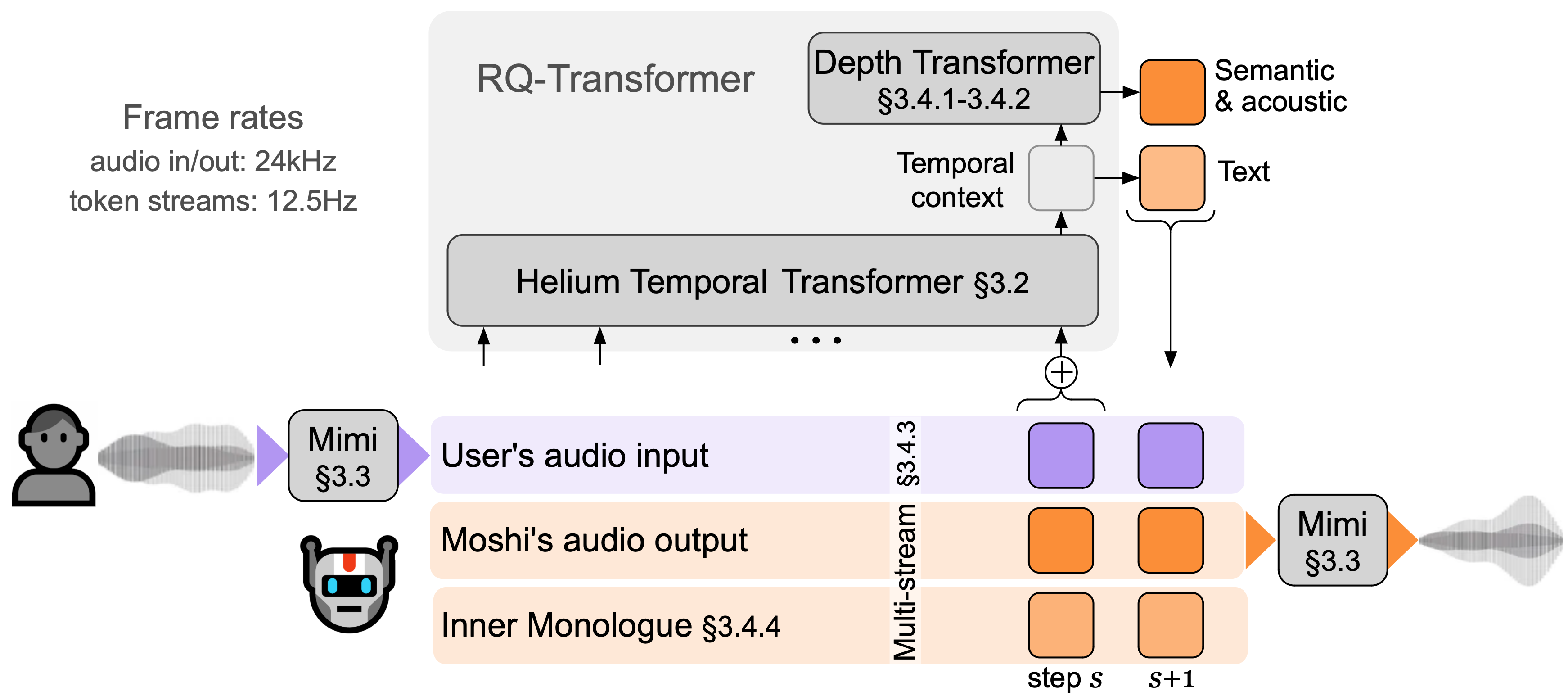
Moshi: a speech-text foundation model for real-time dialogue
A speech-text foundation model for real-time dialogue via end-to-end speech-to-speech generation instead of cascaded components. By jointly modeling overlapping audio streams with text-token prediction, it achieves 200ms latency while preserving emotion and handling natural conversational dynamics like interruptions.

OmniFlatten: An End-to-end GPT Model for Seamless Voice Conversation
A novel GPT-based model, OmniFlatten, enables real-time natural full-duplex spoken dialogue through a multi-stage post-training technique that integrates speech and text without altering the original model's architecture.

Qwen3-TTS Technical Report
The Qwen3-TTS series presents advanced multilingual text-to-speech models with voice cloning and controllable speech generation capabilities, utilizing dual-track LM architecture and specialized speech tokenizers for efficient streaming synthesis.

Fish Audio S2 Technical Report
Fish Audio S2 is an open-source text-to-speech system with multi-speaker capabilities, multi-turn generation, and instruction-following control through natural-language descriptions, utilizing a multi-stage training approach and production-ready inference engine.