
Real-Time Speech: Lip Sync, Accent Conversion, and Low-Latency Dialogue
Today's digest covers real-time advances across the speech pipeline: emotion-aware universal lip sync, timing-precise accent conversion for dubbing, latency-masking turn-taking for voice agents, and a stable-prefix streaming ASR model.
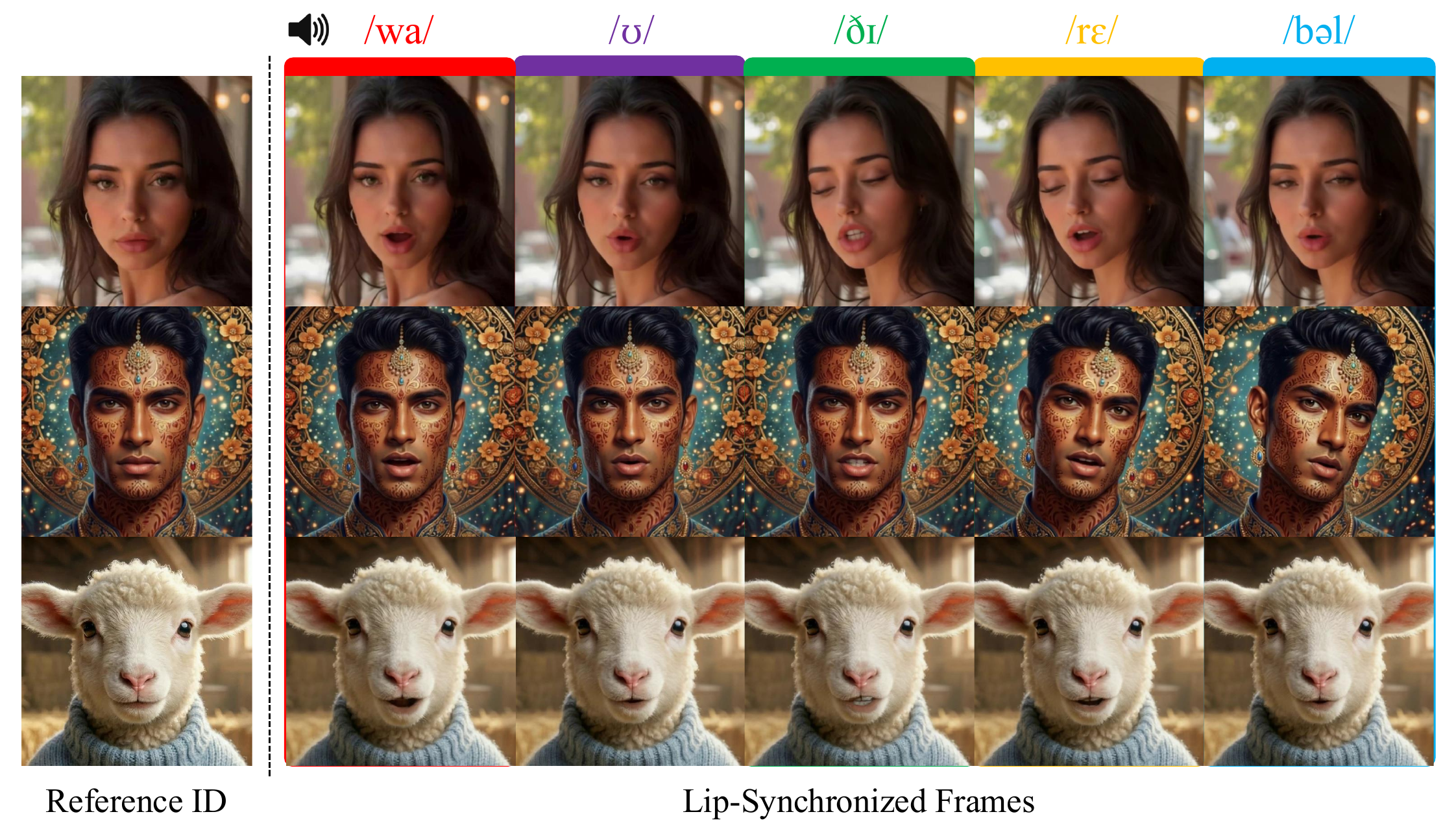
We present an universal model that generates lip-synchronized video on stylistic humans and characters corresponding to driving audio sequences. Our method ensures computational efficiency without sacrificing high visual fidelity. From Research Collective.
Today's papers share a common thread: real-time performance across the speech and avatar stack. From lip-syncing stylized characters to shaving imperceptible milliseconds off dialogue response latency, the field is pushing hard on the boundary between offline quality and live deployment.
Talking Avatars & Lip Sync
Generalization beyond photorealistic humans, with explicit emotional control.
Lip-sync systems have historically been tuned to photorealistic human faces, leaving stylized characters and non-human entities behind. Emo-LiveSync changes that by distilling audio-to-motion mappings through a warp-based portrait animation model — keeping computational costs low enough for real-time operation while maintaining high visual fidelity. Crucially, it also introduces explicit emotional expression control, so content creators aren't stuck with a neutral talking head. The generalization to stylized and non-human subjects opens the door to animated series, virtual mascots, and games.
Emo-LiveSync: Real-Time Universal Lip Synchronization with Explicit Emotion Control
Emo-LiveSync achieves real-time lip-synchronization by distilling audio-to-motion mappings through a warp-based portrait animation model, combining computational efficiency with high visual fidelity. Unlike prior work limited to photorealistic humans, it generalizes to stylized characters and non-human entities while introducing explicit emotional expression control for content enrichment.
Abstract
Lip synchronization, the task of generating realistic lip movements synchronized with audio signals, is fundamental to applications such as film dubbing, virtual avatars, and digital content creation. Recent GAN-based methods offer computational efficiency but often lack visual fidelity, while diffusion-based approaches achieve high-quality results at the cost of substantial computational overhead. Moreover, most existing methods are limited to photo-realistic human faces, restricting their applicability to stylized characters and non-human entities. In this paper, we propose an efficient universal lip-sync video generation framework that achieves high-quality results without compromising computational efficiency. We build on LivePortrait, a warp-based portrait animation model, and introduce a training strategy that aligns audio signals to an implicit motion space by distilling knowledge from a pre-trained video-to-motion model. This enables real-time inference while maintaining high visual fidelity, and naturally generalizes to diverse stylistic characters beyond photo-realistic humans. Furthermore, we introduce an expressive control gate that enables explicit manipulation of emotional expressions for content enrichment. Extensive experiments demonstrate that our method achieves state-of-the-art performance in both visual quality and lip-sync accuracy while ensuring real-time inference.
Voice Conversion & Dubbing
Frame-level timing alignment for accent conversion that actually works in dubbing pipelines.
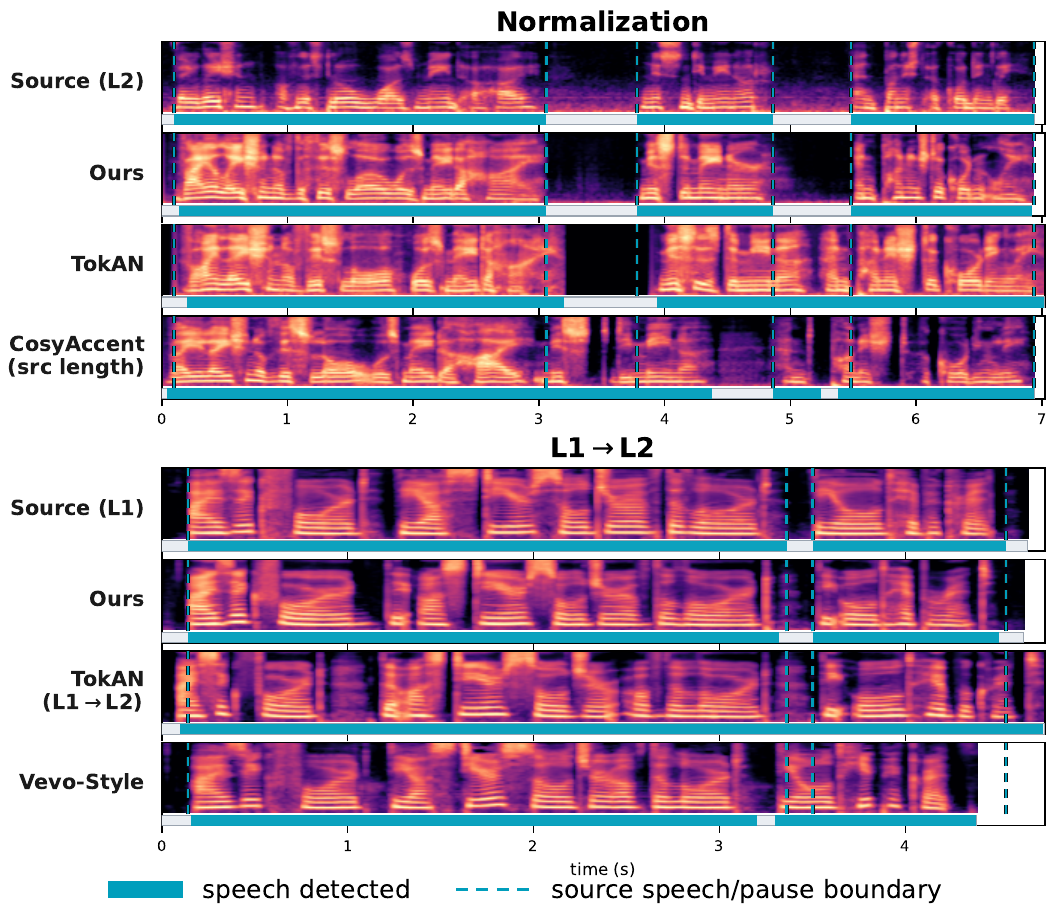
Accent conversion in dubbing is notoriously hard: you need to change the accent without altering content, speaker identity, or timing — and timing errors are immediately perceptible to viewers. AccentCanvas from KAIST tackles this with frame-level speech activity guidance and discrete diffusion, enabling fine-grained local alignment between source and target utterances. Unusually, it handles both directions: native accent normalization (L2 → L1) and non-native accent transfer (L1 → L2), making it broadly useful for localization workflows.
AccentCanvas: Activity-Guided Bidirectional Accent Conversion
AccentCanvas converts speech to target accents while preserving content, voice, and precise timing—crucial for dubbing. Unlike prior normalization approaches, it uses frame-level speech activity guidance and discrete diffusion to achieve fine-grained local timing alignment between source and target, enabling both native accent normalization and non-native L1-to-L2 conversion.
Abstract
Accent conversion for dubbing must change pronunciation while preserving content, voice, and source timing. Normalization alone cannot produce requested non-native accents, and matching total duration does not ensure local speech/pause alignment. We present AccentCanvas, a shared discrete diffusion model for normalization and L1-to-L2 conversion, trained on cross-paired shared-prompt recordings and synthetic pairs. Frame-level speech activity and repetition-preserving units guide local timing through synthesis. Across both tasks, AccentCanvas achieves the highest accent conversion performance (Accent Arrival) and mean listener-rated accent similarity among compared systems, with over 73% lower speech-boundary error than the best baseline for each task. These gains accompany higher L1-to-L2 WER than TokAN and Vevo-Style, highlighting a tradeoff between requested-accent resemblance and ASR-based content recognition. https://smokedindia.github.io/accentcanvas/
Spoken Dialogue & Voice Agents
Masking generation latency and streaming transcription without architectural surgery.
The last mile of a voice agent's perceived responsiveness comes down to two things: how fast it starts transcribing and how quickly it responds after a user stops speaking. Two papers today attack both ends of that problem.
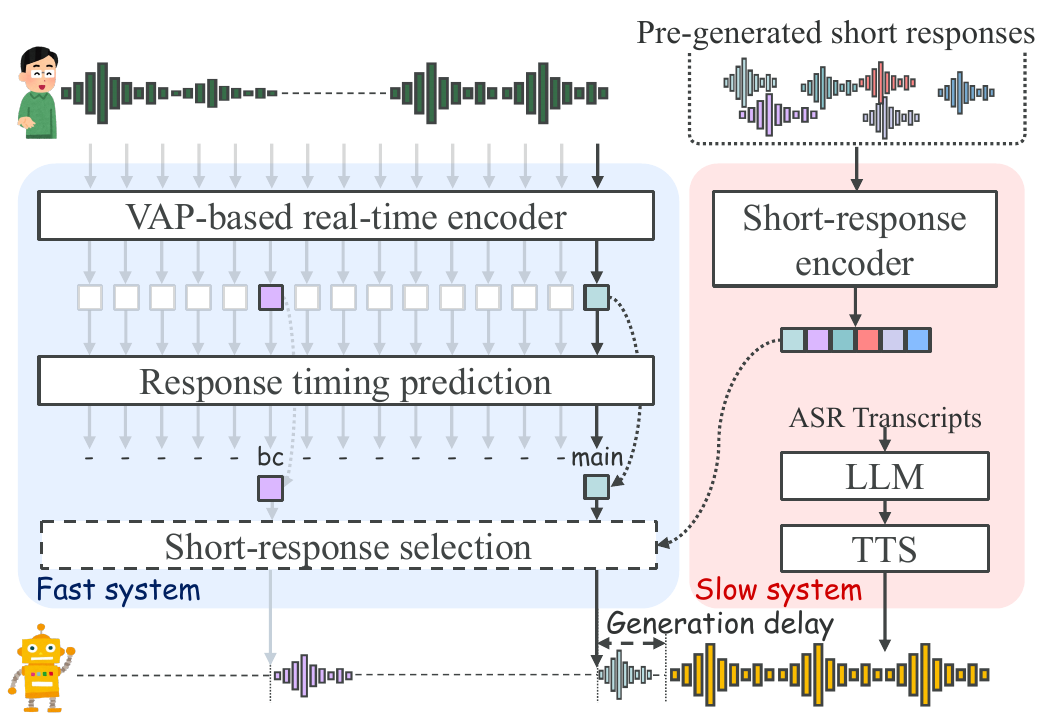
Natural turn-taking in spoken dialogue systems is undermined by the cumulative latency of LLM generation and TTS synthesis — users experience an awkward pause before the agent speaks. Nara Institute of Science and Technology's real-time short-response selection system sidesteps this by using contrastive learning to map dialogue context onto brief, pre-generated filler responses that play while the main response is still being synthesized. The key design choice: no changes to existing turn-taking models are required, making this a drop-in latency mask for current pipelines.
Real-Time Short-Response Selection for Spoken Dialogue Systems
This work addresses natural turn-taking in spoken dialogue systems by proposing a real-time short-response selection mechanism that masks delays from language generation and speech synthesis. Using contrastive learning, the system maps dialogue context to brief pre-generated responses that play while the main response is being synthesized, eliminating perceptible latency without requiring changes to existing turn-taking models.
Abstract
To realize spoken dialogue systems that can interact naturally with users, it is important for the system to respond to user utterances at appropriate timings. To achieve such natural turn-taking, the system needs not only to predict appropriate response timings but also to mask delays caused by language generation and speech synthesis so that they are not perceived by the user. We propose a real-time short-response selection task that can be integrated with existing turn-taking models to mask generation delay. To address this task, the proposed model learns the mapping between dialogue context and short responses using contrastive learning. When a turn-taking event is detected, the system selects a response from a set of pre-generated candidates. The selected response is played while the main response is being generated. Experimental results show that the proposed method learns to select short responses based on dialogue context, outperforming random and LLM-based baselines. Moreover, integrating response selection maintained turn-taking prediction performance and added minimal processing overhead.
Trending on Hugging Face today, Netease Youdao's Confucius4-R2T2 addresses streaming ASR accuracy degradation head-on. Standard streaming models degrade versus full-context models because they can't see future tokens; Confucius4-R2T2 reframes this by post-training on longest stable prefix labels — the longest prefix of the transcript that won't change as more audio arrives. No architectural changes are needed, yet the model achieves near full-context accuracy at low latency, which is exactly what real-time transcription pipelines need.

Confucius4-R2T2: A Stable-Prefix Streaming ASR Model for Real Real-Time Transcription
A stable-prefix streaming speech recognition model achieves near full-context accuracy with low latency by post-training on longest stable prefix labels without architectural changes.
Abstract
Streaming speech recognition is increasingly consumed by machines, such as translators and voice agents, that act on each token as it appears. A token that is later revised costs wasted work or a wrong action. In this work, we present Confucius4-R2T2 (short for Real Real-Time Transcription), a stable-prefix streaming ASR model that never modifies its earlier output while maintaining high accuracy and low latency. R2T2 is obtained by post-training Qwen3-ASR-1.7B on 1,500 hours of Chinese and English audio while freezing its pre-trained audio encoder and projector. The adaptation is based on the concept of Longest Stable Prefix (LSP), a new notion that we introduce in this work. We prove that LSP is monotone under the prefix order, consistent with the full-audio output, and maximal among labels that equal a whole earlier output. Learning from LSP labels converts a full-context model into a stable-prefix streaming one without any architectural change. Extensive evaluations show that R2T2 brings streaming recognition close to the base model's full-context quality while delivering stable text with low emission lag. Its gains extend beyond the post-training languages, demonstrating a practical path from full-context ASR to stable streaming. We open-source the model weights and code at https://huggingface.co/netease-youdao/Confucius4-R2T2 and https://github.com/netease-youdao/Confucius4-R2T2.
Trending on Hugging Face

OmniFlatten: An End-to-end GPT Model for Seamless Voice Conversation
A novel GPT-based model, OmniFlatten, enables real-time natural full-duplex spoken dialogue through a multi-stage post-training technique that integrates speech and text without altering the original model's architecture.

Qwen3-TTS Technical Report
The Qwen3-TTS series presents advanced multilingual text-to-speech models with voice cloning and controllable speech generation capabilities, utilizing dual-track LM architecture and specialized speech tokenizers for efficient streaming synthesis.

Fish Audio S2 Technical Report
Fish Audio S2 is an open-source text-to-speech system with multi-speaker capabilities, multi-turn generation, and instruction-following control through natural-language descriptions, utilizing a multi-stage training approach and production-ready inference engine.

IndexTTS: An Industrial-Level Controllable and Efficient Zero-Shot Text-To-Speech System
IndexTTS, an enhanced text-to-speech system combining XTTS and Tortoise models, offers improved naturalness, enhanced voice cloning, and controllable usage through hybrid character-pinyin modeling and optimized vector quantization.