
LLaMA-Omni
LLaMA-Omni: Seamless Speech Interaction with Large Language Models

LLaMA-Omni enables real-time, low-latency speech interaction with open-source LLMs by generating text and speech responses simultaneously from speech input, bypassing typical ASR and TTS steps. It delivers natural spoken dialogue with minimal delay and better quality than prior models.
Links
Paper & demos
Code & resources
Abstract
Models like GPT-4o enable real-time interaction with large language models (LLMs) through speech, significantly enhancing user experience compared to traditional text-based interaction. However, there is still a lack of exploration on how to build speech interaction models based on open-source LLMs. To address this, we propose LLaMA-Omni, a novel model architecture designed for low-latency and high-quality speech interaction with LLMs. LLaMA-Omni integrates a pretrained speech encoder, a speech adaptor, an LLM, and a streaming speech decoder. It eliminates the need for speech transcription, and can simultaneously generate text and speech responses directly from speech instructions with extremely low latency. We build our model based on the latest Llama-3.1-8B-Instruct model. To align the model with speech interaction scenarios, we construct a dataset named InstructS2S-200K, which includes 200K speech instructions and corresponding speech responses. Experimental results show that compared to previous speech-language models, LLaMA-Omni provides better responses in both content and style, with a response latency as low as 226ms. Additionally, training LLaMA-Omni takes less than 3 days on just 4 GPUs, paving the way for the efficient development of speech-language models in the future.
Overview
LLaMA-Omni is an end-to-end speech-interaction architecture for open-source LLMs that aims to match the low-latency conversational behavior of systems such as GPT-4o while preserving strong response quality. The central idea is to let an LLM consume a speech instruction directly, generate a text response autoregressively, and simultaneously generate the corresponding speech units with a streaming decoder, rather than using a conventional ASR-to-LLM-to-TTS cascade.
The paper argues that cascaded ASR/TTS systems incur avoidable latency because they must first transcribe the user speech, then generate text, and only then synthesize speech. Prior speech-language models can remove the transcription step, but many either rely on sequential generation of text and speech or require much larger-scale training. LLaMA-Omni is designed to address both issues: it uses a pretrained speech encoder, a lightweight speech adaptor, a strong open-source LLM, and a non-autoregressive streaming speech decoder trained with CTC.

The paper’s main claimed contributions are:
- an end-to-end architecture for simultaneous text and speech response generation from speech input;
- a streaming speech decoder trained with CTC so the model does not need explicit speech-text pre-alignment;
- a speech-instruction dataset, InstructS2S-200K, tailored to speech interaction style rather than text-chat style;
- strong latency/quality trade-offs on a new benchmark, including a reported minimum latency of 236 ms in streaming mode.
Model architecture
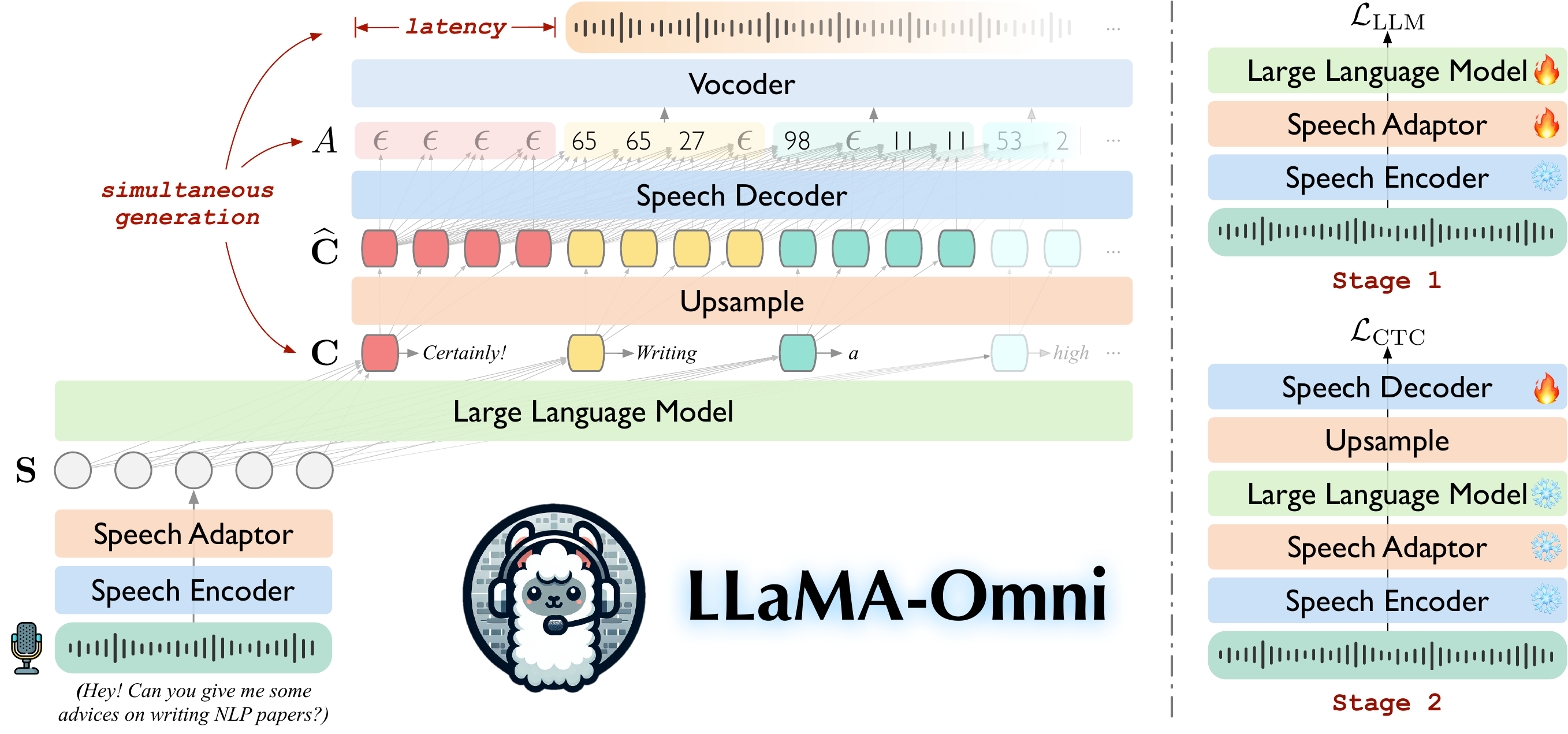
LLaMA-Omni decomposes the problem into four modules:
- Speech encoder $mathcal{E}$: the encoder from Whisper-large-v3, frozen during training;
- Speech adaptor $mathcal{A}$: a trainable adapter that downsamples the speech representation and maps it to the LLM embedding space;
- LLM $mathcal{M}$: Llama-3.1-8B-Instruct, used to generate the text response;
- Streaming speech decoder $mathcal{D}$: a causal, non-autoregressive Transformer stack that predicts discrete speech units from the LLM hidden states using CTC.
Note: the strange symbol here is just a rendering safeguard in the draft; the actual math below is written in standard KaTeX-safe notation.
Let the user’s speech instruction be $X^S$, the text response be $Y^T$, and the speech response be $Y^S$. The speech encoder produces a sequence of hidden states
$$ \mathbf{H} = \mathcal{E}(X^S) = [\mathbf{h}_1, \ldots, \mathbf{h}_N]. $$
The adaptor first downsamples by concatenating every $k$ consecutive frames, and then applies a 2-layer MLP with ReLU:
$$ \mathbf{S} = \mathcal{A}(\mathbf{H}) = \operatorname{Linear}(\operatorname{ReLU}(\operatorname{Linear}(\operatorname{DownSample}(\mathbf{H})))). $$
The adapted speech representation is inserted into the prompt at the speech placeholder and passed to the LLM, which is trained with a standard autoregressive cross-entropy objective:
$$
\mathcal{L}_{\text{text}} = -\sum_{i=1}^{M} \log p\bigl(y_i^T \mid \mathcal{P}(\mathbf{S}), Y^T_{ For speech generation, the paper first converts the target waveform to discrete units using HuBERT features and K-means clustering. Consecutive identical unit indices are merged, yielding $Y^U = [y_1^U, \ldots, y_L^U]$ with $y_i^U \in \{0, \ldots, K-1\}$. A unit-based HiFi-GAN vocoder with a duration predictor then synthesizes waveforms from those units. The speech decoder takes the LLM’s text-side hidden states $\mathbf{C} = [\mathbf{c}_1, \ldots, \mathbf{c}_M]$, upsamples each state by a factor $\lambda$ into $\widehat{\mathbf{C}}$, and predicts a longer sequence of unit emissions. The model uses CTC with a blank symbol $\epsilon$ to align the decoder output to the unit sequence. If $A$ is an alignment and $\beta(A)$ collapses repeated symbols and blanks, then training minimizes $$
\mathcal{L}_{\text{CTC}} = -\log \sum_{A \in \beta^{-1}(Y^U)} \prod_{i=1}^{\lambda M} p(a_i \mid \mathbf{O}),
$$ where $\mathbf{O}$ is the decoder output and $\beta^{-1}(Y^U)$ denotes all alignments that collapse to the target unit sequence. This is the key mechanism that lets the model generate speech units in a non-autoregressive, streaming fashion while the LLM is still producing text. The concrete configuration reported in the paper is: The paper uses a strict two-stage training strategy: Optimization details reported by the authors: At inference time, the LLM generates text tokens autoregressively. As each token is produced, the corresponding hidden state is upsampled and fed to the causal speech decoder. Because the decoder is non-autoregressive, the discrete-unit alignment for a chunk can be produced in parallel. Once the number of new units reaches a chunk threshold $\Omega$, the model immediately sends that unit segment to the vocoder and begins playing the speech output. This design has two important consequences: The paper emphasizes that the decoding speed for text+speech generation is close to text-only decoding because the speech side is generated in parallel inside the non-autoregressive chunk. The paper’s dataset construction is important because the authors argue that ordinary text instruction data does not match speech interaction well. The resulting dataset, InstructS2S-200K, contains 200K triplets of speech instruction, text response, speech response. The pipeline has three steps: The dataset is built from about 50K Alpaca instructions and about 150K UltraChat instructions. For UltraChat, the paper keeps only the first 150K entries and only the first-round instruction from each conversation. The resulting dataset statistics are:
So the dataset comprises about 1,476 hours of synthesized speech in total, with responses substantially longer than instructions, which is consistent with the speech-response setting. The authors evaluate the model on a new benchmark, InstructS2S-Eval, constructed from the helpful_base and vicuna subsets of Alpaca-Eval. They remove math and code questions and end up with 199 instructions, which are then synthesized into speech using CosyVoice-300M-SFT. The paper defines two tasks: For S2SIF, the authors consider both: Decoding is done with greedy search for reproducibility. The evaluation metrics are: The baselines are: For streaming TTS baselines, the paper controls latency by triggering synthesis after a word chunk size $\Theta$ new words arrives. For LLaMA-Omni, latency is controlled by the unit chunk size $\Omega$. The paper reports that LLaMA-Omni is best on the main quality metrics in the offline setting, especially on ChatGPT Score and UTMOS. It is also the most balanced model in the sense that the gap between S2TIF and S2SIF is not as severe as for SpeechGPT. Offline results on InstructS2S-Eval The paper’s interpretation of these results is: The paper explicitly notes that the S2SIF scores are generally lower than the S2TIF scores because speech synthesis errors and ASR-based evaluation both make the task harder. Even so, LLaMA-Omni is reported to outperform the prior speech-language models in both content and style. The streaming experiments are one of the paper’s most important contributions because they show that LLaMA-Omni can begin speaking before the full response is complete. The model keeps speech generation tightly coupled to the LLM token stream, and latency is controlled by the unit chunk size $\Omega$. The key pattern is a clean latency-quality trade-off: The authors also observe that at low chunk sizes, speech is split into more segments, which can reduce continuity and naturalness. This explains why UTMOS is lower at smaller $\Omega$, even though the latency is best. SpeechGPT SALMONN + Orca Qwen2-Audio + Orca These tables make the paper’s main streaming conclusion very clear: The paper highlights that the end-to-end design preserves rhythm and prosody better than a streaming cascade because only the vocoder is cascaded; the speech-unit generation itself remains inside the model. To complement the automatic metrics, the authors run a side-by-side human evaluation. They compare LLaMA-Omni at $\Omega = 40$ and latency 347 ms against SALMONN + Orca at $\Theta = 3$ and latency 352 ms, and against Qwen2-Audio + Orca at $\Theta = 3$ and latency 420 ms. They sample 20 speech instructions, collect outputs from the compared systems, and ask 5 participants to vote on helpfulness and naturalness with win/tie/lose judgments. The paper reports that LLaMA-Omni achieves a higher win rate than the cascade baselines on both dimensions, supporting the claim that its responses are better aligned with human preferences in real-time speech interaction. The appendix includes a case study on the instruction “How do I wrap a present neatly?”. The qualitative comparison reinforces the numerical findings: The paper does not include a formal limitations section, but it does acknowledge a few concrete constraints and future directions: In other words, the paper’s own evidence suggests that LLaMA-Omni already reaches a strong quality/latency compromise, but better speech training data and more expressive vocoding remain open directions. LLaMA-Omni shows that a relatively efficient training recipe can turn a modern open-source LLM into a real-time speech-interaction model without relying on ASR transcription. The key design choices are: a frozen Whisper encoder for speech understanding, a lightweight adaptor, a strong Llama-3.1-8B-Instruct backbone, and a CTC-based streaming decoder that predicts speech units in parallel with text generation. On the paper’s benchmark, this combination yields the best reported ChatGPT Scores, the best UTMOS, and a very low streaming latency of 236 ms, while keeping the training cost low enough to be practical on 4 GPUs. The LLaMA-Omni repository provides the implementation of the speech-language model described in the paper. It builds upon the Llama-3.1-8B-Instruct model and enhances it by integrating components for low-latency, high-quality speech interaction. The core code is organized under the Inference and prediction are facilitated by the The README provides detailed setup and quick-start instructions, including model and vocoder downloading, and launching a Gradio demo interface to interact with LLaMA-Omni.
Two-stage training
Inference and streaming synthesis
Construction of InstructS2S-200K
Statistic Value Speech instruction duration 418 h Speech response duration 1058 h Average speech instruction duration 7.5 s Average speech response duration 19.0 s Average text instruction length 21.7 Average text response length 39.5 Average unit sequence length 553.6 Experimental setup
Offline results
Model
S2TIF ChatGPT Score
S2SIF ChatGPT Score
Δ
ASR-WER
UTMOS
SpeechGPT 2.98 2.19 0.79 45.00 3.8958 SALMONN + Orca 3.44 3.40 0.04 3.78 3.8286 Qwen2-Audio + Orca 3.47 3.38 0.09 6.77 3.6119 LLaMA-Omni 3.99 3.47 0.52 10.82 3.9296
Streaming results and latency-quality trade-offs
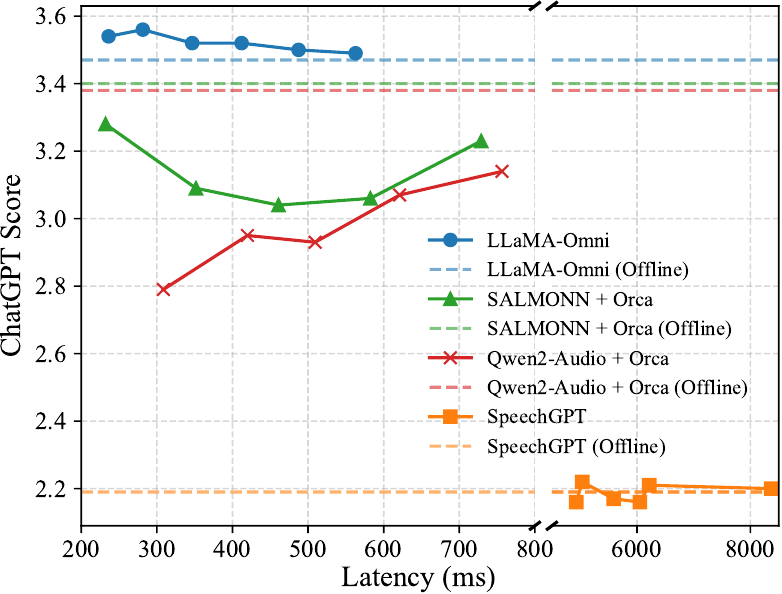
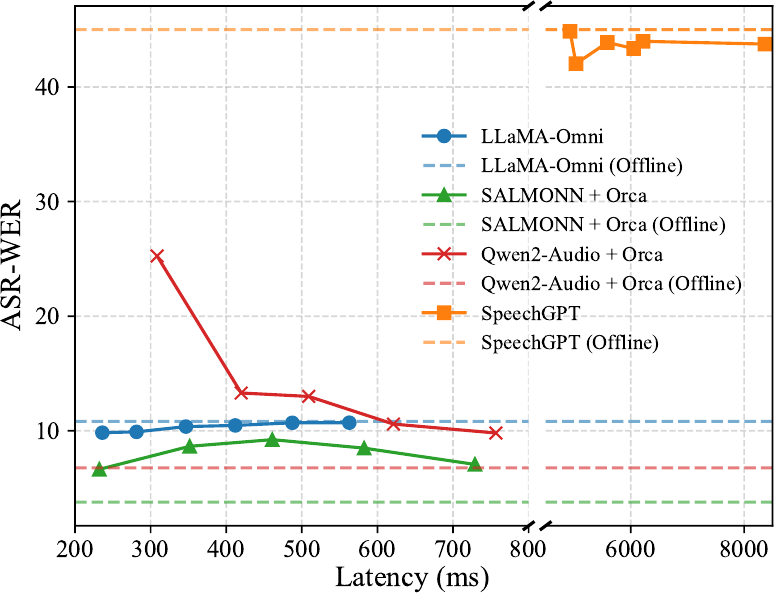
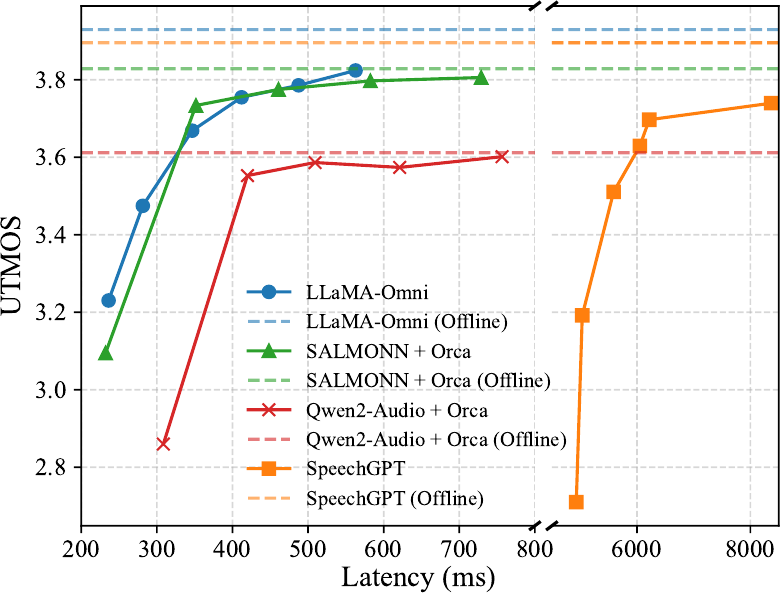
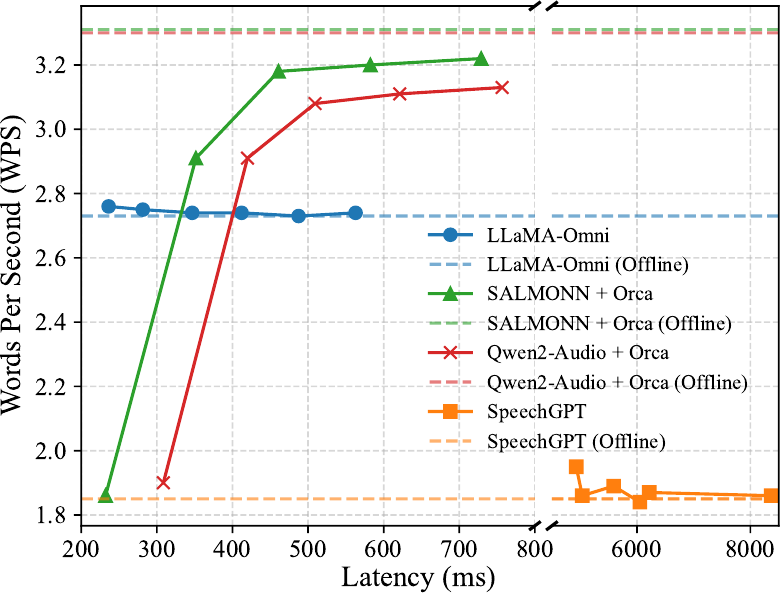
LLaMA-Omni streaming table
$\Omega$
LLM latency (ms)
Vocoder latency (ms)
Total latency (ms)
ChatGPT Score
ASR-WER
UTMOS
WPS
10 206.03 30.15 236.18 3.54 9.84 3.2304 2.76 20 236.18 45.23 281.41 3.56 9.91 3.4748 2.75 40 301.51 45.23 346.73 3.52 10.37 3.6688 2.74 60 361.81 50.25 412.06 3.52 10.47 3.7549 2.74 80 432.16 55.28 487.44 3.50 10.70 3.7858 2.73 100 497.49 65.33 562.81 3.49 10.71 3.8242 2.74 Offline 1542.71 211.06 1753.77 3.47 10.82 3.9296 2.73
Baseline streaming tables
$\Omega$ LLM latency (ms) Vocoder latency (ms) Total latency (ms) ChatGPT Score ASR-WER UTMOS WPS
10 4899.50 30.15 4929.65 2.16 44.85 2.7099 1.95 20 5005.03 30.15 5035.18 2.22 42.03 3.1920 1.86 40 5547.74 40.20 5587.94 2.17 43.88 3.5106 1.89 60 6005.03 45.23 6050.25 2.16 43.35 3.6293 1.84 80 6160.80 55.28 6216.08 2.21 43.98 3.6970 1.87 100 8301.51 65.33 8366.83 2.20 43.74 3.7397 1.86 Offline 17919.60 170.85 18090.45 2.19 45.00 3.8958 1.85
$\Theta$ LLM latency (ms) TTS latency (ms) Total latency (ms) ChatGPT Score ASR-WER UTMOS WPS
1 212.45 19.71 232.16 3.28 6.64 3.0947 1.86 3 316.59 35.08 351.67 3.09 8.65 3.7338 2.91 5 428.79 32.08 460.87 3.04 9.23 3.7750 3.18 7 536.47 45.90 582.37 3.06 8.49 3.7972 3.20 9 659.57 69.38 728.95 3.23 7.07 3.8060 3.22 Offline 4274.48 1049.59 5324.07 3.40 3.78 3.8286 3.31
$\Theta$ LLM latency (ms) TTS latency (ms) Total latency (ms) ChatGPT Score ASR-WER UTMOS WPS
1 289.46 19.15 308.61 2.79 25.25 2.8597 1.90 3 381.66 38.19 419.85 2.95 13.30 3.5529 2.91 5 470.55 38.64 509.19 2.93 13.00 3.5865 3.08 7 568.22 52.95 621.17 3.07 10.59 3.5739 3.11 9 675.55 81.02 756.57 3.14 9.81 3.6016 3.13 Offline 7062.93 2361.49 9424.42 3.38 6.77 3.6119 3.30
Human evaluation
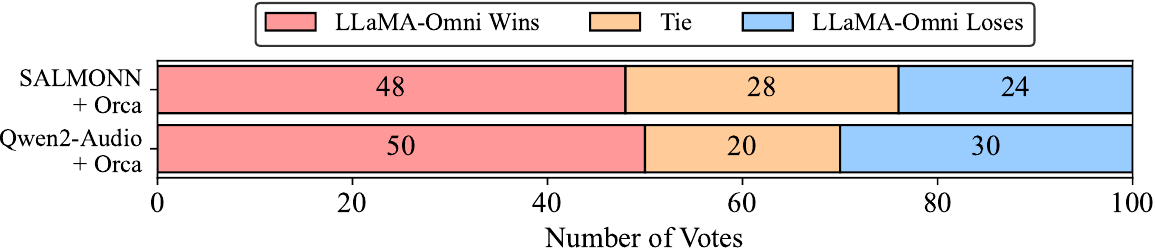
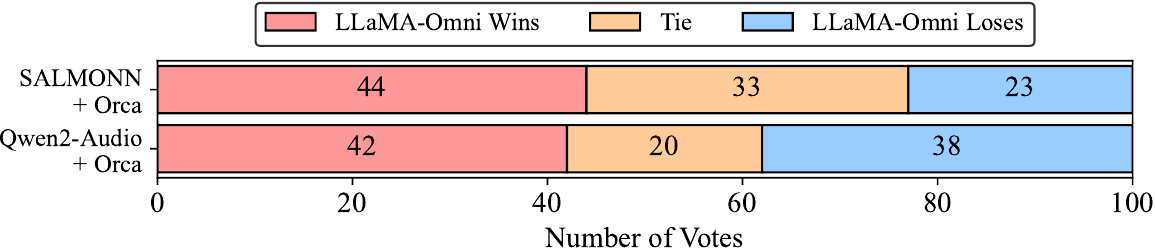
Qualitative case study
Stated limitations and future work
Takeaway
Code & Implementation
omni_speech package, which includes modules for model building, inference, speech encoding, and serving. The key model loading and setup logic is in omni_speech/model/builder.py, where the pretrained OmniSpeech model is loaded, incorporating a speech encoder alongside the language model.predict.py script. It demonstrates loading the model and vocoder, processing input speech, generating textual and speech responses simultaneously, and decoding outputs. This matches the paper's described pipeline of speech instruction input and synchronous text and speech response generation.