
VASA-3D
VASA-3D: Lifelike Audio-Driven Gaussian Head Avatars from a Single Image

VASA-3D generates lifelike, audio-driven 3D head avatars from a single portrait image by transferring rich 2D facial motion latents into a detailed 3D Gaussian avatar. It uniquely captures subtle expressions and supports real-time, free-viewpoint animation without multi-view capture data.
Demos
These demos showcase VASA-3D's ability to generate lifelike, audio-driven 3D head avatars from a single image, emphasizing natural facial expressions and speech synchronization. When evaluating, watch for the realism and smoothness of lip movements, the coherence of emotional cues, and the overall visual fidelity of the avatars. The results highlight VASA-3D's innovation in creating high-quality, expressive avatars with minimal input data.

Links
Paper & demos
Impact
Abstract
We propose VASA-3D, an audio-driven, single-shot 3D head avatar generator. This research tackles two major challenges: capturing the subtle expression details present in real human faces, and reconstructing an intricate 3D head avatar from a single portrait image. To accurately model expression details, VASA-3D leverages the motion latent of VASA-1, a method that yields exceptional realism and vividness in 2D talking heads. A critical element of our work is translating this motion latent to 3D, which is accomplished by devising a 3D head model that is conditioned on the motion latent. Customization of this model to a single image is achieved through an optimization framework that employs numerous video frames of the reference head synthesized from the input image. The optimization takes various training losses robust to artifacts and limited pose coverage in the generated training data. Our experiment shows that VASA-3D produces realistic 3D talking heads that cannot be achieved by prior art, and it supports the online generation of 512x512 free-viewpoint videos at up to 75 FPS, facilitating more immersive engagements with lifelike 3D avatars.
Overview
VASA-3D is an audio-driven, single-shot 3D head avatar generator that turns one portrait image into a lifelike, free-viewpoint talking head. The central goal is to combine two properties that are usually hard to reconcile: highly expressive facial dynamics and true 3D view synthesis from only a single image. The paper argues that prior 3D head avatar methods are often constrained by low-capacity parametric facial motion models and by their dependence on multi-view or video capture of the reference subject. VASA-3D addresses both issues by transferring the motion latent space of VASA-1 from 2D talking-head generation into a 3D Gaussian head avatar representation, then customizing that representation from synthetic videos generated from the input portrait.
The method’s key idea is that the motion latent produced by VASA-1 contains richer facial expression information than standard low-dimensional face model parameters alone. VASA-3D therefore uses the latent both to drive coarse FLAME-based motion and to condition dense, free-form Gaussian residual deformations. This lets the avatar reproduce subtle expression nuances while remaining compatible with efficient 3D Gaussian splatting for real-time rendering. The paper reports that the resulting system can generate $512 \times 512$ free-viewpoint videos at up to $75$ FPS with a stated latency of $65$ ms on an RTX 4090.
Main Contributions
- Motion-latent-to-3D transfer: the VASA-1 motion latent is mapped into a 3D avatar control space rather than relying only on classical expression parameters.
- Single-image customization: a portrait image is expanded into synthetic multi-frame training data using VASA-1, enabling fitting of a personalized 3D head model without real multi-view capture.
- Dual deformation design: the head is controlled by a base FLAME-driven deformation plus a VASA-latent-conditioned dense Gaussian deformation for fine detail.
- Robust training on synthetic data: the paper introduces losses and regularization choices designed for the artifacts and limited pose coverage of the generated training frames.
- Real-time free-viewpoint output: the final system supports audio-driven 3D head animation with live rendering on a commodity GPU.
Method
3D Gaussian Head Representation
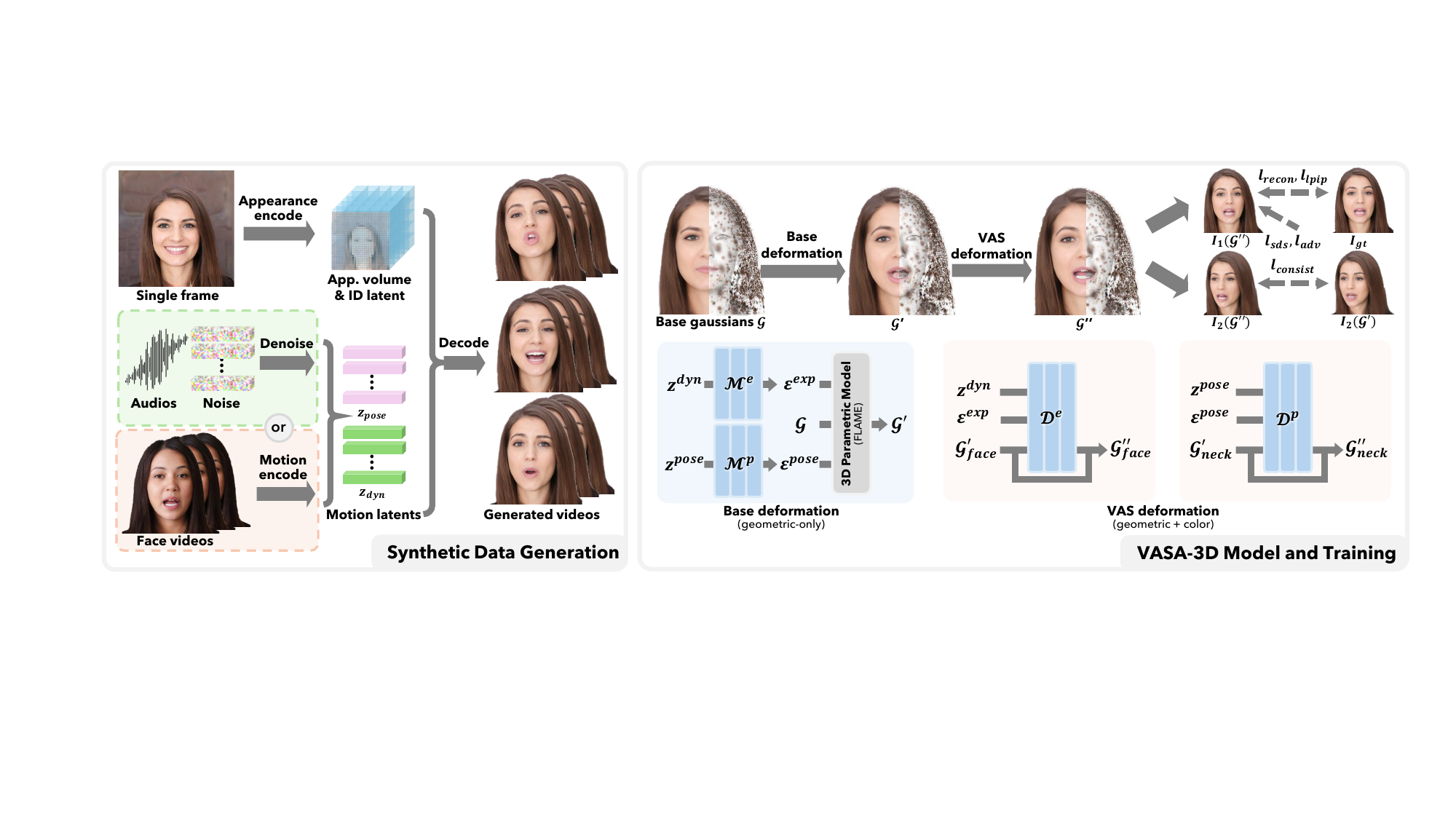
VASA-3D represents a head as a set of $N$ 3D Gaussians
$$ \mathcal{G} = \{\mathbf{g}_i = (\boldsymbol{\mu}_i, \mathbf{r}_i, \mathbf{s}_i, \mathbf{c}_i, \alpha_i)\}_{i=1}^{N}, $$
where each Gaussian stores position $\boldsymbol{\mu}_i$, rotation $\mathbf{r}_i$, scale $\mathbf{s}_i$, color $\mathbf{c}_i$, and opacity $\alpha_i$. The Gaussians are bound to a FLAME mesh, following the design used in GaussianAvatar-style rigging, so that standard facial pose and shape priors provide a stable scaffold for learning.
The model splits deformation into two parts:
- Base deformation: FLAME-driven rigid and articulated motion that moves the Gaussian scaffold.
- VAS deformation: latent-conditioned dense residuals that capture fine-grained facial and neck detail beyond the parametric FLAME motion space.
Base Deformation: Mapping VASA Motion Latents to FLAME
The VASA-1 latent is written as $\mathbf{x} = [\mathbf{z}^{dyn}, \mathbf{z}^{pose}]$, where $\mathbf{z}^{dyn}$ encodes facial dynamics and $\mathbf{z}^{pose}$ encodes head pose. Two multilayer perceptrons map these factors to FLAME parameters:
$$ \boldsymbol{\varepsilon}^{exp} \leftarrow \mathcal{M}^{e}(\mathbf{z}^{dyn}), \qquad \boldsymbol{\varepsilon}^{pose} \leftarrow \mathcal{M}^{p}(\mathbf{z}^{pose}). $$
Here $\boldsymbol{\varepsilon}^{exp} = (\boldsymbol{\psi}, \boldsymbol{\theta}^{eye}, \boldsymbol{\theta}^{jaw})$ includes expression coefficients, eye pose, and jaw pose, while $\boldsymbol{\varepsilon}^{pose} = (\boldsymbol{\theta}^{neck}, \boldsymbol{\theta}^{global}, \mathbf{t})$ includes neck rotation, global rotation, and translation. Each MLP uses three fully connected layers with $256$ hidden units per layer and ReLU activations. A separate shape coefficient is optimized during training and then fixed at inference.
Once the FLAME mesh is posed, the attached Gaussians inherit the corresponding changes in position, rotation, and scale. This gives the model a strong structural prior and makes animation controllable in a familiar parametric head-space.
VAS Deformation: Dense Motion-Latent-Conditioned Residuals
To recover expressive detail that cannot be captured by FLAME alone, the paper introduces dense deformation networks for the face and neck. These networks predict full Gaussian residual transformations:
$$ \Delta \mathbf{g}_i = (\Delta \boldsymbol{\mu}_i, \Delta \mathbf{r}_i, \Delta \mathbf{s}_i, \Delta \mathbf{c}_i, \Delta \alpha_i). $$
For Gaussians in the facial region $\Omega_{face}$, the deformation predictor receives the Gaussian parameters, the VASA facial dynamics latent $\mathbf{z}^{dyn}$, and the base FLAME expression parameters $\boldsymbol{\varepsilon}^{exp}$. For the neck region $\Omega_{neck}$, the analogous predictor takes the Gaussian parameters, the VASA pose latent $\mathbf{z}^{pose}$, and $\boldsymbol{\varepsilon}^{pose}$. The position inputs use sinusoidal positional encoding with $L = 4$.
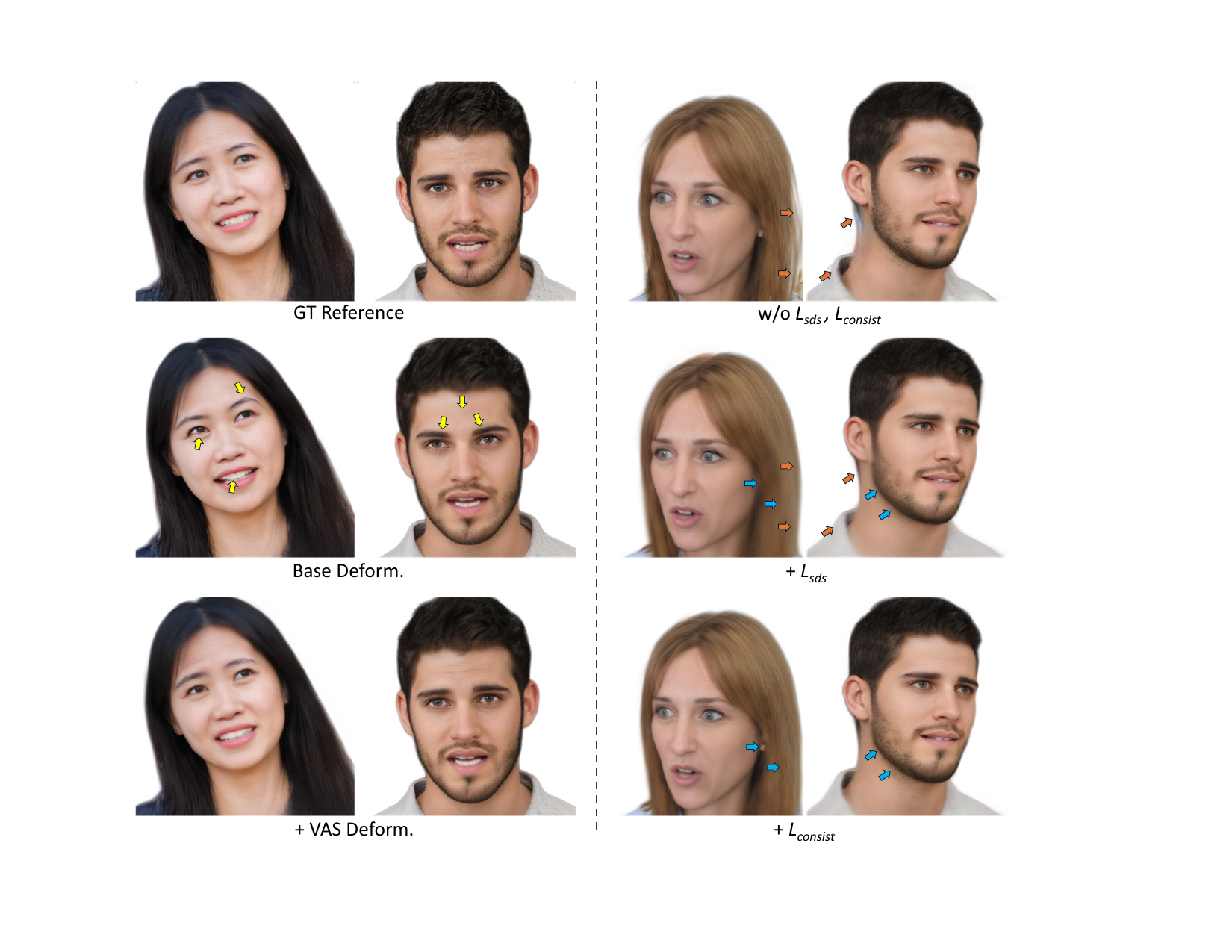
This residual deformation is the paper’s main mechanism for preserving the “micro-expression” quality of VASA-1 while moving to a 3D representation. In the authors’ ablations, this component materially improves image quality and lip-sync alignment relative to a base FLAME-only model.
Animation and Rendering
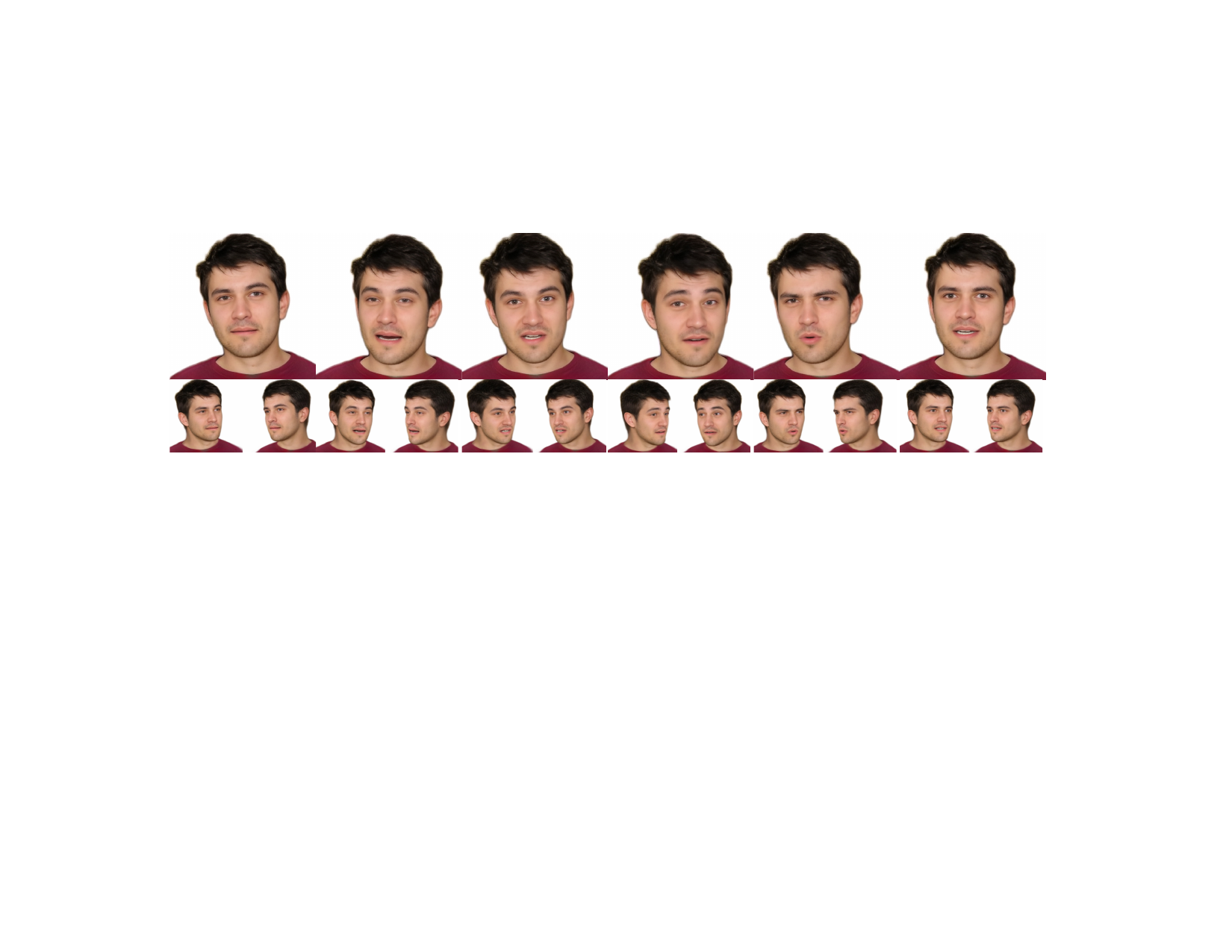
After training, the avatar is driven by motion latents generated from either audio or video. For audio input, VASA-1’s diffusion transformer produces the latent; for video input, VASA-1 motion encoders extract it. Rendering uses Gaussian splatting, enabling real-time animation and free-view synthesis.
Synthetic Training Data
Instead of requiring multiview capture or a real video of the target subject, VASA-3D synthesizes training frames from the single input image using VASA-1. The generated frames are paired with the corresponding motion latents and used to supervise the 3D avatar. The paper emphasizes that this synthetic data can span a much wider range of head poses and facial expressions than a conventional monocular video of the same person.
For most experiments, the authors randomly sample up to $10$ hours of video clips from VoxCeleb2 and use the extracted VASA-1 latents to render training frames from the portrait image. They also note that, depending on the experimental setting, either video frames or audios can be used as the driving source for generating the synthetic training set.
Training Objective and Robustification
All trainable parts of the model, including the Gaussian parameters and deformation MLPs, are optimized end-to-end from scratch. The paper highlights three difficulties in training on synthetic VASA-1-generated data:
- temporal texture and facial shape inconsistencies across synthesized frames,
- limited coverage of large viewing angles, and
- overfitting risk due to the flexibility of dense residual deformation.
Reconstruction Loss
The photometric loss combines SSIM and $L_1$ color error:
$$ L_{recon} = \lambda_{ssim} L_{ssim} + (1 - \lambda_{ssim}) L_1. $$
Perceptual and Adversarial Losses
To reduce reliance on pixel-wise matching when the synthetic frames have temporal inconsistencies, VASA-3D adds an LPIPS perceptual loss and a multi-scale patch adversarial loss:
$$ L_{perc} = \lambda_{lpips} L_{lpips} + \lambda_{adv} L_{adv}. $$
The paper uses a pretrained VGG backbone for LPIPS and three discriminators operating at different image scales.
SDS Regularization for Missing Views
Because the synthesized training data does not always cover large pose changes, the method applies a score distillation sampling loss on randomly rendered novel views to regularize side views and broaden the valid viewing range. The random views are sampled with azimuth in $[-180^\circ, 180^\circ]$ and elevation in $[-22.5^\circ, 22.5^\circ]$. The diffusion prior is Stable Diffusion v2.1, with classifier-free guidance $10.0$ and gradient scale $0.001$. The text prompt is human portrait, realistic photography, by DSLR camera.
The paper applies reconstruction, perceptual, and SDS losses to renders from both the base-deformed Gaussians $\mathcal{G}'$ and the VAS-deformed Gaussians $\mathcal{G}''$. This is meant to let $\mathcal{G}'$ capture shared multi-frame structure while $\mathcal{G}''$ models per-frame residual detail.
Render Consistency Loss
To keep the dense residuals from overfitting and to reduce the tendency of SDS to over-smooth details, the authors add a render consistency loss. They render an additional pair of novel-view images from $\mathcal{G}'$ and $\mathcal{G}''$ and enforce perceptual similarity between them, with gradients stopped through the $\mathcal{G}'$ branch:
$$ L_{consist} = \operatorname{LPIPS}\bigl(I'(\mathcal{G}''), \operatorname{stopgrad}(I'(\mathcal{G}'))\bigr). $$
The new view is sampled at an azimuth in either $[-35^\circ, -55^\circ]$ or $[35^\circ, 55^\circ]$ and an elevation in $[-15^\circ, 15^\circ]$, choosing the azimuth range farther from the current training view.
CAS Sharpening Loss
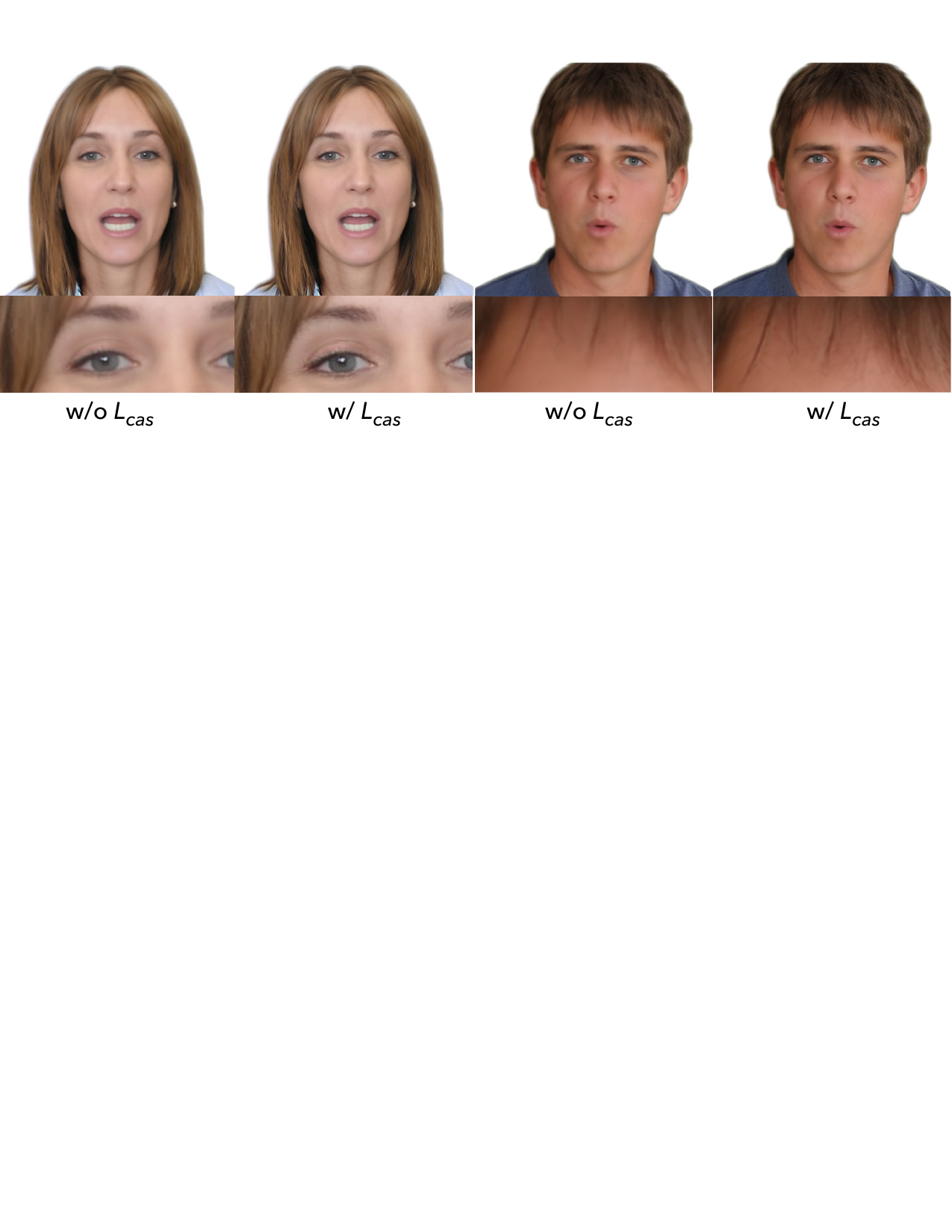
As an optional late-stage finetuning step, the paper applies a contrast-adaptive-sharpening filter to rendered images and uses LPIPS between the sharpened and original render to encourage crisper outputs. This is specifically presented as a lightweight finetuning loss rather than the core of the method.
The overall objective is described as a weighted sum of reconstruction, perceptual, SDS, consistency, sharpening, and additional regularizers inherited from GaussianAvatar-style training:
$$ L = L_{ssim} + L_1 + L_{lpips} + L_{adv} + L_{sds} + L_{consist} + L_{cas} + L_{others}. $$
In the appendix, the reported weights are $\lambda_{ssim} = 0.1$, $\lambda_{lpips} = 1.0$, $\lambda_{adv} = 0.001$, $\lambda_{sds} = 1.0$, $\lambda_{consist} = 0.01$, and $\lambda_{cas} = 10.0$. SDS is applied every $10$ iterations due to cost, with time steps sampled from $t \in [0.02, 0.98]$ and $t_{max}$ decaying by $0.98$ every $2{,}000$ iterations. CAS finetuning runs for an additional $20$K iterations after the default $200$K-iteration training schedule.
Gaussian densification and pruning start at iteration $10$K, are repeated every $2$K iterations, and stop after $100$K iterations or once the Gaussian count exceeds $200{,}000$.
Experimental Setup
The main ablations use $10$ StyleGAN2-generated portraits, split evenly between five male and five female identities. Training is performed on $4$ NVIDIA A100 $40$GB GPUs with batch size $4$, and all main experiments use $512 \times 512$ images and renderings.
The paper also reports several distinct experimental protocols:
- Ablation and scaling study: datasets synthesized from VoxCeleb2 clips, with lengths of $5$ min, $10$ min, $20$ min, $30$ min, $1$ h, $2$ h, $5$ h, and $10$ h.
- Audio-driven comparison: $5$ web-sourced audio clips, two male and three female, each $25$ minutes long; the first $20$ minutes are used for training and the last $5$ minutes for testing.
- Video-driven reenactment comparison: $26$ portraits from CelebVHQ, each with a $1$-minute high-quality talking video, using one extracted reference frame per portrait.
For training time, the paper reports that generating a $10$-hour synthetic dataset takes less than $1$ hour on $4$ A100 GPUs. Training for $20$K or $200$K iterations takes about $1.8$ hours or $18$ hours per model, respectively.
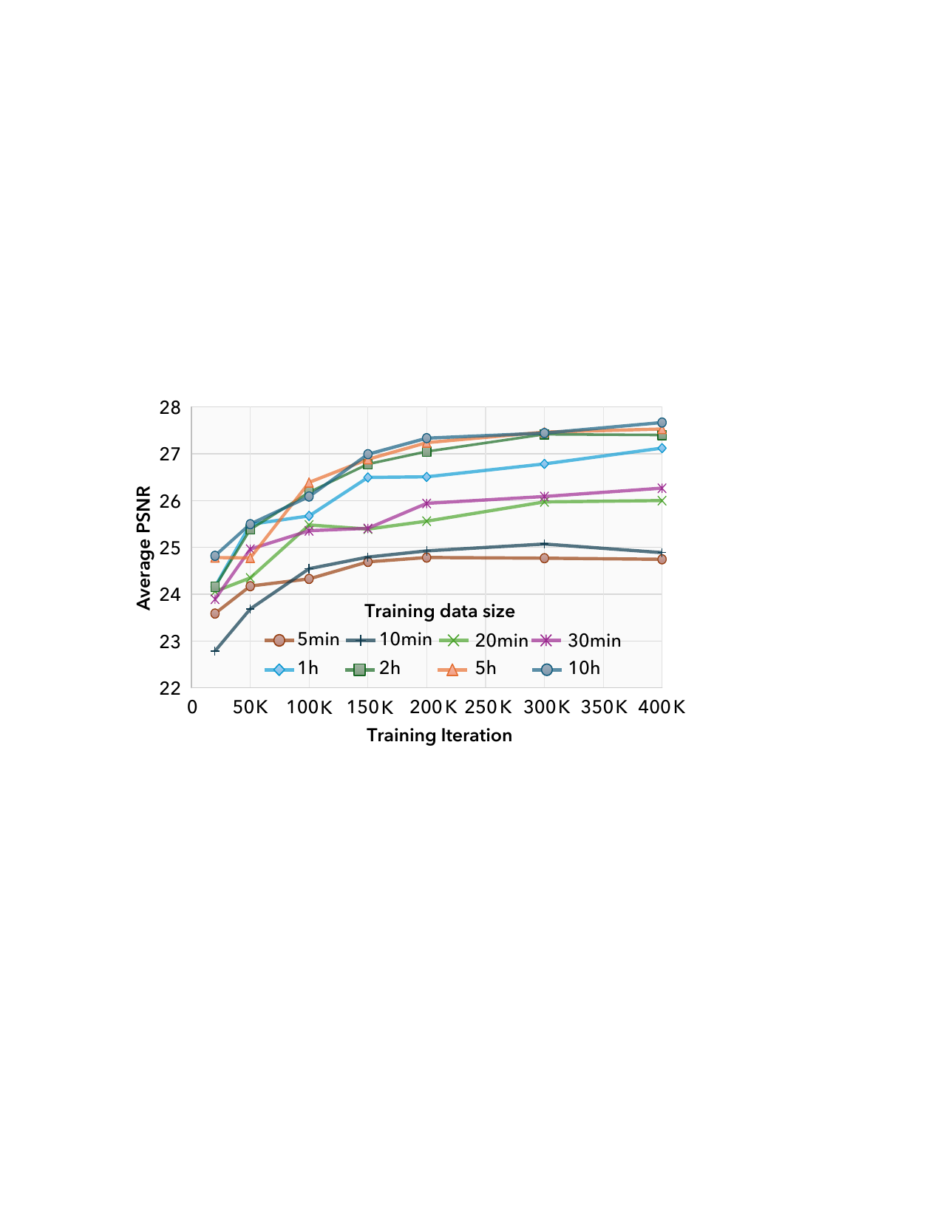
The dataset-size curve shows that improvements largely plateau after about $2$ hours of training video and after roughly $200$K iterations, which is why $200$K iterations is the default training budget in the paper.
Results and Ablations
Inference Speed
The authors report real-time rendering at $75$ FPS with $65$ ms latency on a single NVIDIA RTX $4090$ GPU for $512 \times 512$ output. This is one of the paper’s main practical claims, as it combines expressive motion with online free-view synthesis.
Effect of VAS Deformation and Losses
The ablation study isolates the contribution of the dense motion-latent-conditioned residual deformation and each regularizer. The results support three conclusions:
- VAS deformation gives the largest boost over the base model, improving both reconstruction quality and lip-sync metrics.
- The SDS loss reduces side-view artifacts introduced by limited pose coverage.
- The render consistency loss restores fine details that SDS tends to smooth.
- The CAS finetuning step improves sharpness, reflected especially in LPIPS, but can slightly trade off PSNR and SSIM.
| Setting | PSNR $\uparrow$ | L1 $\downarrow$ | SSIM $\uparrow$ | LPIPS $\downarrow$ | $S_C \uparrow$ | $S_D \downarrow$ |
|---|---|---|---|---|---|---|
| Basic | 25.74 | 0.0228 | 0.8544 | 0.0768 | 6.6347 | 8.1265 |
| + VAS deform. | 27.19 | 0.0195 | 0.8654 | 0.0695 | 6.9636 | 7.9050 |
| + $L_{sds}$ | 27.23 | 0.0195 | 0.8653 | 0.0707 | 6.9581 | 7.9191 |
| + $L_{consist}$ | 27.33 | 0.0192 | 0.8672 | 0.0706 | 6.9429 | 7.9221 |
| + $L_{cas}$ | 26.62 | 0.0209 | 0.8472 | 0.0657 | 6.9145 | 7.9422 |
| GT | -- | -- | -- | -- | 7.1517 | 7.7770 |
The paper states that the full method without CAS gives the best image-fidelity metrics in the ablation table, while CAS gives the best perceptual score. Lip-sync scores remain largely stable across these choices.
Comparison with VASA-1
Since the training data is generated by VASA-1, the paper treats VASA-1 as an upper-bound reference for the generated-video quality. VASA-3D is close to VASA-1 on frame realism and lip-sync while adding genuine 3D and free-view rendering capability.
| Method | FID $\downarrow$ | $S_C \uparrow$ | $S_D \downarrow$ | ID Sim $\uparrow$ |
|---|---|---|---|---|
| VASA-1 | 5.24 | 8.142 | 6.9237 | 0.8154 |
| VASA-3D | 7.45 | 8.121 | 6.9300 | 0.7874 |
Comparison with Prior Audio-Driven 3D Talking-Head Methods
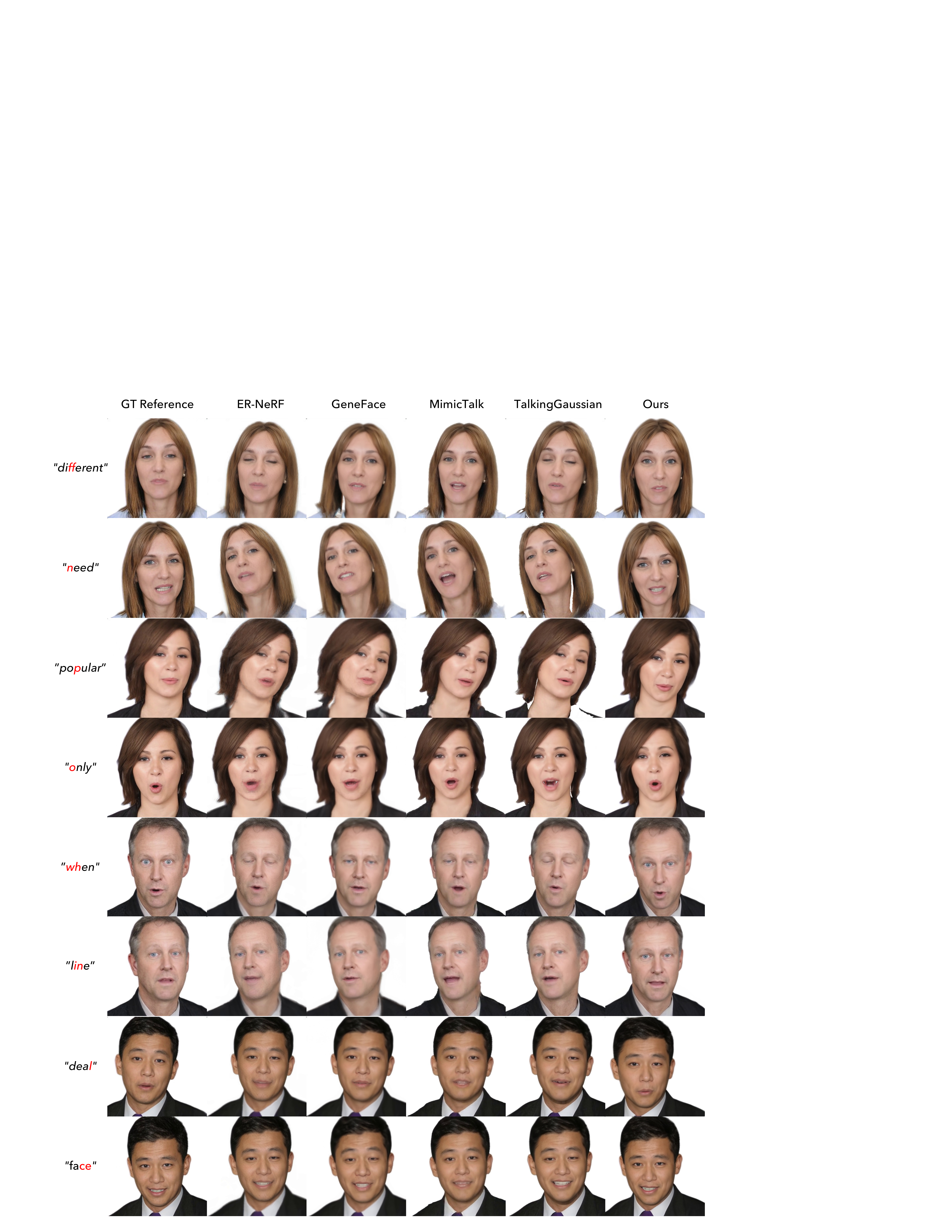
The authors compare against ER-NeRF, GeneFace, MimicTalk, and TalkingGaussian using the same training data and test audios. They note that these baselines do not generate head pose, so pose sequences from the training data are provided for fairness. VASA-3D achieves the strongest lip-sync metrics and the best human ratings.
| Method | $S_C \uparrow$ | $S_D \downarrow$ | ID Sim $\uparrow$ | US Video Quality $\uparrow$ | US Overall Preference $\uparrow$ |
|---|---|---|---|---|---|
| ER-NeRF | 5.921 | 8.7788 | 0.7732 | 1.82 | 1.08% |
| GeneFace | 5.922 | 9.6066 | 0.7857 | 1.73 | 0.72% |
| MimicTalk | 5.270 | 10.9368 | 0.7748 | 2.23 | 3.58% |
| TalkingGaussian | 6.701 | 8.1061 | 0.7971 | 2.38 | 0.72% |
| VASA-3D | 8.121 | 6.9300 | 0.7874 | 4.29 | 93.91% |
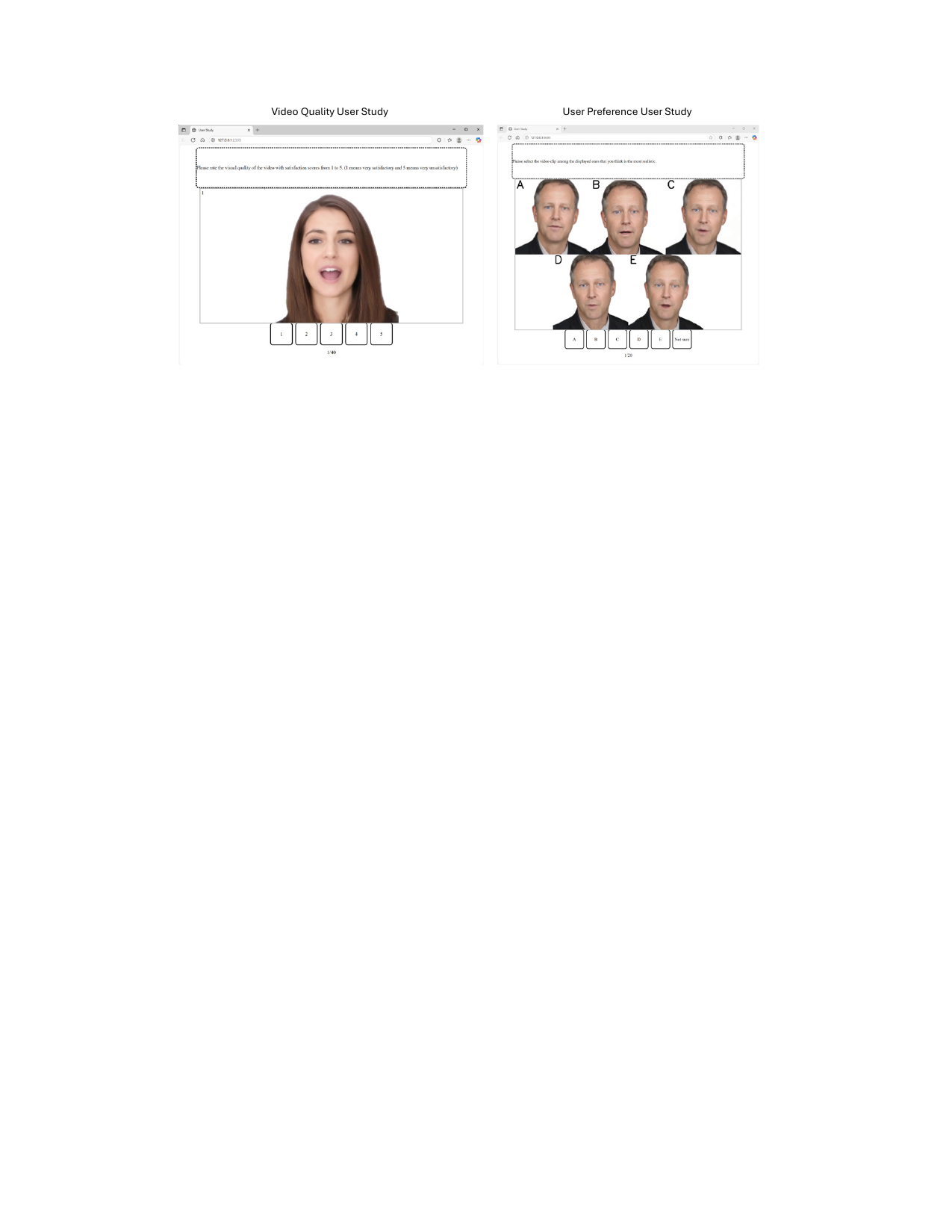
The user study involved $15$ participants rating visual quality from $1$ to $5$ and choosing the most realistic result among the methods. VASA-3D received the highest quality score and was preferred in $93.91\%$ of cases.
Comparison with Video-Driven Face Reenactment Methods
The paper also evaluates the model on face reenactment, even though that is not its primary target task. Using $26$ CelebVHQ portraits and $1$-minute real talking videos as test data, the method is compared with GAGAvatar, GPAvatar, Real3DPortrait, Voodoo3D, and Portrait4D-v2. VASA-3D achieves the best average scores across all reported metrics.
| Method | PSNR $\uparrow$ | PSNR$_{Face}$ $\uparrow$ | L1 $\downarrow$ | SSIM $\uparrow$ | LPIPS $\downarrow$ | $S_C \uparrow$ | $S_D \downarrow$ |
|---|---|---|---|---|---|---|---|
| GAGAvatar | 25.74 | 30.53 | 0.0257 | 0.8695 | 0.0829 | 5.502 | 8.693 |
| GPAvatar | 24.91 | 29.41 | 0.0288 | 0.8583 | 0.1016 | 4.785 | 9.256 |
| Real3DPortrait | 23.78 | 28.04 | 0.0338 | 0.8481 | 0.1091 | 4.971 | 9.179 |
| Voodoo3D | 23.43 | 28.39 | 0.0343 | 0.8380 | 0.1209 | 4.307 | 9.500 |
| Portrait4D-v2 | 23.19 | 27.55 | 0.0356 | 0.8325 | 0.0946 | 5.823 | 8.530 |
| VASA-3D | 26.21 | 31.11 | 0.0255 | 0.8741 | 0.0760 | 6.453 | 7.996 |
| GT | -- | -- | -- | -- | -- | 6.673 | 7.802 |
| VASA-1 | 25.93 | 31.01 | 0.0261 | 0.8544 | 0.0809 | 6.302 | 8.061 |
This table is useful for understanding the paper’s broader claim: the 3D avatar is not only free-viewable, but can also compete strongly on standard image-quality and lip-sync metrics against methods specialized for video-driven reenactment.
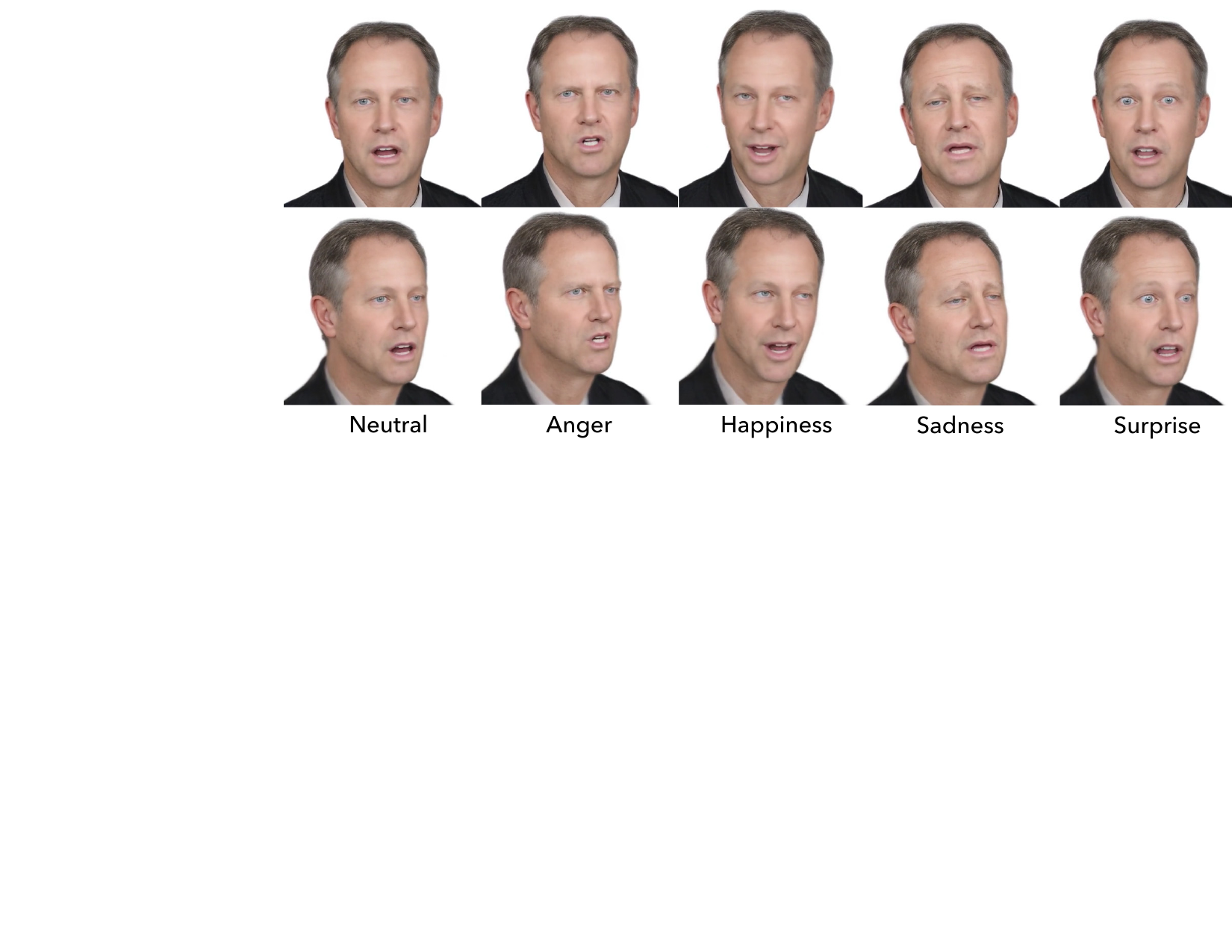
The paper also demonstrates that the same latent-controlled pipeline can incorporate additional control signals inherited from VASA-1, such as eye gaze direction, head distance, and emotion offset. The emotion-control examples show that the generated 3D avatars can be steered toward different affective styles while maintaining the same audio input.
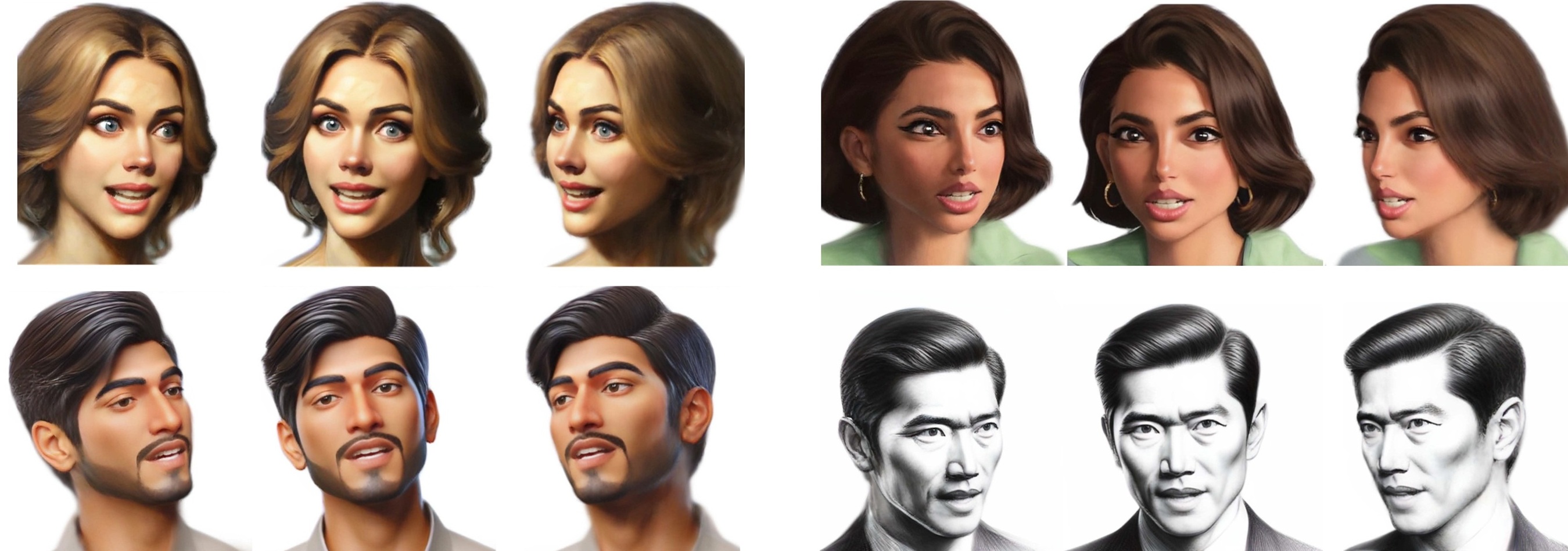
The method is also tested on artistic-style portrait images, and the paper reports that it still produces convincing 3D talking videos. This suggests that the synthetic-data fitting strategy is not limited to photo-realistic portraits, although the paper does not claim a formal benchmark for this setting.
Limitations and Responsible AI Considerations
The paper explicitly notes several limitations. First, because the synthetic training data does not fully cover the back of the head, the model does not reconstruct the rear view of the avatar. Second, like VASA-1, it does not handle dynamic accessories. Third, the authors suggest that extension to the upper body is a natural future direction.
On responsible AI, the authors acknowledge that the technique could be misused to synthesize the likeness of real people. They state that they are training face forgery detection models with outputs from their generators and report that the generated videos remain distinguishable from authentic ones under those detectors, while also improving detector generalization. The paper frames the intended applications as positive ones such as AI coworkers and AI tutors.
Takeaway
VASA-3D’s main technical move is to treat the expressive motion latent of a strong 2D talking-head generator as a rich control signal for a 3D Gaussian avatar. By coupling FLAME-based coarse motion with latent-conditioned Gaussian residuals, and by training the model on synthetic frames generated from a single portrait image, the method reaches a combination of expressiveness, free-view consistency, and runtime performance that the paper argues is not available in prior single-image 3D talking-head systems.