
CosyEdit2
CosyEdit2: Speech-Editing-Oriented Reinforcement Learning Unlocks Better Zero-Shot TTS
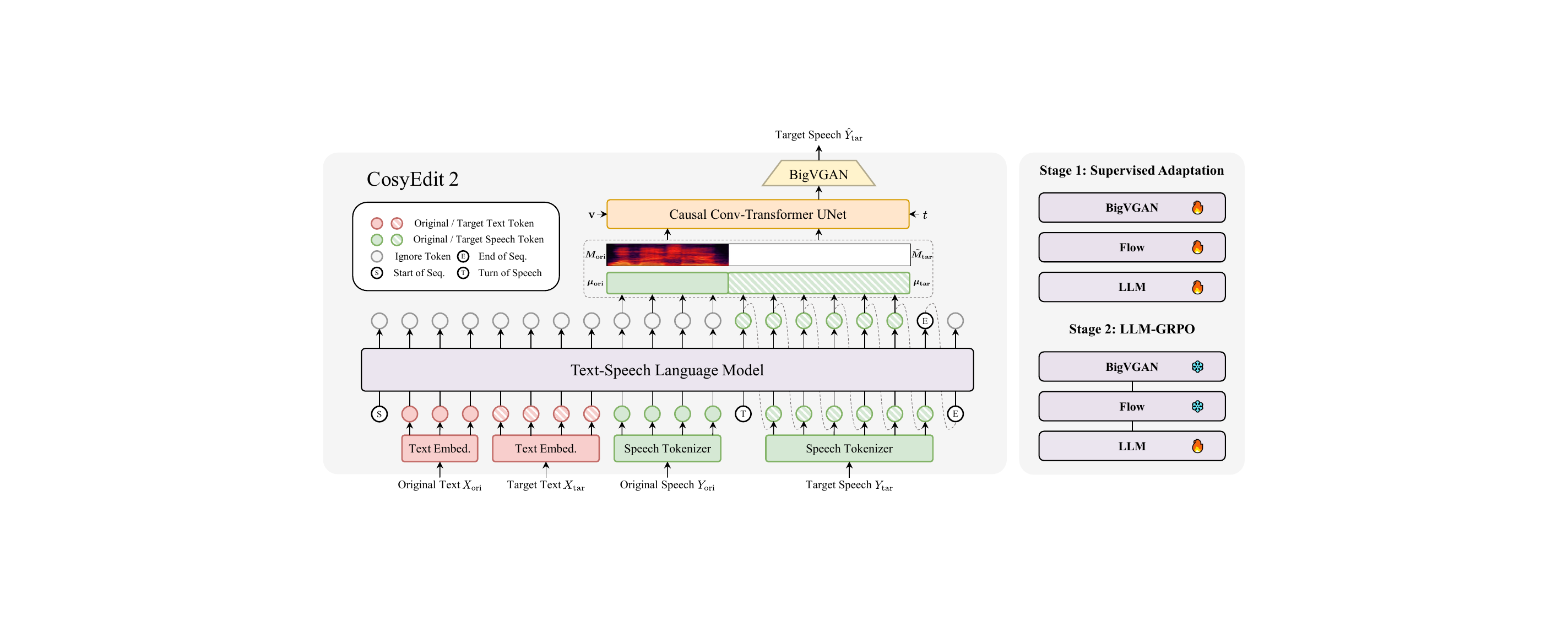
A speech editing model leveraging editing-oriented reinforcement learning to overcome supervised fine-tuning limitations. The approach achieves stronger acoustic preservation while unlocking improved zero-shot TTS, revealing a bidirectional relationship between the two tasks.
Links
Paper & demos
Code & resources
Impact
Abstract
Speech editing and zero-shot Text-to-Speech (TTS) share a similar generative foundation conditioned on speech prompts, yet speech editing demands far stricter local acoustic consistency with surrounding unedited content. While prior work has shown that Supervised Fine-Tuning (SFT) enables TTS models to acquire functional editing capability, this approach remains fundamentally bottlenecked by imperfect paired editing data and coarse-grained optimization signals. To address these limitations, we propose CosyEdit2, a speech editing model built on a two-stage post-training framework that progresses from supervised editing initialization to editing-oriented Group Relative Policy Optimization (GRPO) over target-speech-free data. Extensive experiments demonstrate that CosyEdit2 not only substantially advances speech editing performance, but also unlocks better zero-shot TTS capability, revealing a deeper mutual relationship between the two tasks. Audio samples are available at https://cjy1018.github.io/CosyEdit2.
Introduction and Motivation
Speech editing and zero-shot Text-to-Speech (TTS) are closely related tasks: both generate speech conditioned on a spoken prompt, but they differ fundamentally in what must be preserved. Zero-shot TTS prioritizes rendering a target transcript in a target speaker's voice; speech editing goes further, demanding that the synthesized segment integrate seamlessly into the surrounding, unedited recording in terms of speaker timbre, prosody, background noise, reverberation, and every other acoustic detail. The edited clip must be imperceptible as a modification.
Prior work addressed speech editing through two paradigms. Cascaded systems (e.g., FluentSpeech, VoiceCraft, SSR-Speech) first obtain forced-alignment word/phoneme timestamps, then synthesize or infill the target region. They are accurate but require complex pre-processing and are sensitive to alignment errors. End-to-end models (e.g., Ming-UniAudio, CosyEdit) internalize alignment in a unified speech-language model and offer lower engineering complexity, but their preservation of unedited regions has been limited.
A key bottleneck shared by all prior end-to-end approaches is Supervised Fine-Tuning (SFT). SFT relies on manually constructed paired recordings whose edit boundaries and acoustic conditions are inevitably imperfect. Moreover, SFT optimizes a token-level reconstruction loss that treats edited and unedited tokens equally, providing no fine-grained distinction between content correctness and acoustic preservation. The result is a hard preservation–accuracy trade-off that defines the ceiling of SFT-based methods.
CosyEdit2 addresses these limitations with a two-stage post-training framework:
- Stage 1 (SFT initialization): Supervised adaptation of the CosyVoice2 backbone — separately for the language model (LLM), the flow-matching acoustic model, and a newly trained BigVGAN vocoder — to establish a functional editing capability.
- Stage 2 (GRPO elicitation): Editing-oriented Group Relative Policy Optimization (GRPO) that replaces imperfect paired supervision with reward-driven fine-grained optimization over target-speech-free data, updating only the LLM while the acoustic backend stays frozen.
Crucially, the paper demonstrates that training on speech editing with GRPO also substantially improves zero-shot TTS across multiple languages and difficulty levels — revealing a deep bidirectional connection between the two tasks.
Architecture
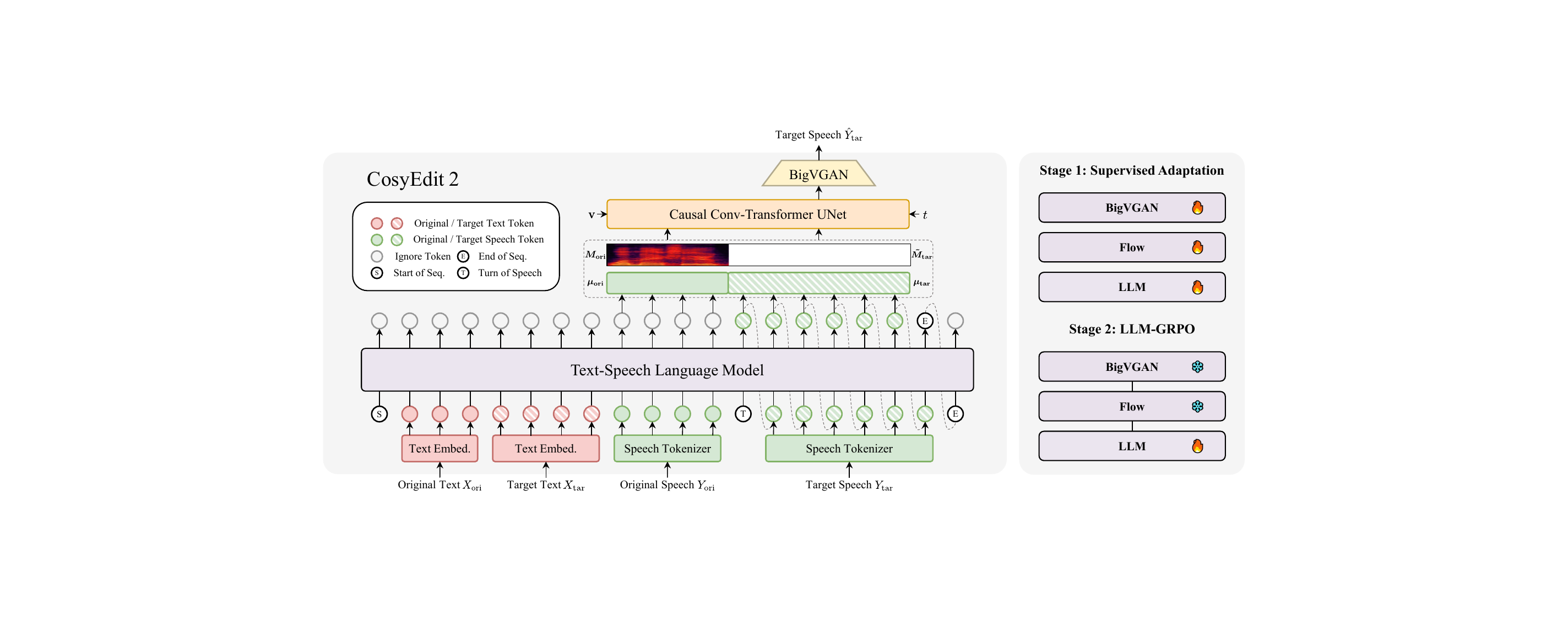
CosyEdit2 is built on the CosyVoice2 architecture, which is a modular pipeline consisting of:
Text Tokenizer
Two identical BPE-based text tokenizers separately encode the original text $X_{\mathrm{ori}}$ and the target text $X_{\mathrm{tar}}$. Following CosyVoice2, no explicit phoneme front-end is used; pronunciation patterns are learned end-to-end from the contrast between the two token streams, which are sequentially concatenated as the LLM input. This explicit separation lets the model learn edit operations implicitly from the textual diff.
Speech Tokenizer
An ASR-oriented encoder with Finite Scalar Quantization (FSQ) extracts low-frame-rate discrete semantic speech tokens from waveforms. The original speech $Y_{\mathrm{ori}}$ is tokenized as part of the editing condition $\mu_{\mathrm{ori}}$, while during SFT the target speech $Y_{\mathrm{tar}}$ is tokenized as the prediction target $\mu_{\mathrm{tar}}$.
Autoregressive Text-Speech Language Model
The backbone LLM is Qwen2.5-0.5B, extended to jointly handle text and speech tokens. The input sequence for CosyEdit2 is organized as: $$[\circledS,\ X_{\mathrm{ori}},\ X_{\mathrm{tar}},\ \mu_{\mathrm{ori}},\ \circledT]$$ where $\circledS$ is a start-of-sequence token and $\circledT$ is a turn-of-speech separator. The model then autoregressively predicts $\mu_{\mathrm{tar}}$ until an end-of-sequence token $\circledE$ is emitted. During GRPO, only this LLM is updated.
Conditional Flow-Matching Model (GOT-CFM)
The Flow module converts semantic tokens into Mel spectrograms. CosyEdit2 adopts the Guided Optimal-Transport Conditional Flow Matching (GOT-CFM) formulation from CosyEdit, where the complete original speech tokens and the original Mel spectrogram are used as global acoustic conditions. Specifically:
Let $M_{\mathrm{ori}}$ and $M_{\mathrm{tar}}$ be the Mel spectrograms of the original and target speech. The prior and data samples are concatenated: $$Z_0 = [M_{\mathrm{ori}}^{0}, M_{\mathrm{tar}}^{0}], \qquad Z_1 = [M_{\mathrm{ori}}, M_{\mathrm{tar}}]$$ The OT interpolation path is: $$\phi_t^{\mathrm{OT}}(Z_0, Z_1) = (1-t)Z_0 + tZ_1$$ with target vector field $\omega_t = Z_1 - Z_0$. The Flow network predicts: $$\nu_t = \operatorname{UNet}_\theta\!\left(\phi_t^{\mathrm{OT}}(Z_0,Z_1),\, t;\; \mathbf{v},\, \mu_z,\, [M_{\mathrm{ori}}, \tilde{M}_{\mathrm{tar}}]\right)$$ where $\mathbf{v}$ is the speaker embedding, $\mu_z = [\mu_{\mathrm{ori}}, \mu_{\mathrm{tar}}]$ are up-sampled concatenated speech tokens, and $\tilde{M}_{\mathrm{tar}}$ is the masked target Mel spectrogram. The training objective is: $$\mathcal{L}_{\mathrm{GOT\text{-}CFM}} = \mathbb{E}_{t,Z_0,Z_1}\left[\left\|\omega_t - \nu_t\right\|_1\right]$$
By conditioning on the full original speech at the Mel level, the Flow module is exposed to leading/trailing silence, background noise, and other unedited acoustic context, substantially helping preservation.
BigVGAN Vocoder
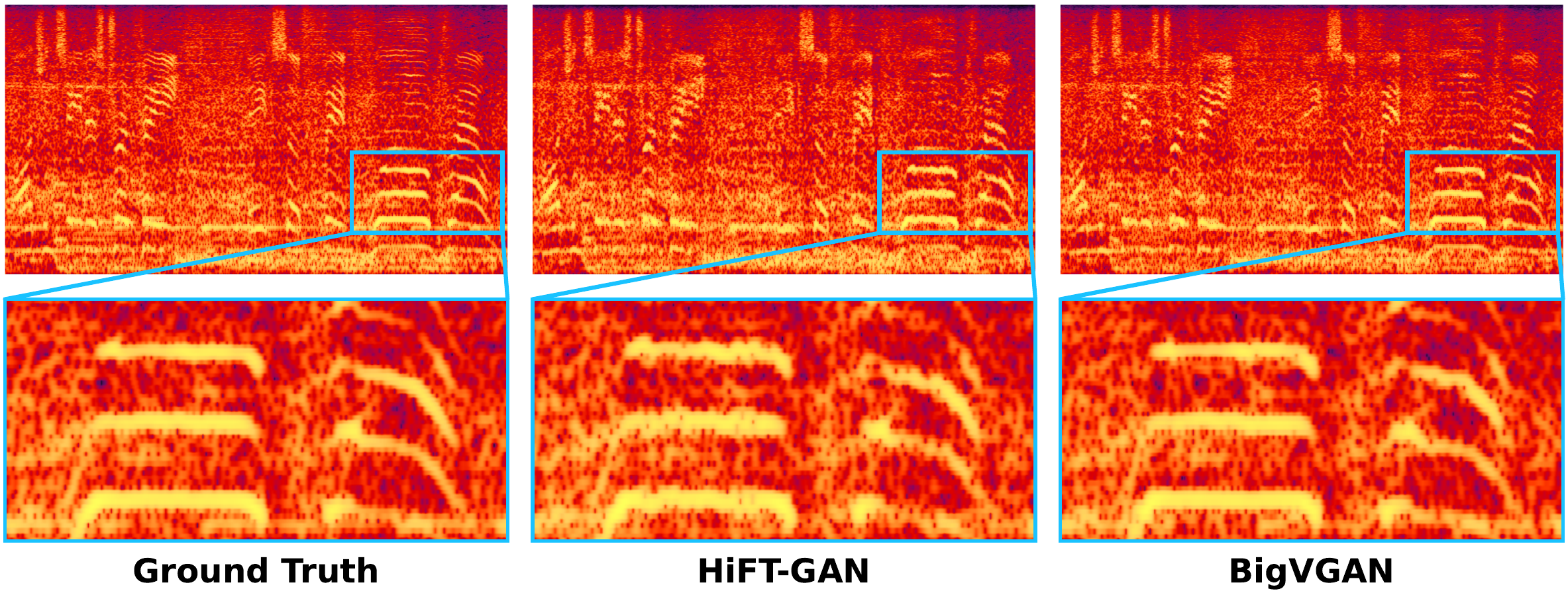
CosyVoice2 uses a HiFT-GAN vocoder, which is a clean-mel-oriented fast frequency-domain variant. CosyEdit2 replaces it with BigVGAN, a GAN-based universal vocoder with periodic activation functions and anti-aliased representations designed for high-fidelity waveform generation under diverse acoustic conditions. The BigVGAN is initialized from the closest available checkpoint (bigvgan_v2_22khz_80band_256x) and adapted to match CosyVoice2's 24 kHz, 80-band, hop-size-480 configuration. This reuses 88.20% of the generator parameters while the discriminator is fully reused. It is then trained on a 625-hour mixture corpus containing LibriTTS, LibriTTS-R (clean speech), and YODAS2 (in-the-wild YouTube speech), exposing the vocoder to both studio-quality and complex acoustic conditions.
Two-Stage Post-Training Framework
Stage 1: Supervised Adaptation
LLM SFT
The LLM is trained on the 250-hour GigaEdit-S dataset (derived from GigaSpeech-S) with standard next-token prediction:
$$\mathcal{L}_{\mathrm{LM}} = -\frac{1}{T_{\mathrm{tar}}+1} \sum_{t=1}^{T_{\mathrm{tar}}+1} \log p_\theta\!\left(\bar{\mu}_{\mathrm{tar},t} \mid c, \bar{\mu}_{\mathrm{tar},
The Flow module is also fine-tuned on GigaEdit-S using the GOT-CFM objective, initialized from the CosyVoice2 checkpoint, with constant learning rate $3\times10^{-5}$ for 9 epochs.
BigVGAN is trained for 460k steps on 625 hours of mixed data: 585 hours from LibriTTS + LibriTTS-R and 40 hours from YODAS2. Training from the adapted checkpoint is far shorter than the 5M-step official pretraining, benefiting from transferred parameters.
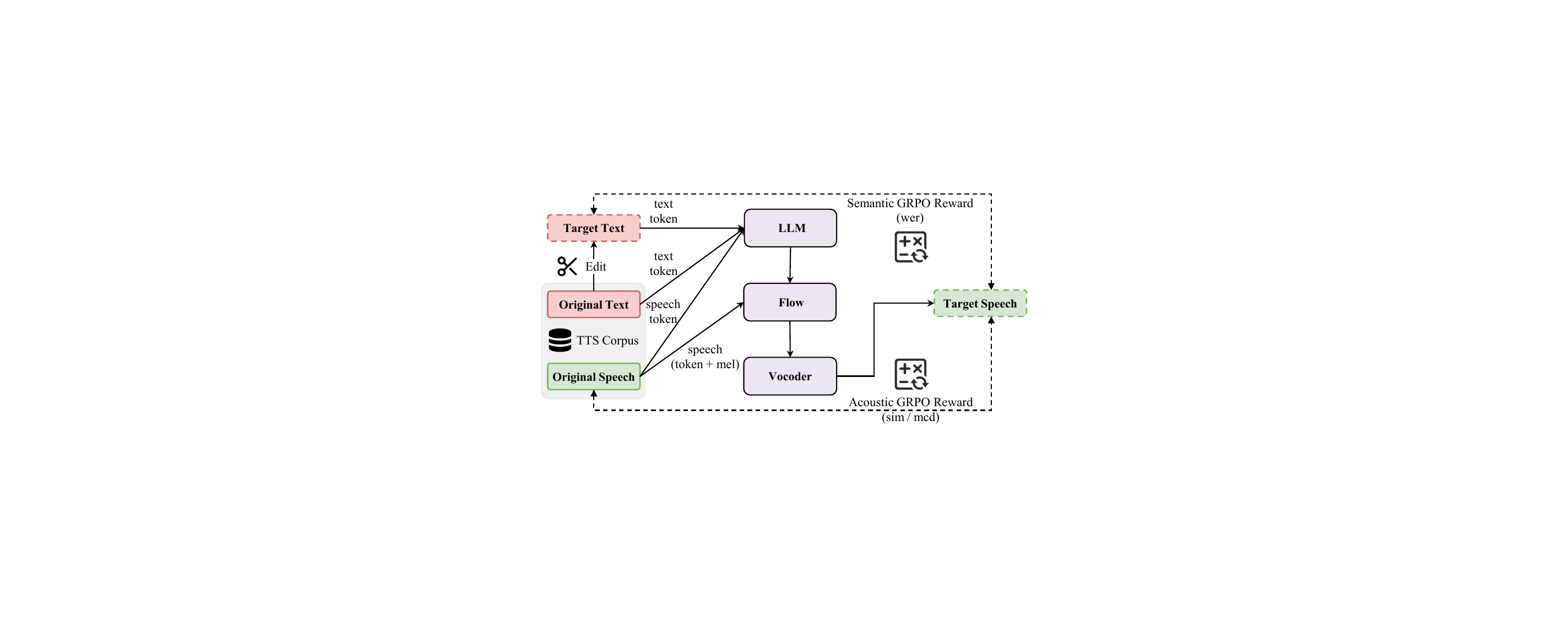
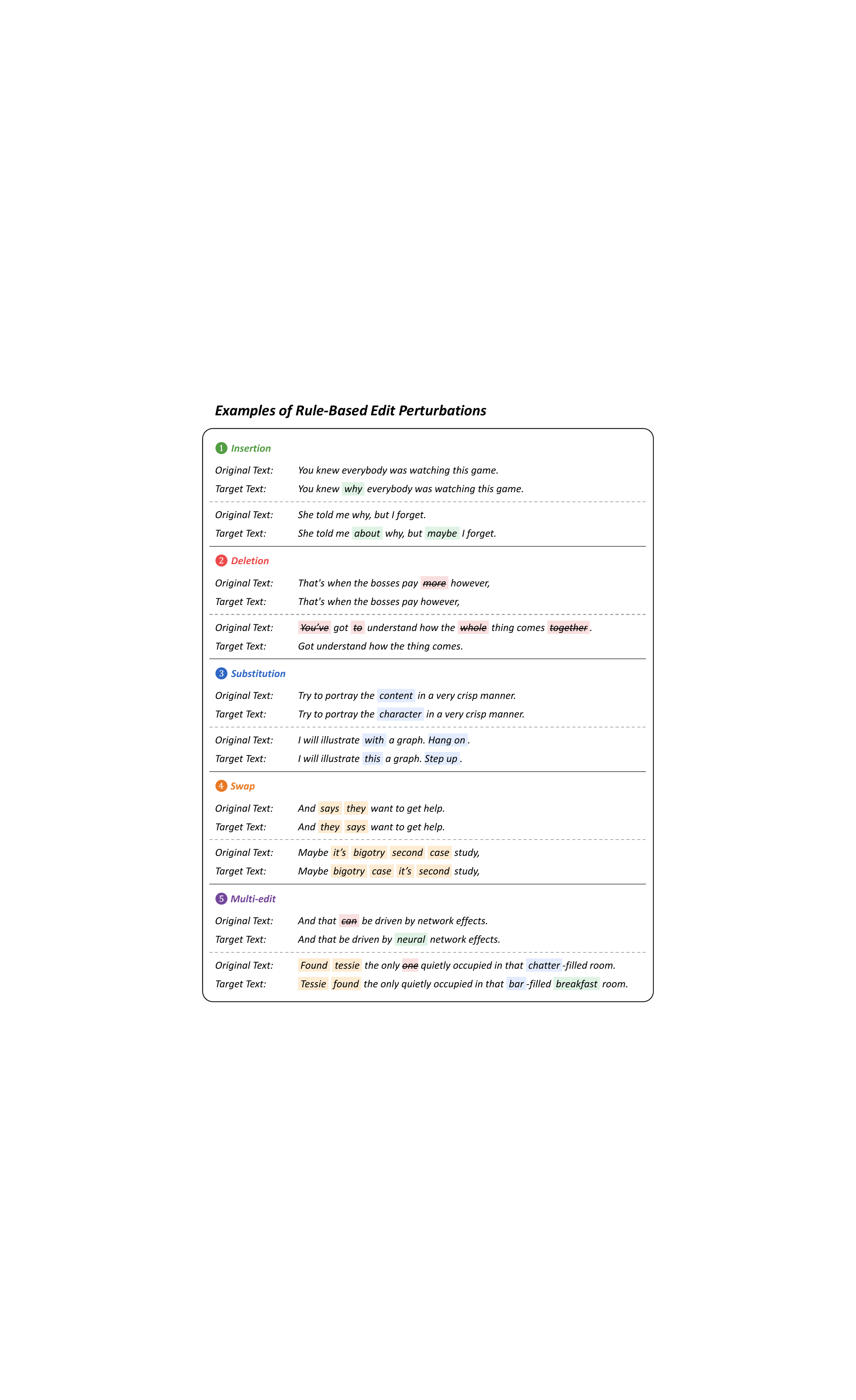
GRPO does not require any manually constructed target recordings. Instead, any TTS corpus with speech-transcription pairs is converted into editing prompts:
Only 3,000 utterances from GigaSpeech-XL are used, reflecting the efficiency of this approach. WhisperX with large-v3-turbo is used for auxiliary forced alignment to identify non-edited regions $\Omega$ for MCD reward computation.
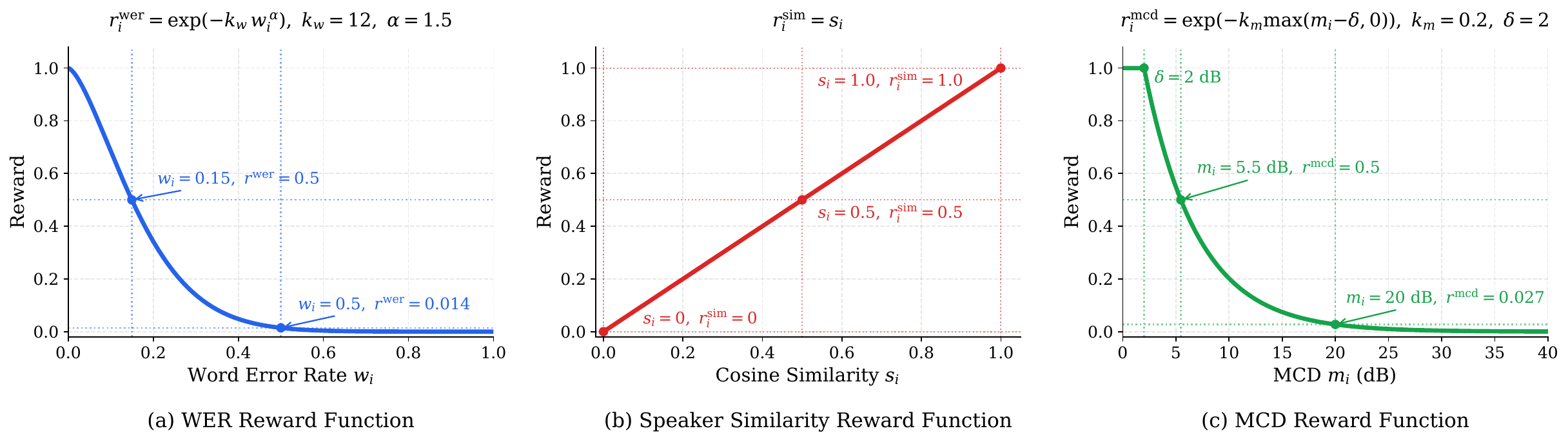
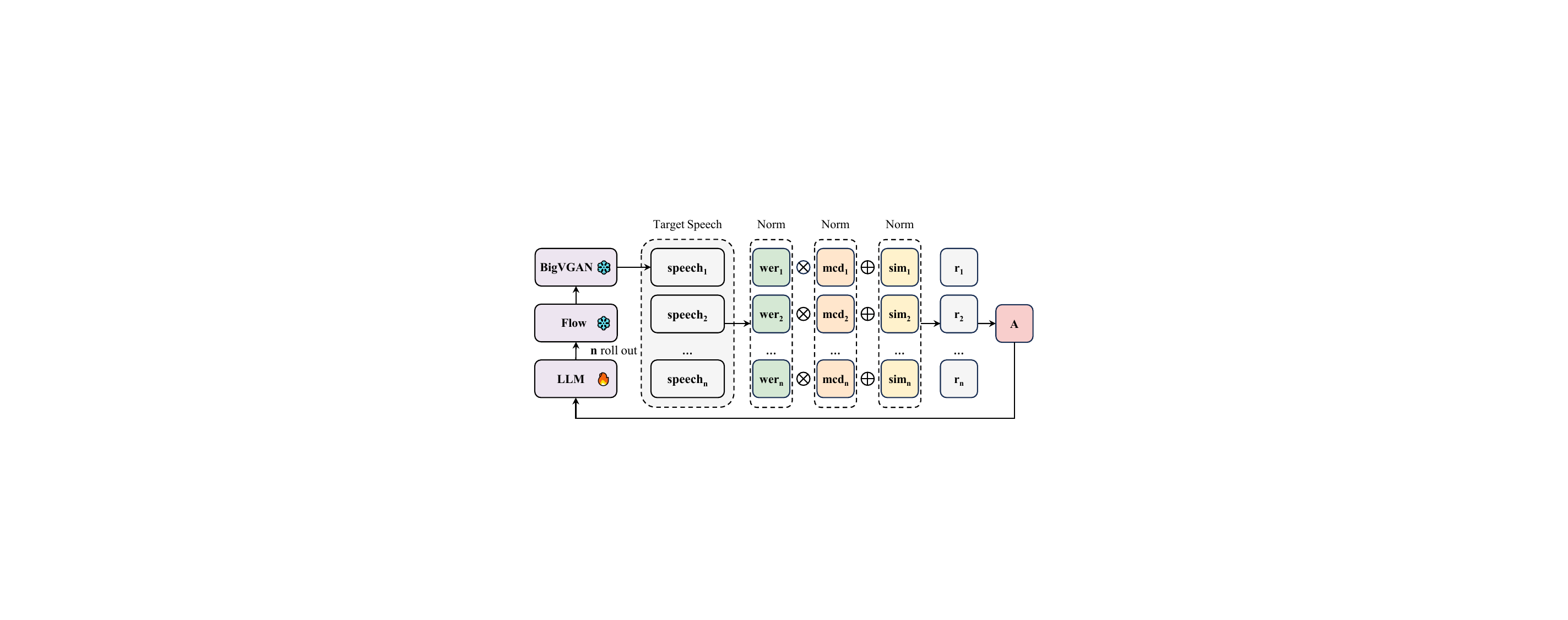
For each editing prompt $c = (X_{\mathrm{ori}}, X_{\mathrm{tar}}, Y_{\mathrm{ori}})$, the policy samples a group of $G$ candidate token sequences $\{Z_i\}_{i=1}^G$, decoded by frozen Flow and BigVGAN into waveforms $\{\hat{Y}_{\mathrm{tar}}^i\}_{i=1}^G$. Three complementary rewards are designed:
Content Reward (WER):
$$w_i = \operatorname{WER}\!\left(X_{\mathrm{tar}},\, \operatorname{ASR}(\hat{Y}_{\mathrm{tar}}^i)\right)$$
$$r_i^{\mathrm{wer}} = \exp\!\left(-k_w \cdot w_i^{\alpha}\right)$$
The exponential decay with power-law exponent $\alpha$ sharply suppresses high-WER samples while providing finer discrimination in the low-WER region, stabilizing early training.
Speaker Consistency Reward:
$$r_i^{\mathrm{sim}} = s_i = \frac{\mathbf{Emb}(Y_{\mathrm{ori}})^\top \mathbf{Emb}(\hat{Y}_{\mathrm{tar}}^i)}{\|\mathbf{Emb}(Y_{\mathrm{ori}})\|_2\, \|\mathbf{Emb}(\hat{Y}_{\mathrm{tar}}^i)\|_2}$$
Cosine similarity is used directly without nonlinear transformation since it already lies in $[0,1]$.
Acoustic Preservation Reward (MCD on unedited regions):
Let $\Omega$ denote the non-edited regions shared by the original and generated speech. DTW alignment is used to handle boundary imprecision:
$$m_i = \operatorname{MCD}\!\left(\operatorname{DTW}\!\left(Y_{\mathrm{ori}}^\Omega,\, \hat{Y}_{\mathrm{tar}}^{i,\Omega}\right)\right)$$
$$r_i^{\mathrm{mcd}} = \exp\!\left(-k_m \cdot \max(m_i - \delta, 0)\right)$$
A tolerance margin $\delta$ prevents over-penalizing perceptually negligible differences, focusing on severe acoustic degradation.
Priority-aware Reward Composition:
The rewards are composed in a coarse-to-fine, priority-aware hierarchy. WER serves as a content gate; given comparable correctness, MCD selects for acoustic preservation; speaker similarity then ranks remaining candidates:
$$r_i^{\mathrm{wer\text{-}mcd}} = r_i^{\mathrm{wer}} \left[(1-\gamma) + \gamma r_i^{\mathrm{mcd}}\right]$$
$$r_i = \lambda_{\mathrm{c}}\, r_i^{\mathrm{wer\text{-}mcd}} + \lambda_{\mathrm{s}}\, r_i^{\mathrm{sim}}, \qquad \lambda_{\mathrm{c}} + \lambda_{\mathrm{s}} = 1$$
The weights are dynamically scheduled: $(\lambda_{\mathrm{c}}, \lambda_{\mathrm{s}}) = (0.9, 0.1)$ for the first 290 steps (emphasizing content), and $(0.8, 0.2)$ for the last 90 steps (strengthening speaker consistency). Hyperparameters: $k_w = 12$, $\alpha = 1.5$, $k_m = 0.2$, $\delta = 2$, $\gamma = 0.5$.
Group-relative advantages normalize rewards within the sampled group:
$$\hat{A}_i = \frac{r_i - \mu_r}{\sigma_r + \epsilon}, \qquad \mu_r = \frac{1}{G}\sum_{j=1}^G r_j$$
The GRPO objective with PPO-style clipping and KL regularization is:
$$\mathcal{J}_{\mathrm{GRPO}}(\theta) = \mathbb{E}\!\left[\frac{1}{G}\sum_{i=1}^G \frac{1}{T_i}\sum_{t=1}^{T_i} \min\!\left[\rho_{i,t}(\theta)\hat{A}_i,\; \operatorname{clip}(\rho_{i,t}(\theta), 1\pm\epsilon_c)\hat{A}_i\right] - \beta D_{\mathrm{KL}}\!\left(\pi_\theta \,\|\, \pi_{\mathrm{ref}}\right)\right]$$
where the importance ratio is:
$$\rho_{i,t}(\theta) = \frac{\pi_\theta(z_{i,t} \mid c, z_{i,
GRPO training uses $G=4$ rollouts per prompt, 380 steps, learning rate $3\times10^{-6}$, KL coefficient 0.001, batch size 64, temperature 0.8, top-$p=0.95$, top-$k=25$, on two NVIDIA H800 GPUs.
The paper formalizes a unified conditional speech generation view. Zero-shot TTS — given prompt $Y_{\mathrm{p}}$ and target text $X_{\mathrm{tar}}$, generate $\hat{Y}_{\mathrm{tar}}$ preserving speaker identity — is a special case of speech editing where the entire content is replaced (full-tail insertion or complete replacement). Speech editing is the localized variant: only the specified region changes; everything else must stay consistent with the original recording.
Under this view, editing-oriented GRPO inherently strengthens the core in-context learning capability shared by both tasks: understanding contextual conditions, preserving speaker acoustic cues, and generating speech faithful to the text. This explains why improvements in editing transfer to zero-shot TTS.
The modular architecture enables two inference configurations:
Ming-Freeform-Audio-Edit covers insertion, deletion, and substitution across English and Chinese basic/full subsets. Metrics include WER (content accuracy), speaker similarity (SS), DNSMOS (perceptual quality), and — crucially — $\mathrm{MAE}_{\mathrm{DNSMOS}}$ between generated and original speech to detect acoustic normalization artifacts. A lower MAE is better, indicating the generated speech matches the original acoustic quality rather than generating unrealistically clean output.
VoiceCraft-X (multilingual cascaded), SSR-Speech (monolingual cascaded), Ming-UniAudio (large-scale end-to-end), CosyEdit (SFT-based end-to-end), VoiceCraft, LEMAS-Edit, ECPA (GRPO-based cascaded).
CosyEdit2 achieves the lowest $\mathrm{MAE}_{\mathrm{DNSMOS}}$ across all edit types — the key differentiator. For substitution it achieves the lowest WER overall. For insertion it approaches SSR-Speech in WER/SS while substantially improving acoustic consistency. For deletion, SSR-Speech slightly leads in WER/SS (benefiting from explicit alignment), but CosyEdit2 achieves the best acoustic preservation without any alignment preprocessing.
CosyEdit2 substantially outperforms all multilingual baselines (VoiceCraft-X, LEMAS-Edit, Ming-UniAudio) on WER and SS across all edit types on the Chinese subset, reducing WER to ~1–1.4% for insertion and substitution. This demonstrates cross-lingual generalization despite GRPO training being conducted only on English data.
RealEdit is a 310-sample in-the-wild benchmark with complex acoustic conditions.
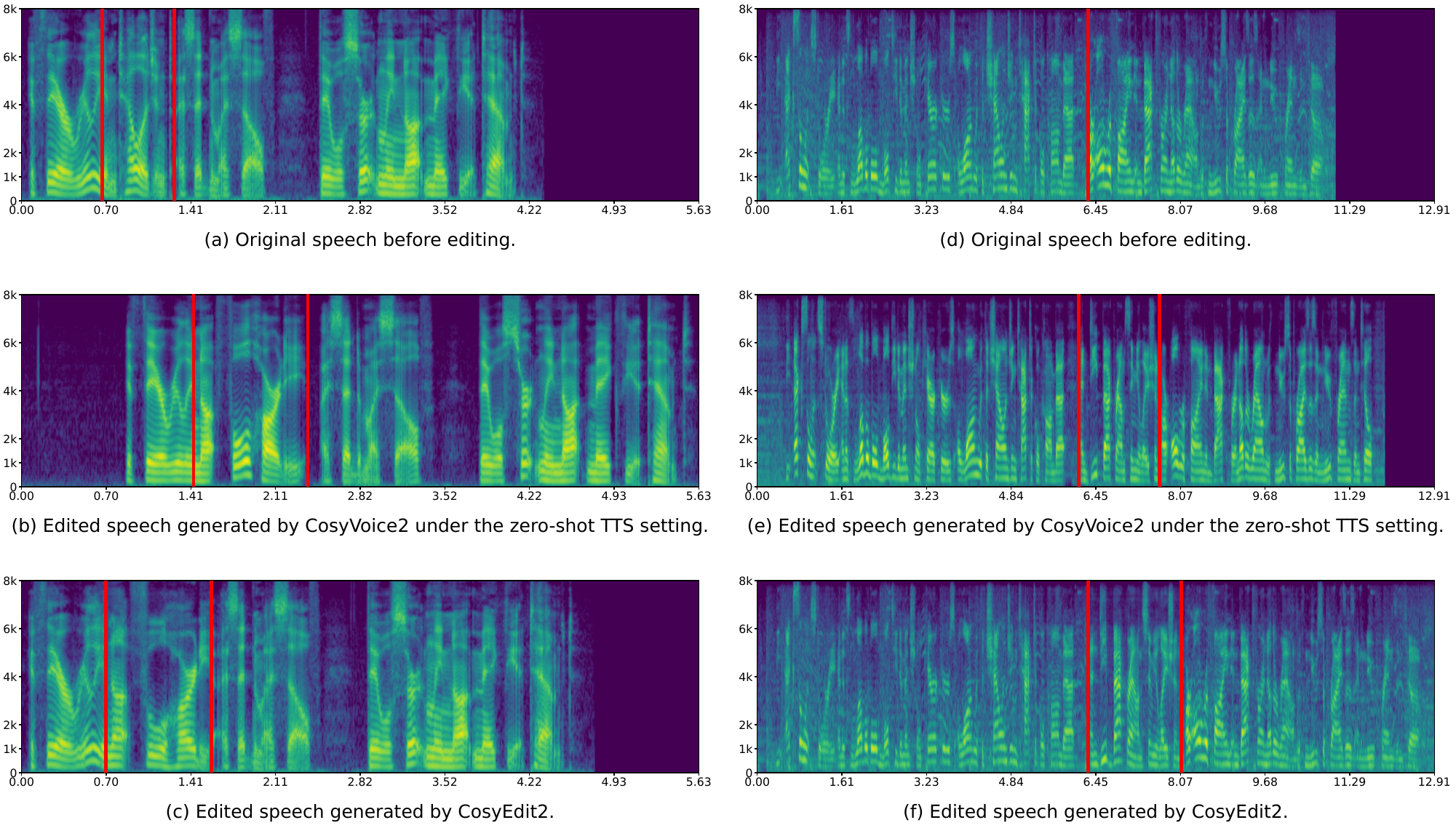
CosyEdit2 achieves the lowest WER among all systems and the best MCD on unedited regions (3.93 vs. 4.94 for CosyEdit), demonstrating genuine acoustic preservation improvements. The higher WER of CosyEdit2 compared with CosyVoice2 is attributed to ASR errors caused by preserved background noise — not semantic editing errors.
Key findings from the ablation:
Evaluated on CV3-EVAL (derived from CosyVoice3 evaluation suite) covering multilingual voice cloning, hard samples (tongue-twisters, repeated words, long utterances), and cross-lingual voice cloning. VAD-based trimming is applied to prompt speech to remove leading/trailing non-speech. Also evaluated on SEED-TTS-EVAL (English and Chinese). Baselines include VoiceCraft-X, SSR-Speech, CosyEdit, and CosyVoice2 (same backbone).
CosyEdit2 improves over the CosyVoice2 baseline in every language, with especially clear gains in Japanese (7.76 → 6.16) and Korean (6.89 → 5.14).
GRPO is the primary driver: without GRPO, hard-zh CER is 13.17 (barely better than CosyVoice2); with GRPO, it drops to 8.06. Hard-en WER drops from 11.99 (SFT-only) to 5.93 (GRPO). These improvements on tongue-twisters and repeated/lengthy utterances reflect substantially reduced omissions, insertions, and mispronunciations.
CosyEdit2 outperforms all baselines across all target-prompt language pairs (to-zh, to-en, to-ja, to-ko), with especially large improvements over CosyVoice2 in cross-lingual scenarios (e.g., to-zh from en-prompt: 13.15 → 7.16; to-en from zh-prompt: 6.02 → 5.07).
Despite training GRPO only on English editing prompts, CosyEdit2 reduces Chinese CER (1.36 → 1.16) and English WER (3.10 → 1.95) with speaker similarity well preserved. The improvement is not language-specific.
To isolate the vocoder effect, Mel spectrograms extracted directly from source waveforms are reconstructed using HiFT-GAN and BigVGAN. Evaluated on the VoiceBank-DEMAND test set (both clean and noisy subsets):
BigVGAN improves all metrics on both clean and noisy subsets, with particularly clear reductions in MCD — indicating more faithful spectral reconstruction.
An identity-editing experiment (target text = original text) on RealEdit directly measures acoustic preservation ability without confounding content changes. Models not trained on identity pairs are zero-shot tested:
CosyEdit2 dramatically closes the gap to oracle vocoder reconstruction (SS: 96.92 → 99.08; MCD: 6.24 → 3.07), operating nearly as an acoustic reconstruction system rather than a generative TTS model when no content change is needed. It even slightly surpasses the HiFT-GAN oracle in speaker similarity.
10 annotators (5 male, 5 female, native Chinese speakers, CET-6 or above) rated speech editing on three MOS scales (1–5):
On the English Ming-Freeform-Audio-Edit subset, CosyEdit2 achieves the best IMOS and SMOS across all edit types, and the best or near-best PMOS. It is strongest on substitution (best on all three dimensions). On the Chinese subset, CosyEdit2 achieves the best IMOS, SMOS, and PMOS for all edit types, with especially strong PMOS gains over CosyVoice2.
For zero-shot TTS subjective evaluation on CV3-EVAL multilingual voice cloning, CosyEdit2 achieves the highest IMOS and SMOS in both English and Chinese, confirming that editing-oriented GRPO improves perceived content correctness and speaker similarity.
The paper interprets zero-shot TTS as full-utterance content replacement under the unified speech generation view. Both tasks require: understanding contextual conditions, leveraging speaker acoustic cues from prompt speech, and producing text-faithful speech — fundamentally, prompt-conditioned in-context learning.
Editing-oriented GRPO strengthens this shared capability along multiple axes:
The authors identify three main limitations:
CosyEdit2's high-fidelity speech editing and zero-shot voice cloning capabilities raise misuse concerns including unauthorized voice impersonation, deceptive content creation, and misinformation. The strong acoustic preservation capability — retaining recording environment, prosody, and speaking characteristics while modifying only partial content — may make edited audio particularly difficult for humans to detect. The authors emphasize that the work targets legitimate applications (speech correction, accessibility, multimedia production, HCI research) and recommend deployment safeguards such as watermarking, synthetic-audio detection, and consent-aware usage policies.
The repository contains the CosyVoice family of TTS models (v1–v3) alongside the CosyEdit2 training framework. The core contribution of CosyEdit2 is a two-stage post-training pipeline implemented via Group Relative Policy Optimization (GRPO) over target-speech-free data.
GRPO training is invoked via the verl trainer (stages 0–4 in run.sh): data preparation → token2wav reward server launch → GRPO training loop → checkpoint merging → evaluation on zero-shot/test splits. The trained model can be converted back to CosyVoice format for inference.
Flow SFT
BigVGAN Training
Stage 2: Editing-Oriented GRPO
TTS-to-Edit Prompt Construction
Editing-Oriented Reward Design
GRPO Objective
Unified Perspective: Speech Editing as Generalized TTS
Inference Pipelines
Experiments: Speech Editing
Benchmarks and Metrics
Baselines
English Subset Results
Edit Type Model WER↓ (basic|full) SS↑ (basic|full) MAE↓ (basic|full)
Insertion VoiceCraft-X 5.74 | 6.27 0.85 | 0.84 0.166 | 0.162 SSR-Speech 1.75 | 2.03 0.94 | 0.94 0.139 | 0.128 Ming-UniAudio 6.49 | 7.84 0.80 | 0.80 0.168 | 0.167 CosyEdit2 1.90 | 1.93 0.93 | 0.93 0.107 | 0.108 Deletion VoiceCraft-X 9.71 | 10.65 0.80 | 0.80 0.172 | 0.173 SSR-Speech 5.22 | 5.29 0.91 | 0.91 0.132 | 0.134 Ming-UniAudio 14.79 | 24.37 0.77 | 0.75 0.206 | 0.204 CosyEdit2 5.52 | 5.83 0.90 | 0.90 0.131 | 0.131 Substitution VoiceCraft-X 7.29 | 6.73 0.81 | 0.81 0.155 | 0.146 SSR-Speech 1.90 | 1.95 0.89 | 0.90 0.146 | 0.140 Ming-UniAudio 8.10 | 7.95 0.77 | 0.77 0.166 | 0.178 CosyEdit2 1.43 | 1.52 0.89 | 0.90 0.137 | 0.132 Chinese Subset Results
RealEdit Results
Method WER↓ SS↑ MCD↓ MOS MAE↓ Ground Truth 6.06 — — 3.34 — FluentSpeech 5.97 92.74 — 2.72 0.78 VoiceCraft 6.55 97.12 — 3.18 0.24 SSR-Speech 5.05 98.31 — 3.32 0.14 Ming-UniAudio 9.98 96.70 5.36 3.13 0.33 CosyEdit 4.50 97.34 4.94 3.19 0.29 CosyEdit2 4.31 97.91 3.93 3.21 0.25 Ablation Study
Method LLM Flow BigVGAN WER↓ SS↑ MCD↓ DNSMOS MAE↓ GT — — — 6.06 — — 3.03 — CosyVoice2 × × × 4.14 96.65 6.68 3.28 0.275 CosyEdit2 SFT × × 5.83 97.05 5.82 3.20 0.207 CosyEdit2 GRPO × × 4.71 97.23 5.50 3.20 0.210 CosyEdit2 GRPO ✓ × 4.34 97.79 4.07 3.07 0.134 CosyEdit2 GRPO × ✓ 4.69 97.27 5.42 3.21 0.208 CosyEdit2 (full) GRPO ✓ ✓ 4.31 97.91 3.93 3.04 0.131
Experiments: Zero-Shot TTS
Benchmarks and Baselines
Multilingual Voice Cloning (CV3-EVAL)
Model zh en ja ko VoiceCraft-X 9.74 19.17 23.00 43.15 SSR-Speech — 14.08 — — CosyEdit 5.29 7.22 17.31 9.25 CosyVoice2 3.77 5.45 7.76 6.89 CosyEdit2 3.52 4.87 6.16 5.14 Hard Samples (CV3-EVAL)
Model hard-zh CER↓ hard-zh SS↑ hard-en WER↓ hard-en SS↑ CosyVoice2 15.70 74.96 8.11 67.22 CosyEdit2 w/o GRPO 13.17 75.17 11.99 67.24 CosyEdit2 8.06 75.86 5.93 67.32 Cross-Lingual Voice Cloning (CV3-EVAL)
SEED-TTS-EVAL Results
Model test-zh CER↓ test-zh SS↑ test-en WER↓ test-en SS↑ CosyVoice2 1.36 75.1 3.10 65.7 CosyEdit2 1.16 75.2 1.95 64.3 Additional Analyses
Vocoder Reconstruction Experiment
Source Vocoder MR-STFT↓ PESQ↑ STOI↑ ESTOI↑ MCD↓ MAE_DNSMOS↓ Clean HiFT-GAN 1.215 3.475 0.974 0.920 1.631 0.063 Clean BigVGAN 1.138 3.668 0.980 0.936 1.310 0.056 Noisy HiFT-GAN 1.490 3.019 0.933 0.859 1.988 0.115 Noisy BigVGAN 1.438 3.185 0.945 0.881 1.630 0.114 Speech Preservation Evaluation
Method SS↑ MCD↓ HiFT-GAN† 99.02 3.03 BigVGAN† 99.25 2.81 CosyVoice2 96.92 6.24 CosyEdit2 99.08 3.07 Subjective Evaluation

Why Editing Improves TTS: Discussion
Limitations
Ethical Considerations
Summary of Key Contributions
Code & Implementation
Repository Structure
Paper-to-Code Mapping
sft_model_path)examples/grpo/cosyvoice2/run.sh using the verl framework (GitHub: yuekaizhang/verl, thread branch). GRPO is configured as algorithm.adv_estimator=grpo in the training command, with policy optimization over parquet-encoded training datareward_tts.py computes speech quality rewards via pinyin-level WER using a remote Triton ASR service (token2wav), evaluating both generated speech tokens and ground-truth text consistencyprepare_data.py converts JSONL dataset (AISHELL-3) to verl-compatible parquet format; data includes prompt text, target text, and speech token sequencesQuick Run