
Lifelike Avatars, Expressive Voices, and Smarter Gesture Generation
Today's digest covers eight papers pushing the boundaries of audio-driven avatar animation, 3D head reconstruction, co-speech gesture synthesis, and expressive TTS — from production-ready streaming avatars to privacy-aware speaker unlearning.
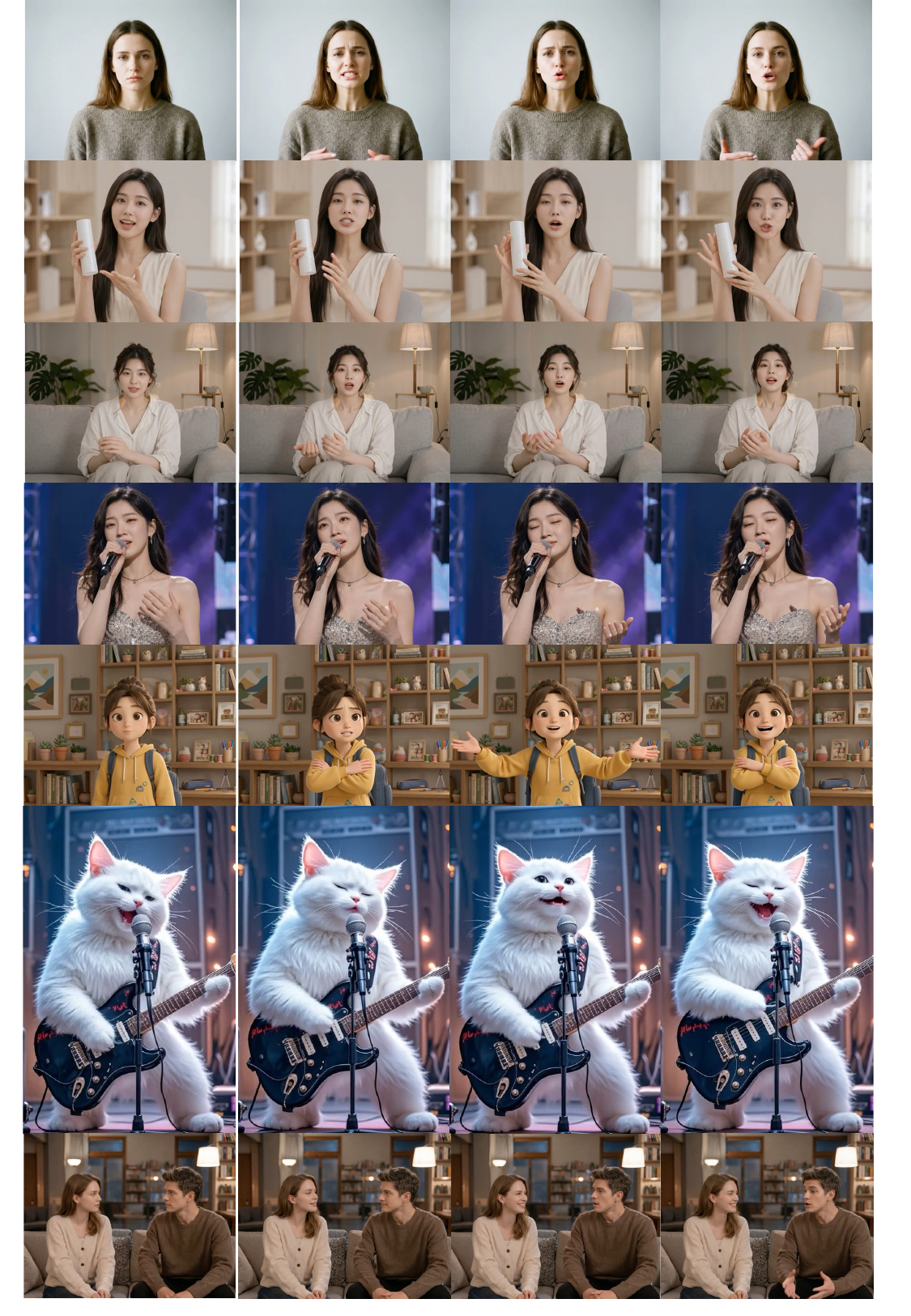
Demonstration of generated video frames across various application scenarios, including broadcasting, acting, singing, e-commerce marketing, multi-person conversation, animation, and animal. The leftmost column shows the input, followed by the generated intermediate frames. From LongCat-Video-Avatar 1.5.
A strong batch of papers lands today across the full avatar-and-voice stack: streaming character animation that finally escapes autoregressive chunk drift, a one-shot 3D head avatar that knows where to spend its Gaussians, dual-stream gesture generation grounded in biomechanics, and a TTS ecosystem that gains both fine-grained non-verbal expressiveness and principled speaker privacy. Here's everything worth reading.
Talking Avatars & Audio-Driven Animation
Real-time and long-duration audio-driven character animation continues to mature rapidly, with this batch tackling production stability, streaming latency, and the overlooked problem of natural gaze-head coupling.
Production-ready audio-driven avatars demand more than good lip-sync — they need identity stability over minutes of footage, diverse scenario coverage, and reliable training pipelines. LongCat-Video-Avatar 1.5 addresses all of these at once, combining large-scale curated data, advanced audio encoding, and reinforcement learning to produce stable, identity-consistent, long-duration videos with accurate lip-sync and full-body motion across real and stylized scenarios.
LongCat-Video-Avatar 1.5 · 2026-05
LongCat-Video-Avatar 1.5 Technical Report
An open-source audio-driven avatar video system prioritizing production readiness. It blends large-scale curated data, advanced audio encoding, and reinforcement learning to deliver stable, identity-consistent, long-duration videos with accurate lip-sync and full-body motion in diverse real and stylized scenarios.
Abstract
Despite advances in audio-driven video generation, achieving commercial-grade stability remains challenging. We present LongCat-Video-Avatar 1.5, an upgraded open-source framework prioritizing systematic engineering and production-readiness over architectural novelty. By upgrading the audio encoder to Whisper Large and meticulously scaling our training recipes, v1.5 achieves accurate lip-synchronization, full-body temporal stability, and robust long-video generation with strict identity consistency. Through rigorous data curation and RLHF Training, the model readily generalizes to stylized domains such as anime and animals, and natively handles complex real-world conditions, such as multi-person interactions and object handling. Furthermore, addressing the practical demands of industrial deployment, we employ advanced step distillation to accelerate inference to an optimal 8 NFE, achieving a favorable trade-off between serving efficiency and visual fidelity. The superiority of our approach is validated through extensive quantitative metrics and a rigorous human evaluation conducted on a comprehensive benchmark of over 500 diverse test cases. Results show that v1.5 achieves competitive or superior performance compared to leading closed-source systems (e.g., HeyGen, OmniHuman 1.5, Kling Avatar 2.0) across human-likeness ratings and expert-level quality assessments on our benchmark. With its open-source release, LongCat-Video-Avatar 1.5 narrows the gap between academic research prototypes and commercial-grade deployment.
0 citations · ★ 4,562 · MIT
Streaming avatar generation has historically suffered from error accumulation when audio-video chunks are stitched autoregressively. StreamChar sidesteps this by decoupling the problem into two cooperating modules: an LLM orchestrator that manages transcript fidelity over long horizons, and a joint diffusion transformer that handles efficient audio-video denoising — eliminating chunk-boundary artifacts while enabling genuine real-time streaming.

StreamChar · 2026-05
StreamChar: Long-Horizon Streaming Character Audio-Video Generation with Decoupled Orchestration
StreamChar enables real-time streaming character animation by decoupling transcript orchestration from audio-video denoising. An LLM orchestrator maintains fidelity while a joint diffusion transformer handles efficient synthesis, eliminating error accumulation from autoregressive chunk generation.
Abstract
Real-time streaming joint audio-video generation for character animation requires a generator to speak the requested transcript, maintain visual identity across chunks, and run within a strict playback budget. These requirements are difficult to satisfy simultaneously: chunk-wise autoregressive generation can accumulate transcript-audio misalignment and visual drift, while the few-step distillation needed for low latency often degrades spatial diversity and temporal quality. We present StreamChar, a streaming framework that separates long-horizon orchestration from short-window audio-video denoising. An LLM-based orchestrator uses the transcript and historical context to produce frame-aligned audio conditions, and a joint audio-video DiT performs local bidirectional denoising with reference and motion-frame conditioning. For efficient deployment, we use a two-stage distillation pipeline that first compresses the sampler and then fine-tunes the student under online chunk rollouts. A progress-aware pointer aligns partial transcripts with generated audio during rollout training, and a sink-chunk memory provides a persistent visual anchor for reducing long-horizon drift. Experiments on short-clip and long-horizon protocols show that StreamChar runs in real time on a single H100 GPU and provides a favorable system-level trade-off among transcript fidelity, audio-visual synchronization, visual quality, and streaming stability compared with recent joint and audio-driven baselines.
0 citations
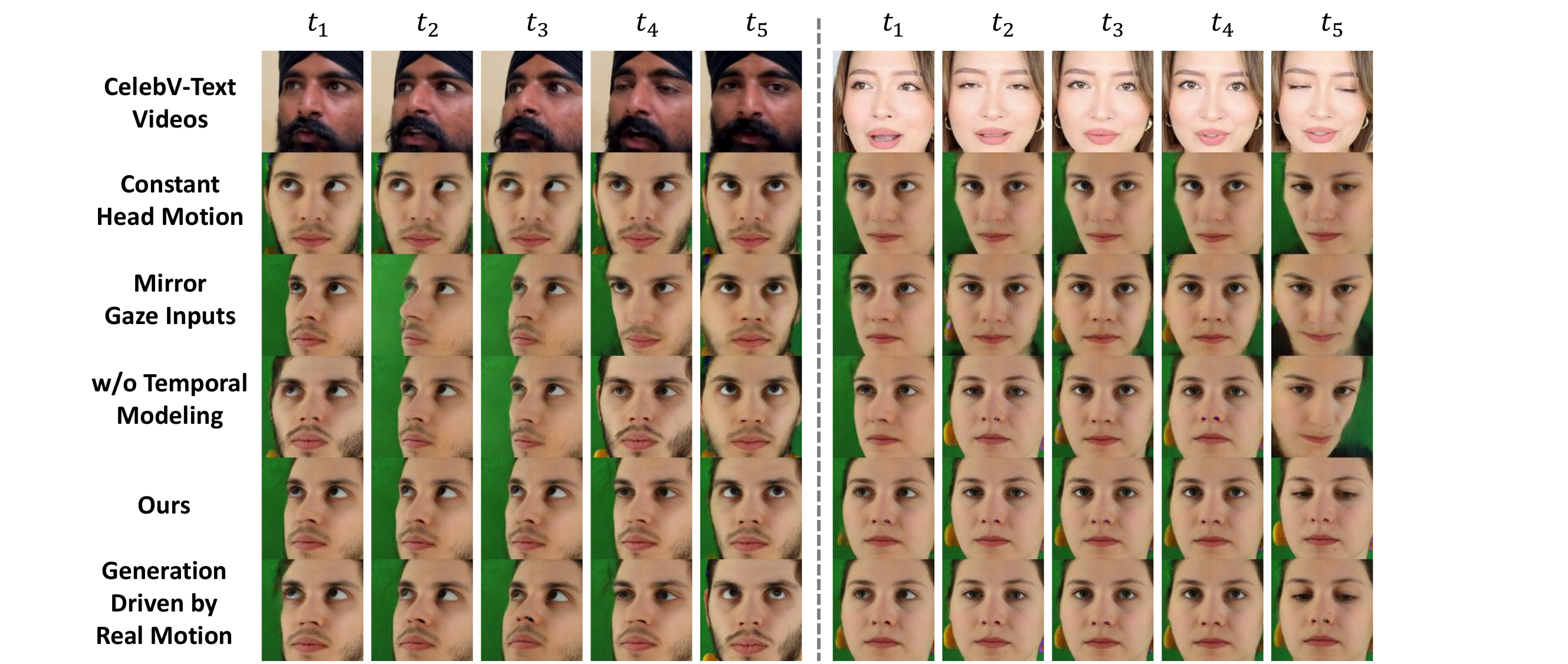
Head motion in talking avatars is usually modeled independently of where a character is actually looking, which breaks the natural coupling humans exhibit between gaze shifts and head rotation. GazeHead tackles this directly with a data-driven generative VAE trained on in-the-wild video, capturing the intrinsic temporal relationship between gaze direction and head pose to produce head motion that naturally follows input gaze rather than moving in an uncorrelated way.
GazeHead · 2026-05
Data-driven Head Motion Generation through Natural Gaze-Head Coordination
A data-driven approach to model temporal gaze-head coordination from in-the-wild videos. Unlike prior work treating head pose independently, it captures the intrinsic relationship between gaze and head motion using a generative VAE, enabling realistic head motion synthesis that naturally follows input gaze.
Abstract
We present the first data-driven approach to model temporal gaze-head coordination from large-scale in-the-wild facial videos. To obtain training data for generalizable learning, we propose an automatic pipeline that extracts natural yet diverse gaze and head motions with off-the-shelf appearance-based gaze estimators. To capture the probabilistic correlation and temporal dynamics of gaze-head coordination, we build our model on a generative conditional Variational Autoencoder for plausible yet diverse gaze-conditioned head motion generations. We further apply our framework to gaze-controlled facial video generation, where we enable video generation with natural and realistic head motion correlated to the input gaze - an aspect that has not been emphasized before. Human evaluation and quantitative comparisons demonstrate our method's effectiveness and validate our design choices, with evaluators showing statistically significant preference for our approach over baseline methods.
0 citations
Digital Humans & 3D Head Avatars
One-shot 3D reconstruction quality hinges on where you allocate representational capacity — and 3DGS methods have struggled to do this adaptively.
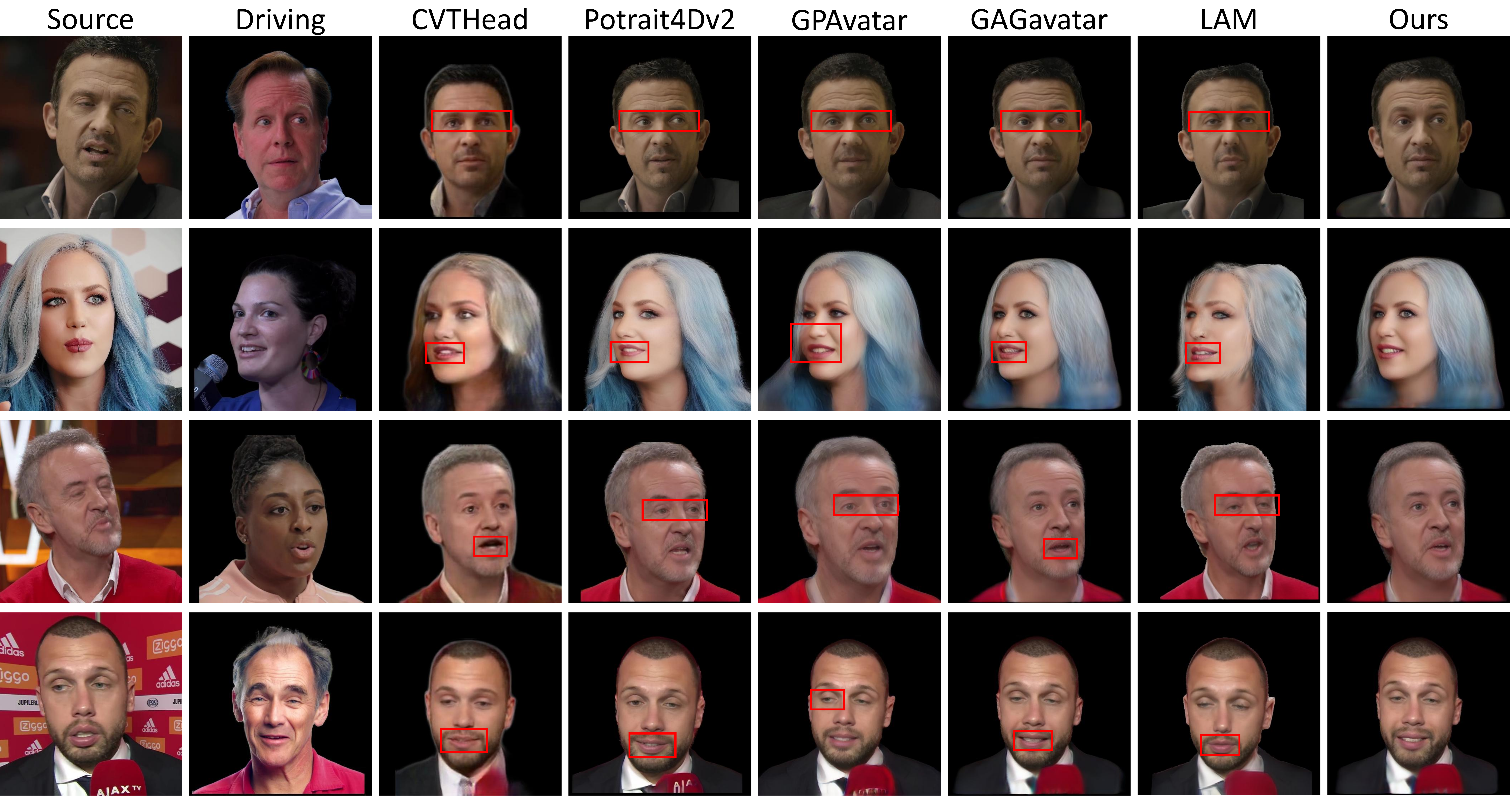
Existing 3D Gaussian Splatting approaches for head avatars apply uniform Gaussian density regardless of facial region, wasting capacity on flat skin while under-representing the high-motion areas around eyes and mouth. SplitAvatar fixes this with an autoregressive Gaussian splitting strategy that progressively refines expression detail by learning density control — concentrating Gaussians in expressive regions and delivering sharper reconstruction from a single reference image.
SplitAvatar · 2026-05
SplitAvatar: One-shot Head Avatar with Autoregressive Gaussian Splitting
One-shot head avatar reconstruction using autoregressive Gaussian splitting to progressively refine expression details. It addresses scale mismatches in prior 3DGS methods by progressively splitting Gaussians with learned density control, allocating more detail to expressive regions like eyes and mouth.
Abstract
3D Gaussian Splatting (3DGS) provides an efficient method for high-quality scene reconstruction using anisotropic Gaussians. Recently, 3DGS-based methods have significantly improved the rendering quality of human avatars while enabling real-time performance. However, existing methods suffer from a magnitude mismatch in the number of Gaussians generated by image-based and 3DMM-based approaches. This discrepancy results in reconstructed expressions that lack fine-grained detail. In this paper, we introduce a novel method for reconstructing an animatable head avatar from a single image. We propose a Graph splitting network to progressively generate Gaussians from coarse to fine using an autoregressive architecture. To address the graph inconsistency caused by split Gaussians, we employ a mesh topology extension method to align the GNN's connectivity with the increased Gaussian count. Furthermore, we introduce a novel density control method that includes a gating mechanism that generates soft masks for Gaussians, preventing over-densification after the splitting operation. This allows for dynamic control over Gaussian density across different facial regions. For smooth and rapid training, we employ a delayed filtering strategy to avoid re-computing the graph topology during training. Experimental results demonstrate that our autoregressive structure effectively improves expression representation ability by progressively splitting Gaussians. This process, enabled by the GNN-guided splitting, synthesizes more precise facial details and achieves higher reconstruction quality.
0 citations
Co-Speech Gesture & Body Animation
Bridging the gap between linguistically grounded semantics and rhythmically driven beat motion remains a central challenge in gesture synthesis.
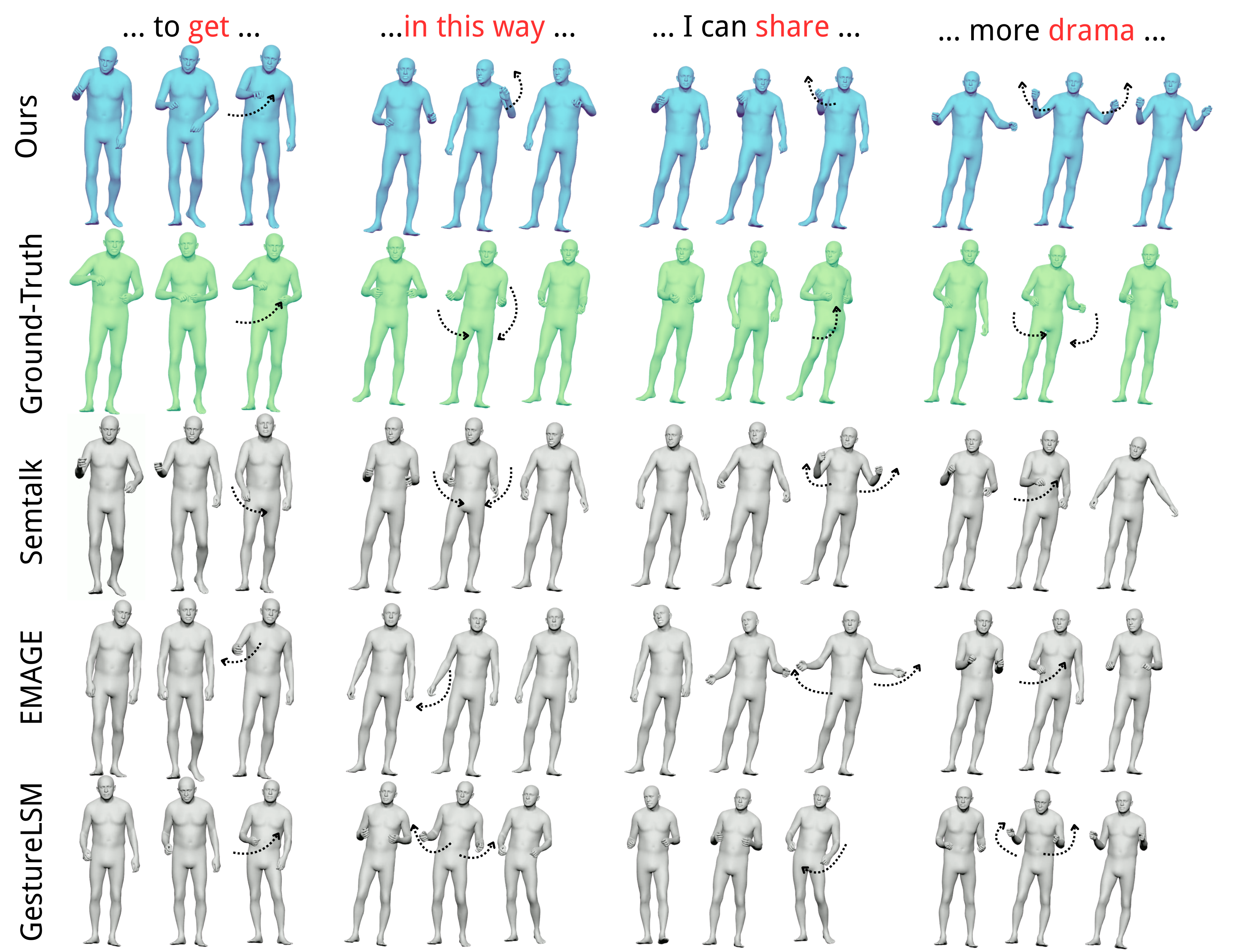
Most co-speech gesture systems use a single conditioning stream that forces a trade-off between semantic expressivity and rhythmic accuracy. DuoGesture takes inspiration from neuroscience and biomechanics to decompose generation into separate semantic and beat streams, each with specialized conditioning. Motion-grounded semantic representations replace purely linguistic embeddings, stochastic gating controls stream mixing, and biomechanical regularization keeps the output physically plausible — improving both speech-motion alignment and expressive quality.
DuoGesture · 2026-05
DuoGesture: Neuro-Inspired and Biomechanically Informed Dual-Stream Co-Speech Gesture Generation
DuoGesture decomposes co-speech gesture synthesis into semantic and beat streams with specialized conditioning and biomechanical regularization. It improves semantic expressivity and speech-motion alignment by using motion-grounded semantic representations and stochastic gating instead of purely linguistic embeddings.
Abstract
Co-speech gesture generation requires both semantic expressivity and biomechanically plausible rhythmic motion. Existing holistic gesture models mix lexically grounded semantic gestures with frequent prosody-aligned beat gestures. This limits semantic grounding, speech-motion alignment, and kinematic smoothness. We propose \emph{DuoGesture}, a neuro-inspired and biomechanically informed dual-stream approach that decomposes co-speech gesture synthesis into coupled semantic and beat streams. The two streams are coordinated by a \emph{Semantic Variational Information Bottleneck}, a stochastic frame-level gate that learns when semantic gestures should override rhythmic beat motion. The semantic stream is controlled by \emph{Motion-Grounded Semantic Conditioning}, which replaces purely linguistic word embeddings with motion-language representations to provide motion-aligned semantic priors for long-tailed lexical triggers of gestures. The beat stream is further regularised by an \emph{Inertial Beat Prior}, an anthropometry-weighted arm-chain module that reduces jitter and improves rhythmic consistency without constraining semantic frames. Objective evaluations and subjective experiments show that DuoGesture outperforms strong holistic baselines, while component ablations confirm the complementary roles of semantic grounding, stochastic stream selection, and biomechanical regularisation.
★ 0 · null
TTS & Voice Synthesis
Three papers today extend the TTS frontier in complementary directions: better acoustic editing via RL, fine-grained non-verbal vocal expression, and privacy-preserving continual speaker unlearning.
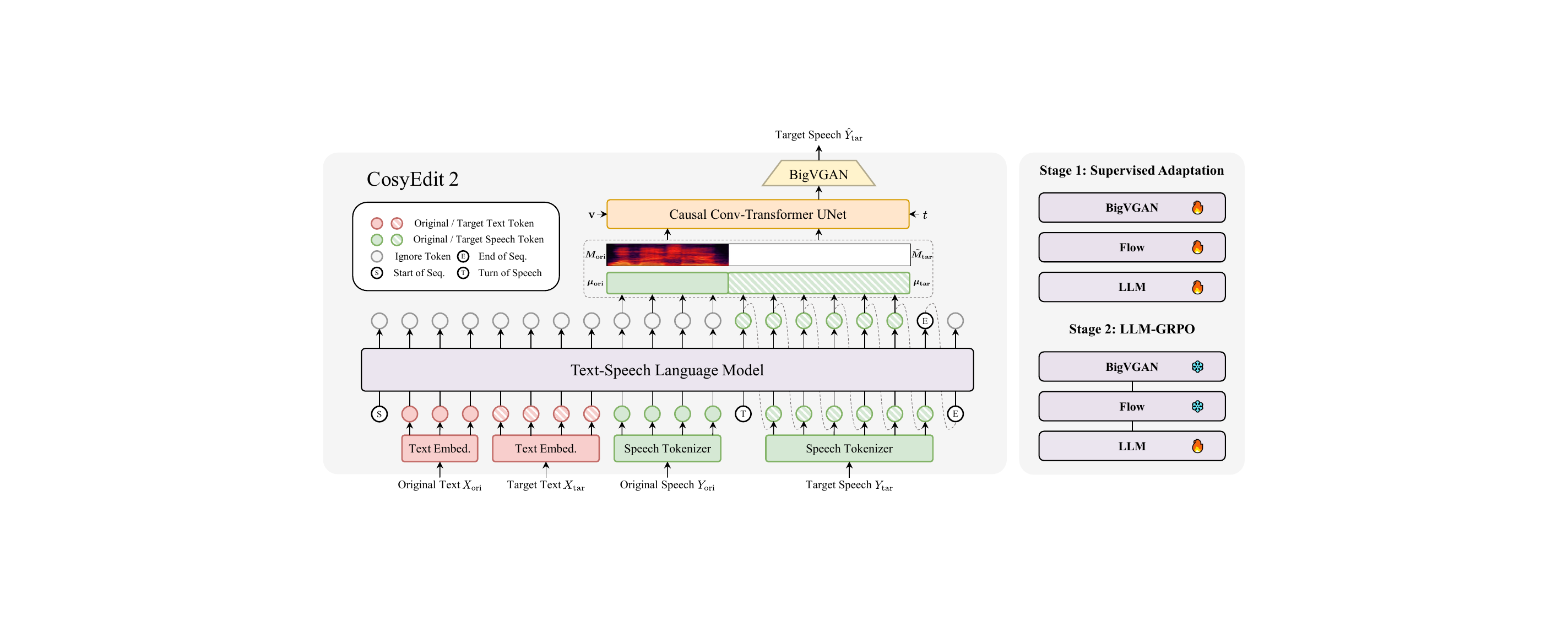
Supervised fine-tuning for speech editing tends to plateau: the model learns to produce plausible edits but struggles to preserve the surrounding acoustic context precisely. CosyEdit2 introduces editing-oriented reinforcement learning to push past this ceiling — and interestingly, the gains in acoustic preservation transfer back to improved zero-shot TTS performance, revealing a bidirectional relationship between the two tasks.
CosyEdit2 · 2026-05
CosyEdit2: Speech-Editing-Oriented Reinforcement Learning Unlocks Better Zero-Shot TTS
A speech editing model leveraging editing-oriented reinforcement learning to overcome supervised fine-tuning limitations. The approach achieves stronger acoustic preservation while unlocking improved zero-shot TTS, revealing a bidirectional relationship between the two tasks.
Abstract
Speech editing and zero-shot Text-to-Speech (TTS) share a similar generative foundation conditioned on speech prompts, yet speech editing demands far stricter local acoustic consistency with surrounding unedited content. While prior work has shown that Supervised Fine-Tuning (SFT) enables TTS models to acquire functional editing capability, this approach remains fundamentally bottlenecked by imperfect paired editing data and coarse-grained optimization signals. To address these limitations, we propose CosyEdit2, a speech editing model built on a two-stage post-training framework that progresses from supervised editing initialization to editing-oriented Group Relative Policy Optimization (GRPO) over target-speech-free data. Extensive experiments demonstrate that CosyEdit2 not only substantially advances speech editing performance, but also unlocks better zero-shot TTS capability, revealing a deeper mutual relationship between the two tasks. Audio samples are available at https://cjy1018.github.io/CosyEdit2.
0 citations · ★ 0 · Apache-2.0
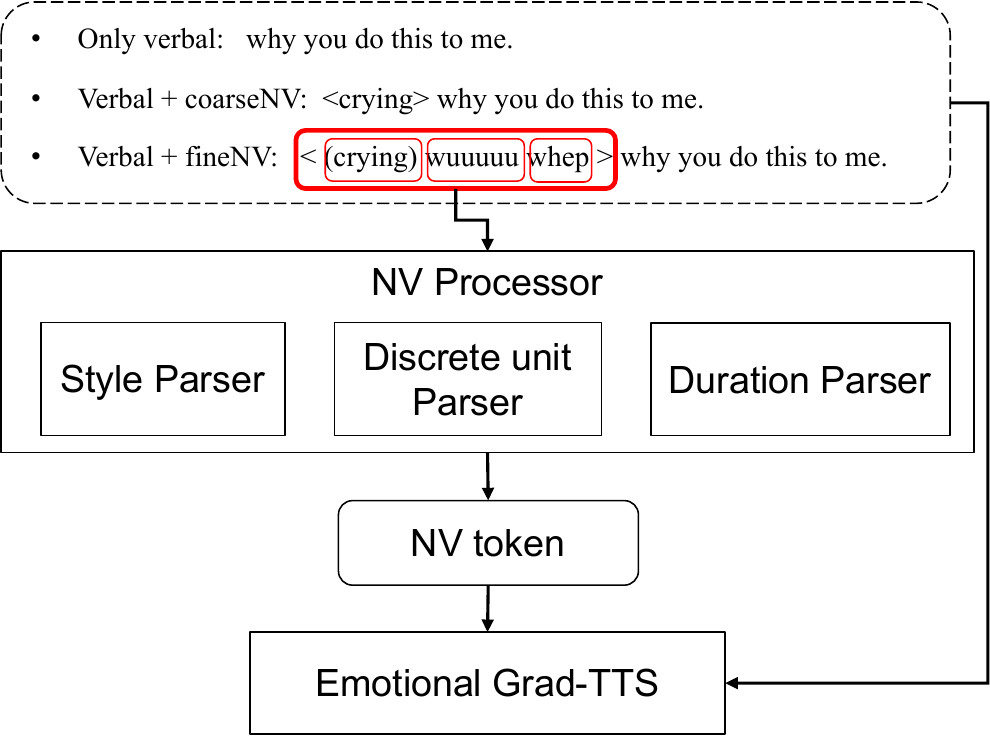
Emotional TTS has long treated non-verbal vocalizations (laughter, sighs, cries) as afterthoughts, relying on coarse emotion tags that give the model little guidance on timing or intensity. Fine-Grained NV-TTS adds structured annotations specifying vocalization type, frequency, and duration, enabling precise placement and synthesis of emotional sounds with measurably higher expressiveness and emotion recognition accuracy compared to tag-only baselines.
Fine-Grained NV-TTS · 2026-05
Toward Natural Emotional Text-To-Speech System with Fine-Grained Non-Verbal Expression Control
This paper adds controllable non-verbal vocalizations (laughter, cries, sighs) to emotional TTS using fine-grained annotations specifying type, frequency, and duration. Unlike coarse-tag baselines, this enables precise emotional sound synthesis with significantly higher expressiveness and emotion recognition accuracy.
Abstract
While current emotional Text-to-Speech (TTS) models have successfully controlled verbal prosody, they often ignore non-verbal vocalizations (NVs), which are essential for authentic human emotion. Although some non-verbal datasets have recently emerged, they often lack high-quality, fine-grained annotations, which restricts a model's ability to precisely control NV generation. To address this limitation, we propose a novel approach for fine-grained non-verbal expression synthesis. We curate and reprocess female NV utterances from the EARS corpus, develop a new annotation scheme using tags to encode NV types, frequencies, and durations, and build an emotional TTS benchmark to demonstrate its effectiveness. Our evaluation shows that while our NV approach leads to minor trade-offs in perceived naturalness, it significantly improves expressiveness (eMOS 4.20) and emotional recognition accuracy (78.8%). Emotion-specific analysis further reveals that NV cues are highly effective for high-arousal emotions like happy (82.5%) and fear (82.7%), and almost perfectly convey sadness (98.3%).
★ 0 · null
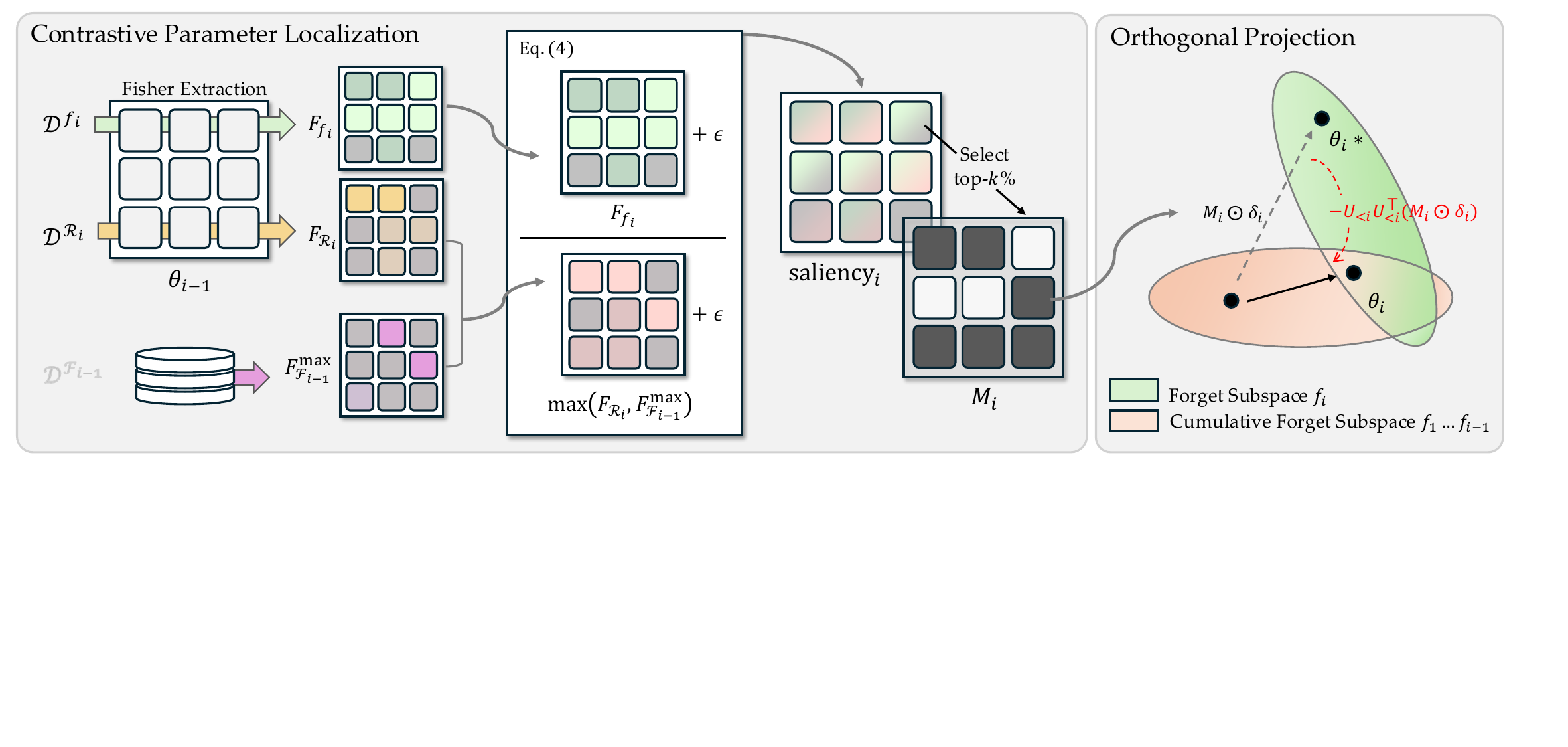
Zero-shot TTS systems trained on large speaker corpora face a growing legal and ethical obligation to remove specific speaker identities on request — and to keep removing them as new requests arrive, without access to past data. CORTIS addresses continual speaker identity unlearning by combining contrastive Fisher-information masking with orthogonal projection, preventing previously forgotten speakers from being revived as new unlearning rounds occur, all without storing historical speaker data.
CORTIS · 2026-05
Continual Speaker Identity Unlearning with Minimal Interference
CORTIS enables continual speaker identity unlearning in zero-shot text-to-speech without reviving previously forgotten speakers. It combines contrastive Fisher-information masking with orthogonal projection to handle sequential privacy-removal requests without retaining past speaker data.
Abstract
Machine unlearning removes designated concepts or knowledge from pre-trained models. Recent work has extended this paradigm to speaker identity unlearning in zero-shot text-to-speech (ZS-TTS), the task of selectively erasing a model's ability to replicate a speaker's voice. Existing methods, however, quietly assume all unlearning requests arrive at once; an unrealistic assumption, since privacy-motivated removals arrive sequentially over time. We show this assumption breaks state-of-the-art methods: unlearning each new speaker fully revives previously unlearned speakers, reintroducing the very privacy risk unlearning was meant to eliminate. We present Cumulative ORThogonal Identity Suppression (CORTIS), the first framework for continual speaker identity unlearning in ZS-TTS that requires no access to previously-unlearned speaker data. CORTIS combines Fisher-information-based parameter masking, which localizes updates to speaker-relevant weights, with orthogonal projection against subspaces spanned by prior unlearning updates. With VoiceBox, CORTIS unlearns each requested speaker while keeping previously unlearned speakers forgotten across long request sequences, substantially outperforming sequential application of prior methods. The demo is available at https://cumulativeortis.github.io/ .
0 citations