
Real-Time Avatars and Noise-Robust Speech Recognition
Today's digest covers ray-traced shadows for 3DGS avatars, high-resolution feedforward human reconstruction from sparse video, and a variational bottleneck approach to noise-robust audio-visual speech recognition.
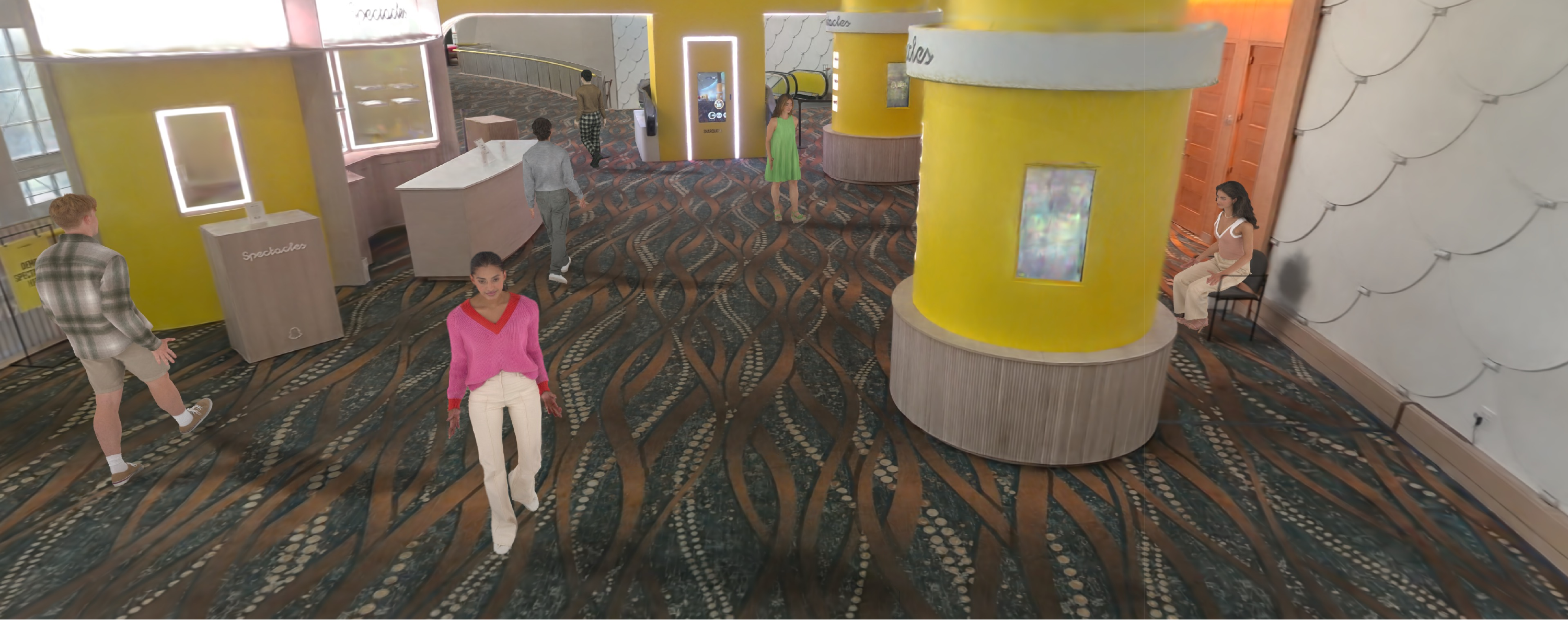
RAGA casts physically plausible shadows for animated 3DGS avatars composited into 3DGS scenes. Our ray-traced Gaussian shadow casting produces soft, temporally stable shadows entirely in Gaussian space, without any meshing. From RAGA.
A compact but technically rich set of papers today — two pushing the boundaries of real-time 3D human rendering and one bringing more robust perception to LLM-based speech systems. Whether you're building interactive avatars or deploying ASR in noisy environments, there's something here worth your attention.
Digital Humans & 3D Avatars
Advances in Gaussian Splatting pipelines are making photorealistic, real-time human reconstruction more practical than ever — both for rendering fidelity and scene integration.
One longstanding gap in 3DGS avatar work has been physically plausible shadow casting: avatars placed in reconstructed scenes cast no shadows, breaking visual coherence. RAGA addresses this directly by moving shadow computation entirely into Gaussian space, using closed-form ray–Gaussian line integrals rather than binary hit tests. A dedicated stable avatar proxy suppresses the temporal flickering that plagues naïve per-frame approaches, enabling smooth real-time results.
RAGA · 2026-06
RAGA: Real Time Ray Traced Gaussian Shadow Casting for 3DGS Avatar-Scene Interaction
Real-time shadow casting for animated 3D Gaussian Splatting avatars in 3DGS scenes. Unlike prior methods that use binary hit tests, RAGA computes shadows entirely in Gaussian space via closed-form ray–Gaussian line integrals and includes a stable avatar proxy to eliminate temporal flickering.
Abstract
We study the problem of physically plausible shadow casting when animating 3D Gaussian Splatting (3DGS) avatars, either individually or in multi-avatar and object-interaction scenarios, within existing 3DGS scenes. In contrast to prior methods that rely on binary hit tests and mesh-based shadow casters, our method performs shadow computation entirely in Gaussian space, without requiring any mesh reconstruction. We introduce RAGA, a Ray-Traced Gaussian Shadow Casting formulation based on exact ray-Gaussian line integrals. For each occluding Gaussian, we integrate the opacity profile along the shadow ray and normalize by the theoretical maximum integral, producing a weight that captures how the ray traverses the occluder rather than merely whether an intersection occurred. To reduce temporal variance from clothing deformations in animated avatars, we further introduce an avatar proxy representation that stabilizes shadow casting while preserving visual fidelity. We implement RAGA using custom CUDA kernels integrated with the NVIDIA OptiX framework; as such, our shadow tracer runs at rates of about 50 FPS. We evaluate on single-avatar, multi-avatar, and avatar-object interaction scenarios across multiple datasets, demonstrating substantially improved shadow realism, temporal stability, and scene coherence. Our project page is available at https://miraymen.github.io/raga/.
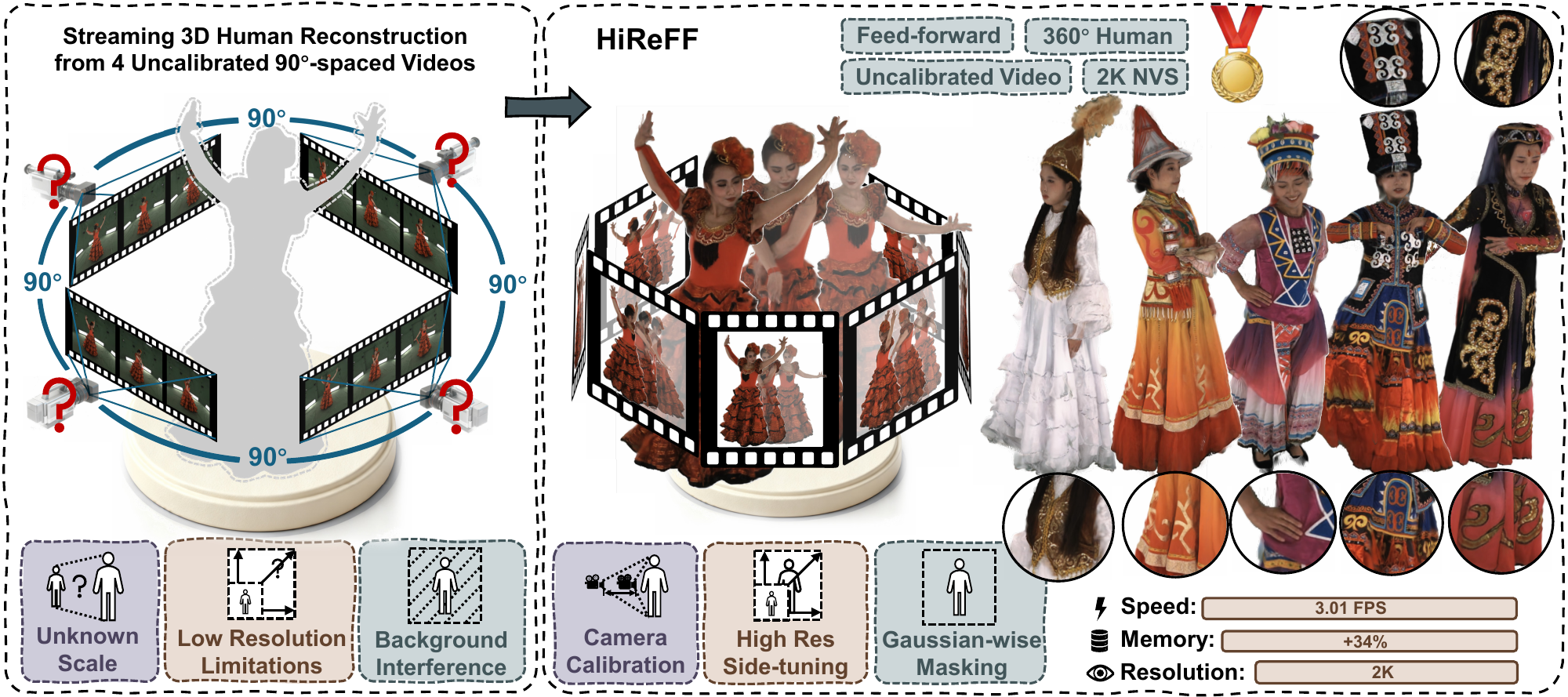
On the reconstruction side, getting a high-fidelity 360° human model from just a few uncalibrated cameras — and doing it in a streaming, real-time fashion — remains a hard problem. HiReFF tackles this with a feed-forward architecture that decomposes the task: Gaussian reconstruction handles geometry and coarse appearance, while a lightweight side-tuning module handles high-resolution (2K) synthesis. The result is temporally consistent streaming reconstruction without the overhead of per-scene optimization.
HiReFF · 2026-06
HiReFF: High-Resolution Feedforward Human Reconstruction from Uncalibrated Sparse-View Video
A feed-forward method for streaming 360° human reconstruction at 2K resolution from uncalibrated sparse-view videos. It achieves real-time performance with temporal consistency by efficiently decomposing Gaussian reconstruction and high-resolution synthesis via a lightweight side-tuning architecture.
Abstract
Uncalibrated volumetric video streaming for human reconstruction is essential for holographic communication and AR/VR, yet remains challenging due to the need for temporal consistency and computational efficiency from sparse-view inputs. Existing methods rely on per-scene optimization or calibrated cameras, while recent feed-forward models are limited to low-resolution (0.5K) single-frame synthesis. We present HiReFF, a feed-forward method for 2K-resolution 360° human video reconstruction from uncalibrated sparse-view videos. Our framework decomposes the problem into two key tasks: foreground 3D Gaussian reconstruction from sparse-view videos (four views separated by 90°) and computationally efficient high-resolution synthesis. To enable the former, we propose Scale-synchronized Camera Calibration to resolve scale ambiguity for multi-view supervision, and Gaussian-wise Foreground Masking to reconstruct clean foregrounds by modulating Gaussian parameters. For efficient high-resolution synthesis, our High-resolution Side-tuning achieves 2K rendering by augmenting the Gaussian head with supplementary features while keeping the backbone at 0.5K, drastically reducing computational overhead. Experiments demonstrate that HiReFF significantly outperforms existing methods in high-resolution streaming volumetric video reconstruction. https://iridescentjiang.github.io/HiReFF
MIT
Audio-Visual Speech Recognition
LLM-based AVSR systems inherit powerful priors but remain sensitive to acoustic noise — targeted compression of audio representations offers a principled fix.
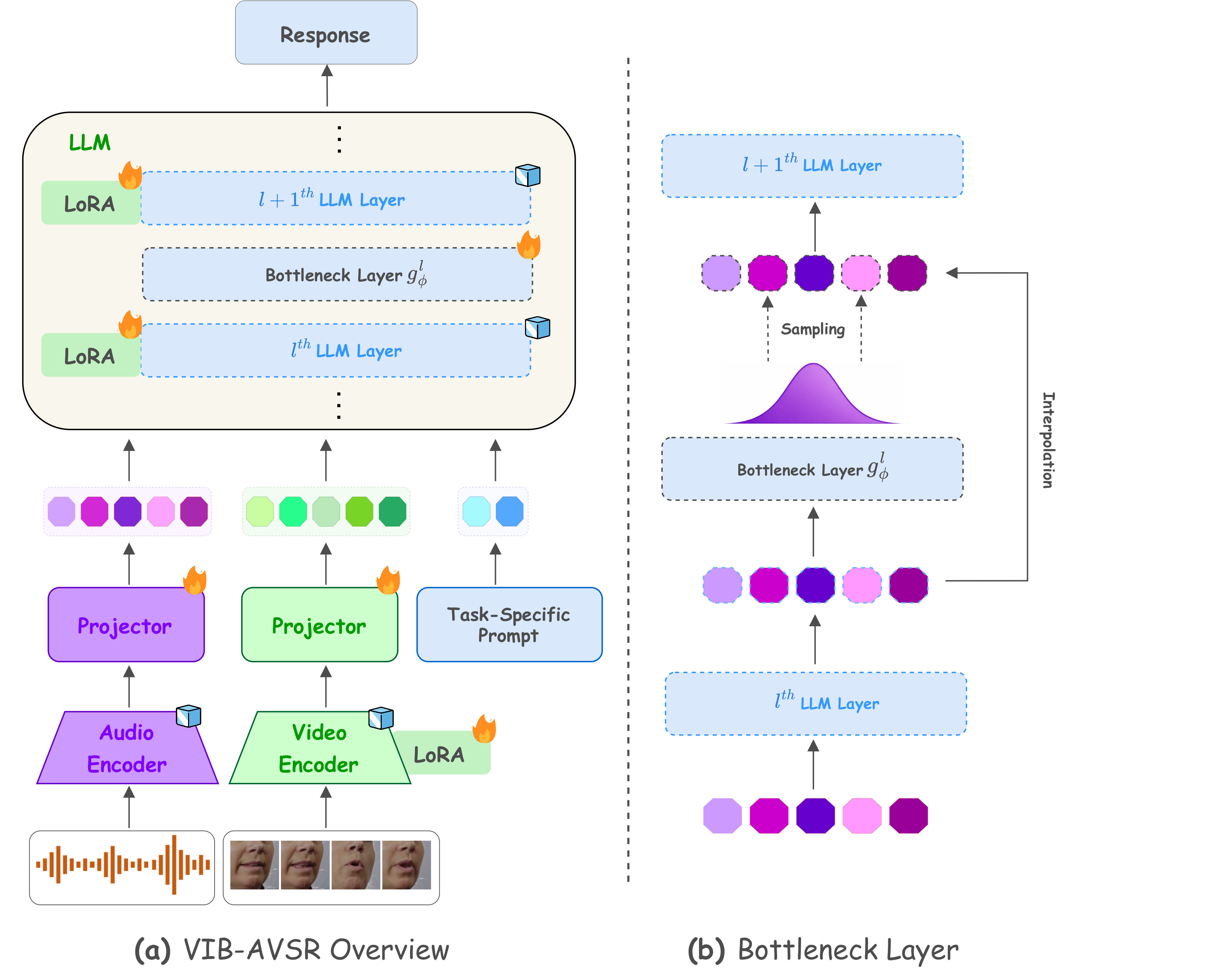
Integrating visual context into speech recognition has improved robustness, but LLM-based AVSR pipelines still struggle when audio is heavily corrupted. VIB-AVSR inserts Variational Information Bottleneck layers into the audio encoding pathway, forcing the model to compress representations and discard noise variance before they reach the LLM. Crucially, this is achieved without architectural overhaul or extra training data, yet delivers significant WER gains across a range of noise conditions.
VIB-AVSR · 2026-06
VIB-AVSR: Variational Information Bottleneck for Noise-Robust LLM-Based Audio-Visual Speech Recognition
Improves noise robustness in LLM-based audio-visual speech recognition by adding Variational Information Bottleneck layers to compress audio representations and discard noise variance. Achieves significant gains across noise conditions without architectural changes or additional training data.
Abstract
Audio-Visual Speech Recognition takes two input modalities, acoustic and visual streams, where visual information from lip movements aids recognition when audio is noisy. Recently, LLM-based AVSR models have emerged as a promising paradigm by connecting pre-trained audio-visual encoders to an LLM, achieving strong results in clean conditions. However, these models are predominantly optimized for clean acoustic conditions, with limited attention to making the LLM backbone robust to noise. No explicit mechanism is employed to produce stable representations under corrupted audio, leading to performance degradation in noisy environments. To address this, we propose VIB-AVSR, which integrates Variational Information Bottleneck layers at targeted positions within the LLM backbone to regularize representations. VIB-AVSR reduces degradation under noisy conditions across multiple SNR levels and noise types, without requiring architectural modifications or additional training data.