
This Week in Conversational AI Research: June 29–July 05, 2026
A dense week spanning real-time multimodal agents, TTS alignment via reinforcement learning, and a wave of single-image avatar reconstruction systems — plus a sobering audit of how well production voice AI actually uses the emotions it perceives.
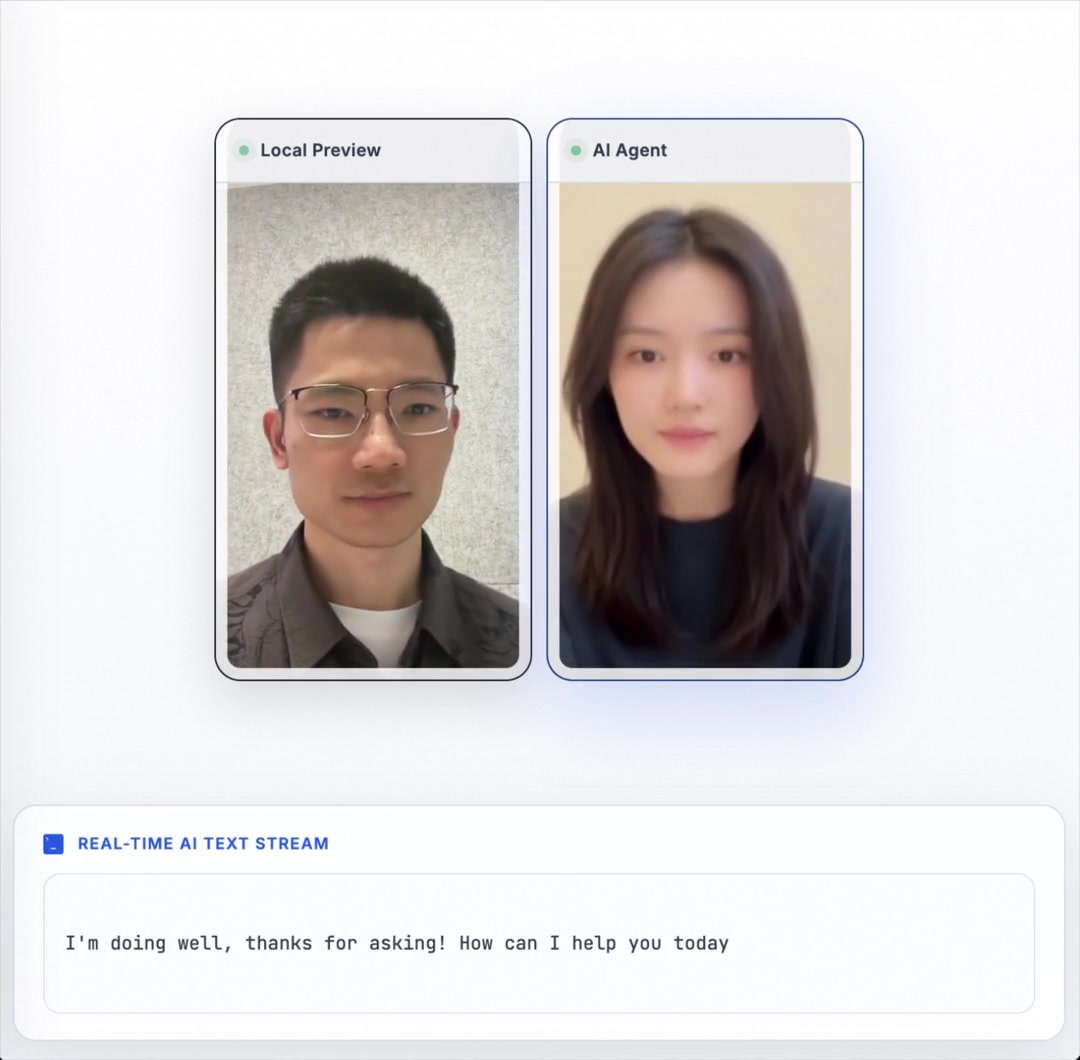
The week of June 29–July 05 brought an unusually rich slate of papers across every layer of the conversational AI stack: end-to-end streaming agents, a cluster of RL-driven TTS refinement methods, new benchmarks exposing gaps in expressiveness and acoustic grounding, and a bumper crop of avatar and 3D face work pushing toward production-quality digital humans from minimal input. Several threads run through many of the papers simultaneously — the move from cascaded to unified architectures, the use of flow matching as a universal generative substrate, and the recognition that preference alignment (via RL or human feedback) is becoming as important for speech and face models as it already is for text LLMs.
End-to-End Streaming Interaction
The hardest constraint in conversational AI is latency under full-duplex conditions — this week's headline system tackles it by eliminating the pipeline entirely.
The most architecturally ambitious paper of the week is Wan-Streamer, which argues that the entire stack of VAD, ASR, LM, TTS, animation, and video generation should be collapsed into a single causal Transformer. Rather than being a serving optimization, this is presented as a modeling necessity: the system must maintain a unified interaction state across modalities while simultaneously consuming user audio-visual input and producing its own speech and video response.
Wan-Streamer · 2026-06
Wan-Streamer v0.1: End-to-end Real-time Interactive Foundation Models
Wan-Streamer is an end-to-end interactive foundation model unifying text, audio, and video in a single Transformer for real-time full-duplex audio-visual interaction. It jointly learns perception and generation without separate modules, enabling sub-second latency streaming with synchronized multimodal responses.
Abstract
We present Wan-Streamer, a native-streaming, end-to-end interactive foundation model designed from the ground up for real-time, low-latency, full-duplex audio-visual interaction. Wan-Streamer seamlessly models language, audio, and video as both input and output within a single Transformer, where the sequence is represented as interleaved visual, audio, and text input tokens together with visual, audio, and text output tokens, coordinated by block-causal attention for incremental streaming. Unlike cascaded interactive systems that rely on separate VAD, ASR, language, TTS, audio-driven animation, or video-generation modules, Wan-Streamer does not rely on external language, speech, avatar, or video-generation modules: perception, reasoning, generation, response timing, turn management, and cross-modal synchronization are learned jointly within one unified model, reducing pipeline latency and error accumulation. To support natural audio-visual responsiveness, we redesign the entire stack around streamability, including causal encoders, causal decoders, block-causal attention, and low-latency multimodal token scheduling, enabling streaming units as short as 160 ms at 25 fps. Wan-Streamer achieves approximately 200 ms model-side response latency and approximately 550 ms total interaction latency when combined with 350 ms bidirectional network latency, supporting sub-second duplex audio-visual communication. These results position Wan-Streamer as a unified, end-to-end, multimodal interactive foundation model for low-latency streaming interaction.
Wan-Streamer represents text autoregressively with next-token prediction and audio/video with conditional flow matching over continuous latents, all within the same model under a block-causal attention mask. Each streaming unit is as short as 160 ms at 25 fps, and the reported model-side latency is approximately 200 ms — with ~550 ms total including 350 ms of bidirectional network round-trip. Whether a v0.1 system of this scope can match cascaded baselines on any individual subtask remains to be seen, but it establishes a concrete unified baseline that the field can now measure against.
Reinforcement Learning Meets TTS
A striking convergence: three independent groups applied RL-style preference optimization to flow-matching TTS models in the same week, each attacking a different failure mode.
Supervised fine-tuning on next-token prediction has a well-known pathology in TTS: it averages over the training distribution, flattening prosody and emotional expressiveness. This week saw a cluster of papers that treat this as a preference alignment problem, borrowing GRPO and related objectives from the LLM literature.
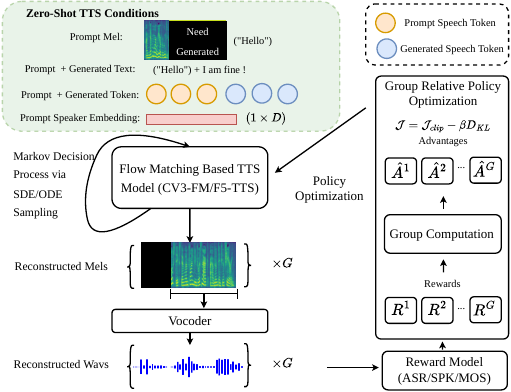
FlowTTS-GRPO is the most direct application of this idea to flow-matching TTS. The key technical challenge is that FM decoding is a deterministic ODE, which provides no exploration for RL. The paper solves this by converting the ODE trajectory into a stochastic reverse-time SDE, enabling on-policy sampling without any auxiliary models. Applied to CosyVoice 3.0 and F5-TTS, it uses a weighted combination of speaker similarity (ERes2Net), perceptual quality (DNSMOS), and ASR-based intelligibility rewards, with standard-deviation normalization to handle the reward-scale mismatch across objectives.
FlowTTS-GRPO · 2026-06
FlowTTS-GRPO: Online Reinforcement Learning with Multi-Objective Reward Optimization for Flow-Matching Based Text-to-Speech
FlowTTS-GRPO uses online reinforcement learning to fine-tune flow-matching TTS models with multi-objective rewards for speaker similarity, quality, and intelligibility. It enables exploration via stochastic sampling without auxiliary models, improving voice cloning and cross-lingual transfer.
Abstract
Existing Reinforcement Learning (RL) research for Text-to-Speech (TTS) focuses on large language models (LLMs), leaving Flow-Matching (FM) under-explored. We present FlowTTS-GRPO, an online RL framework for FM-based TTS. By converting ordinary differential equation (ODE) trajectories into stochastic differential equation (SDE) paths, our method enables direct fine-tuning of open-source FM models without auxiliary models. We show that a weighted reward combination converges faster than a probabilistic scheme, and identify three practical optimizations: omitting classifier-free guidance (CFG) during training accelerates convergence; synthesizing hard cases improves robustness; and applying RL to the FM component enhances audio-detail metrics. Experiments on CosyVoice 3.0 and F5-TTS demonstrate objective and subjective preference gains in speaker similarity and perceptual quality, with F5-TTS also improving intelligibility.
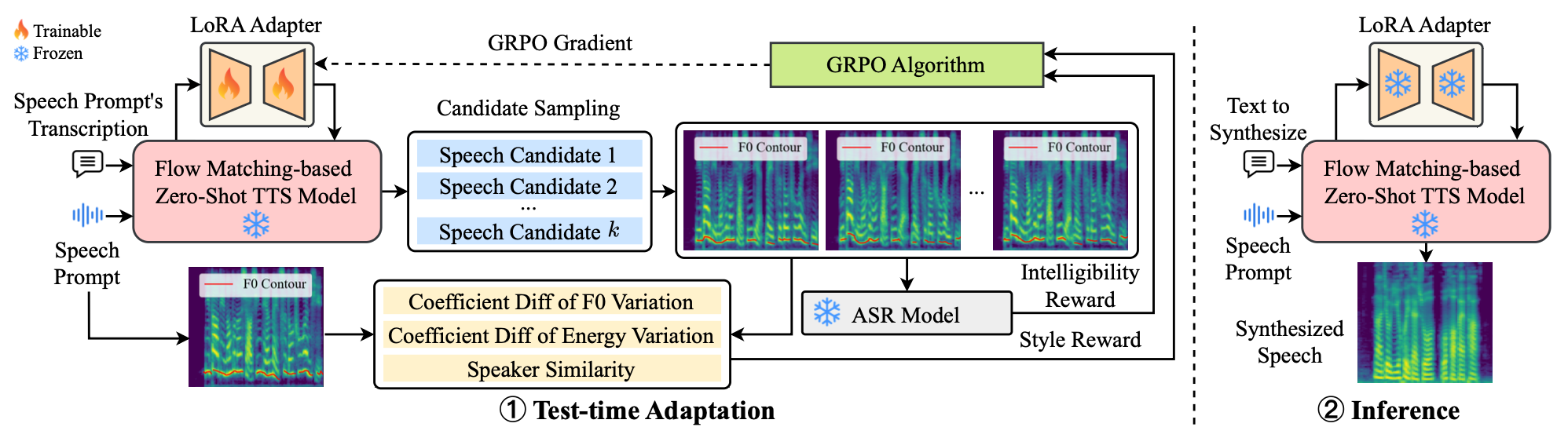
VoiceTTA takes a complementary angle: rather than fine-tuning the model weights, it adapts learnable prefixes at test time via GRPO, requiring only a few seconds of reference audio. This makes it particularly useful for out-of-distribution speaking styles — crosstalk, dialects, children's speech — where the pretrained model lacks coverage. The reward uses F0 and energy coefficient-of-variation differences to capture style dynamics, in addition to speaker similarity and Whisper-based WER.
VoiceTTA · 2026-06
VoiceTTA: Enhancing Zero-Shot Text-to-Speech via Reinforcement Learning-Based Test-Time Adaptation
VoiceTTA enhances zero-shot text-to-speech by using reinforcement learning for test-time adaptation that optimizes lightweight prefixes with style and intelligibility rewards. It adapts pretrained models on unseen speech styles at inference without large fine-tuning datasets.
Abstract
Recently, zero-shot text-to-speech (TTS) has enabled high-fidelity and expressive speech synthesis, but it often fails to imitate unseen speaking styles from uncommon scenarios (e.g., crosstalk, dialects). Moreover, fine-tuning pretrained models requires large, high-quality datasets, limiting rapid personalization. We propose VoiceTTA, a reinforcement learning-based test-time adaptation (TTA) method that improves voice imitation of pretrained zero-shot TTS models. VoiceTTA introduces two style rewards based on coefficient-of-variation differences of F0 and energy, combined with speaker similarity and intelligibility (WER from a pretrained Whisper model), and optimizes learnable prefixes via group relative preference optimization (GRPO) in a flow matching-based model at inference time. Extensive experiments demonstrate substantial improvements on uncommon speech prompts, outperforming state-of-the-art baselines. Audio samples are available at https://voicetta.pages.dev/
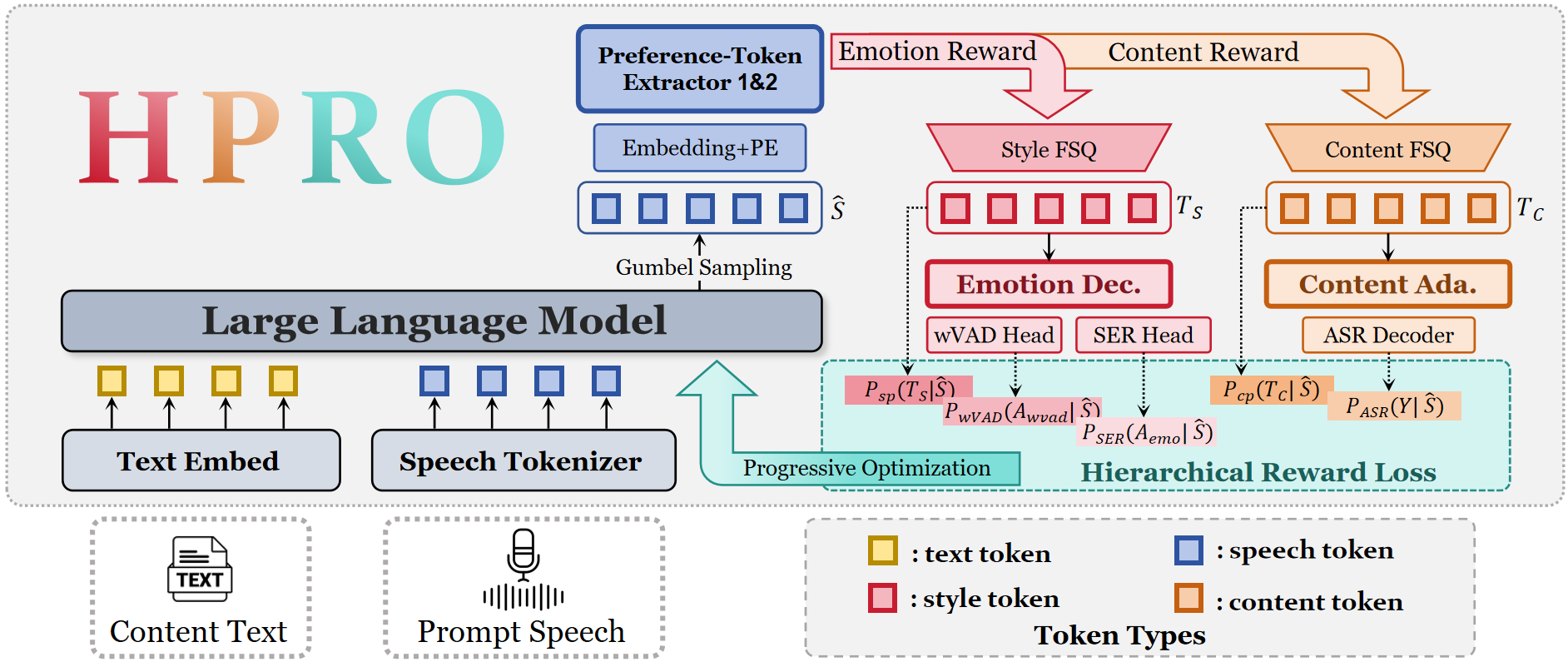
HPRO attacks a different failure mode: the information conflict that arises when content and emotion are jointly represented in a shared latent space and reward gradients interfere with each other. The solution is a new differentiable reward model, the HD-Emo codec, which factorizes speech tokens into content-preference tokens (supervised by ASR loss) and style-preference tokens (supervised hierarchically at frame, word, and sentence levels using emotion2vec and valence-arousal-dominance objectives). This structural separation prevents reward hacking from degrading intelligibility while pursuing emotional expressiveness.
HPRO · 2026-06
HPRO: Hierarchical Progressive Reward Optimization via Preference Extraction for Emotional Text-to-Speech
HPRO improves emotional text-to-speech by separating content and style into distinct preference tokens and optimizing generation progressively at frame, word, and sentence levels, boosting naturalness and expressiveness while avoiding semantic-emotion conflicts.
Abstract
Recently, Large Language Model (LLM)-based Text-to-Speech (TTS) models have achieved remarkable naturalness. However, the standard Supervised Fine-Tuning paradigm often converges to statistically averaged prosody, limiting emotional expressiveness. While preference-driven optimization offers a promising alternative, existing approaches suffer from two structural mismatches: information conflict, where content and emotion in a shared latent space produce conflicting gradients, leading to reward hacking and semantic degradation; and scale gap, where sparse sentence-level rewards struggle to guide dense frame-level generation. To overcome these challenges, we propose HPRO, a hierarchical progressive reward optimization framework. Within HPRO, we introduce the HD-Emo codec as a novel differentiable reward model to resolve the information conflict. It extracts speech into distinct content and style preference tokens, structurally isolating emotional optimization from semantic content. Building upon this structured preference space, HPRO bridges the scale gap by progressively aligning frame-, word- and sentence-level objectives. Experiments demonstrate that HPRO significantly enhances emotional expressiveness, while effectively preserving linguistic intelligibility. The code and audio samples are publicly available at https://xxh333.github.io/hpro-demo/.
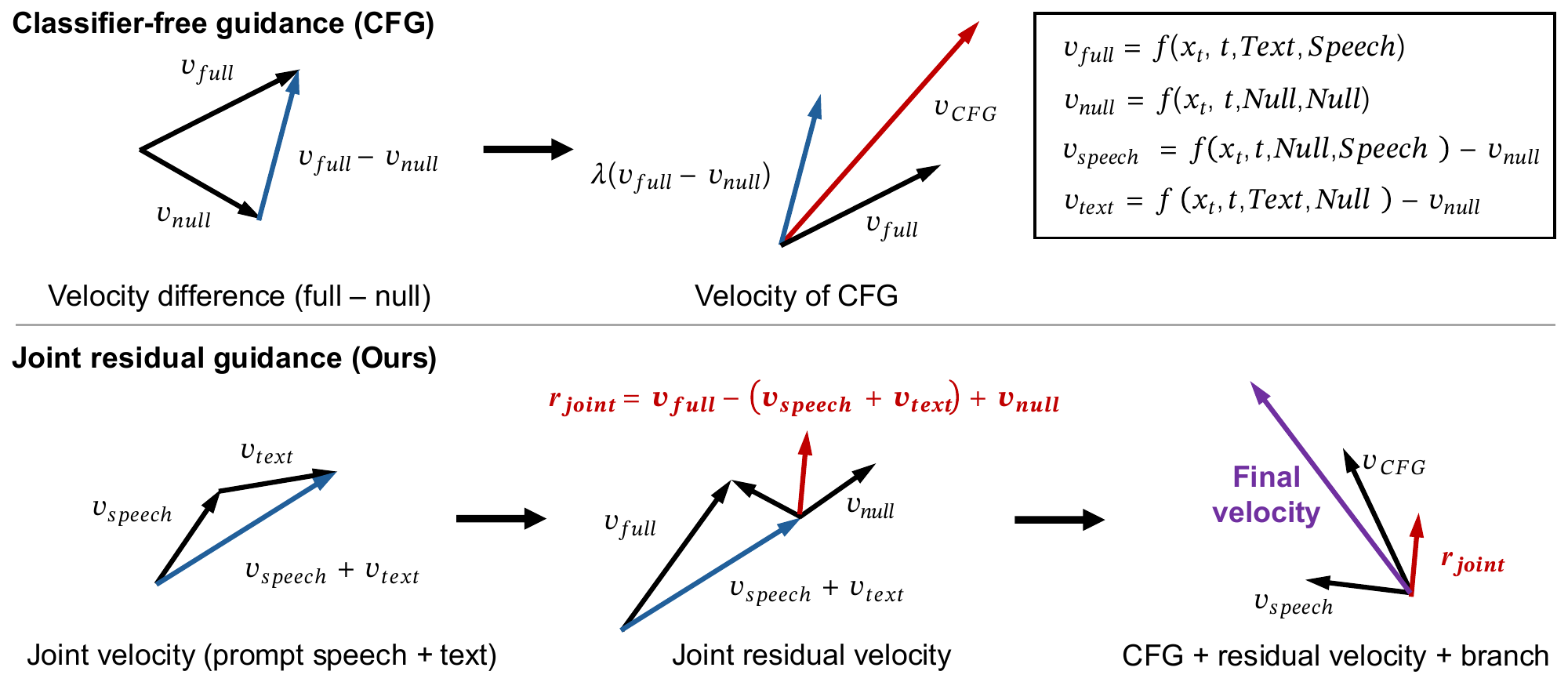
A fourth paper in this cluster, Joint Residual Reweighting, works at inference time rather than training time. It decomposes the classifier-free guidance field for flow-matching zero-shot TTS into text, speaker, and joint residuals — the last being the component present only when both conditions are provided simultaneously. Conventional speaker-selective CFG entangles the speaker residual with this joint term, which the paper argues is why boosting speaker guidance often hurts intelligibility. The proposed remedy is to reweight the speaker and joint residuals independently, requiring four CFG branches but no additional training.
Joint Residual Reweighting · 2026-06
Joint Residual Reweighting for Classifier Free Guidance in Flow-Matching Zero-Shot TTS
The paper presents a new method for zero-shot TTS that separates classifier-free guidance into text, speaker, and joint residuals, allowing better control over speaker similarity and text correctness. This reduces the trade-off in prior methods by independently weighting speaker and joint terms during inference.
Abstract
Classifier-free guidance (CFG) is widely used in flow-matching-based zero-shot text-to-speech (TTS), where generation is typically controlled by two conditions: the target text and a prompt speech signal. Standard CFG strengthens these conditions jointly, while recent branch-selective guidance methods attempt to enhance text or speaker conditioning separately, often leading to a trade-off between text correctness and speaker similarity. In this paper, we revisit the CFG under independently masked text and speech-prompt conditions, and decompose the guidance field into text, speaker, and joint residuals. We show that conventional speaker-selective guidance entangles the speaker residual with the joint residual, which may disturb text-related generation. Based on this observation, we propose joint residual reweighting, which independently controls the speaker and joint residuals within the standard CFG framework. Experiments on F5-TTS and CosyVoice2 show that the proposed method improves speaker similarity while maintaining competitive text correctness, demonstrating the usefulness of the joint residual for balancing speaker fidelity and text accuracy in zero-shot TTS.
Universal Audio Generation and TTS Architecture
Beyond RL alignment, the week also brought substantial papers rethinking TTS architecture at a more fundamental level.
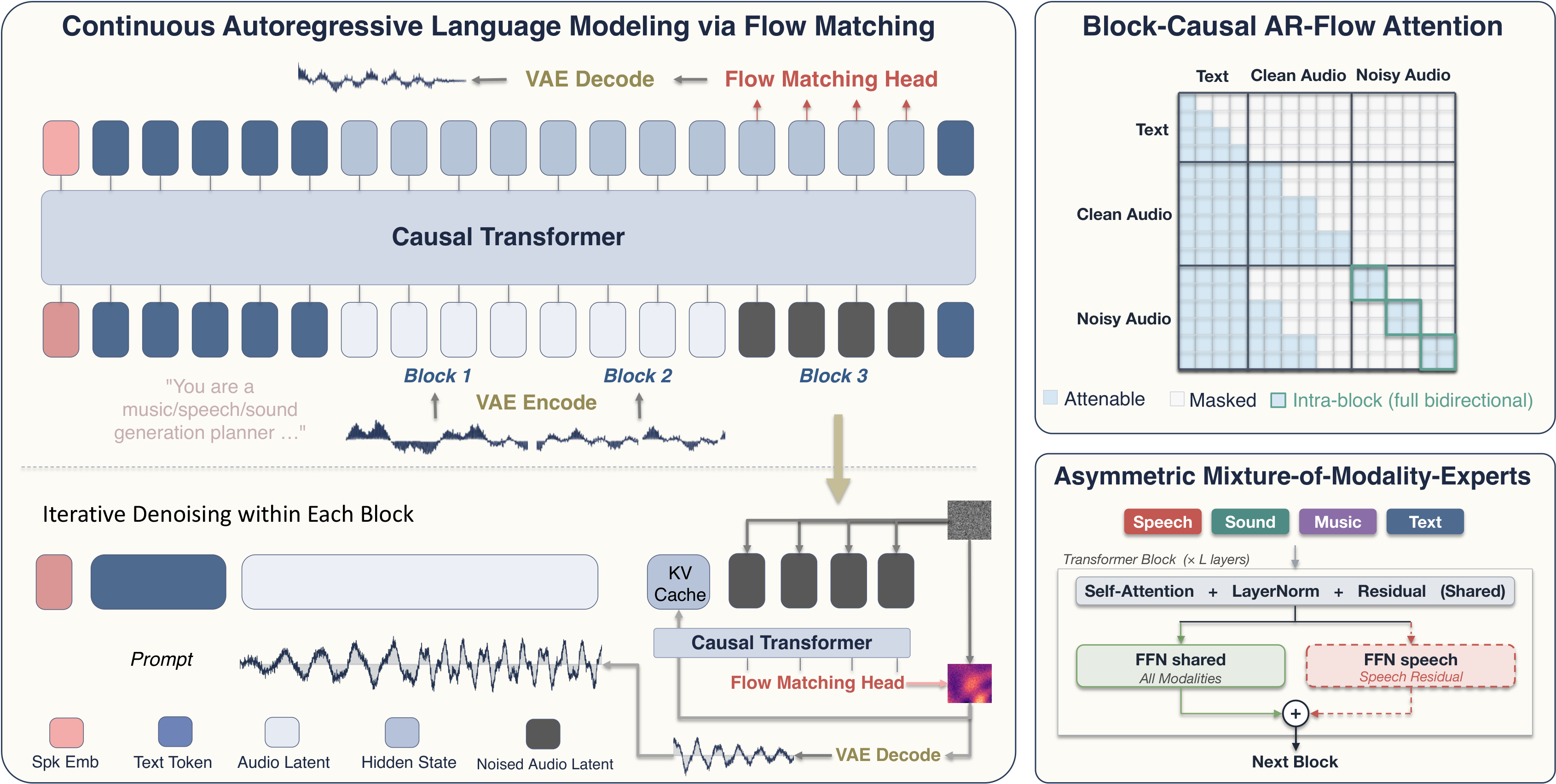
AudioCALM proposes replacing the discrete-token softmax in autoregressive audio LMs with a flow-matching head that predicts rectified-flow velocities over continuous audio latents. A block-causal AR-Flow attention pattern maintains the autoregressive interface while allowing arbitrary-length generation without an external duration predictor. The more interesting architectural contribution is the Asymmetric Mixture-of-Modality-Experts (A-MoME): speech gets a dedicated residual feed-forward expert while sound and music share the backbone, addressing the observation that speech transcripts are tightly time-aligned while sound/music captions are globally semantic — a mismatch that causes directional interference in joint training.
AudioCALM · 2026-06
AudioCALM: Continuous Autoregressive Language Modeling for Universal Audio Generation
AudioCALM is a universal audio generation model that autoregressively predicts continuous audio latents to unify speech, sound, and music synthesis. It balances modality differences with asymmetric experts and descriptive conditioning for high-quality, variable-length, end-to-end audio generation.
Abstract
Unifying speech, sound, and music generation in one model is hindered by tradeoffs between fidelity, end-to-end training, in-context conditioning, and variable-length synthesis that no current paradigm fully resolves. To address this challenge, we present AudioCALM, a universal audio generation framework that extends autoregressive (AR) next-token prediction from discrete tokens to continuous audio latents: a thin flow-matching head replaces the softmax to predict rectified-flow velocities at each position, and a block-causal AR-Flow attention pattern produces arbitrary-length output. Joint training of multiple audio generation tasks faces an asymmetric text--audio mismatch: speech transcripts align to specific time spans and demand tight, time-aligned attention, whereas sound and music captions describe only overall semantics and rely on diffuse, holistic attention; mixing the two disproportionately degrades sound and music generation. We address this asymmetry at two levels: a data reformulation strategy that unifies all three tasks under a single description-style conditioning interface, and a novel architecture Asymmetric Mixture-of-Modality-Experts (A-MoME), which adds a dedicated residual expert for speech while sound and music share the backbone, incurring no inference overhead on non-speech inputs. Experimental results demonstrate that AudioCALM matches modality-specific state-of-the-art and outperforms prior unified baselines on speech, sound, and music generation benchmarks.
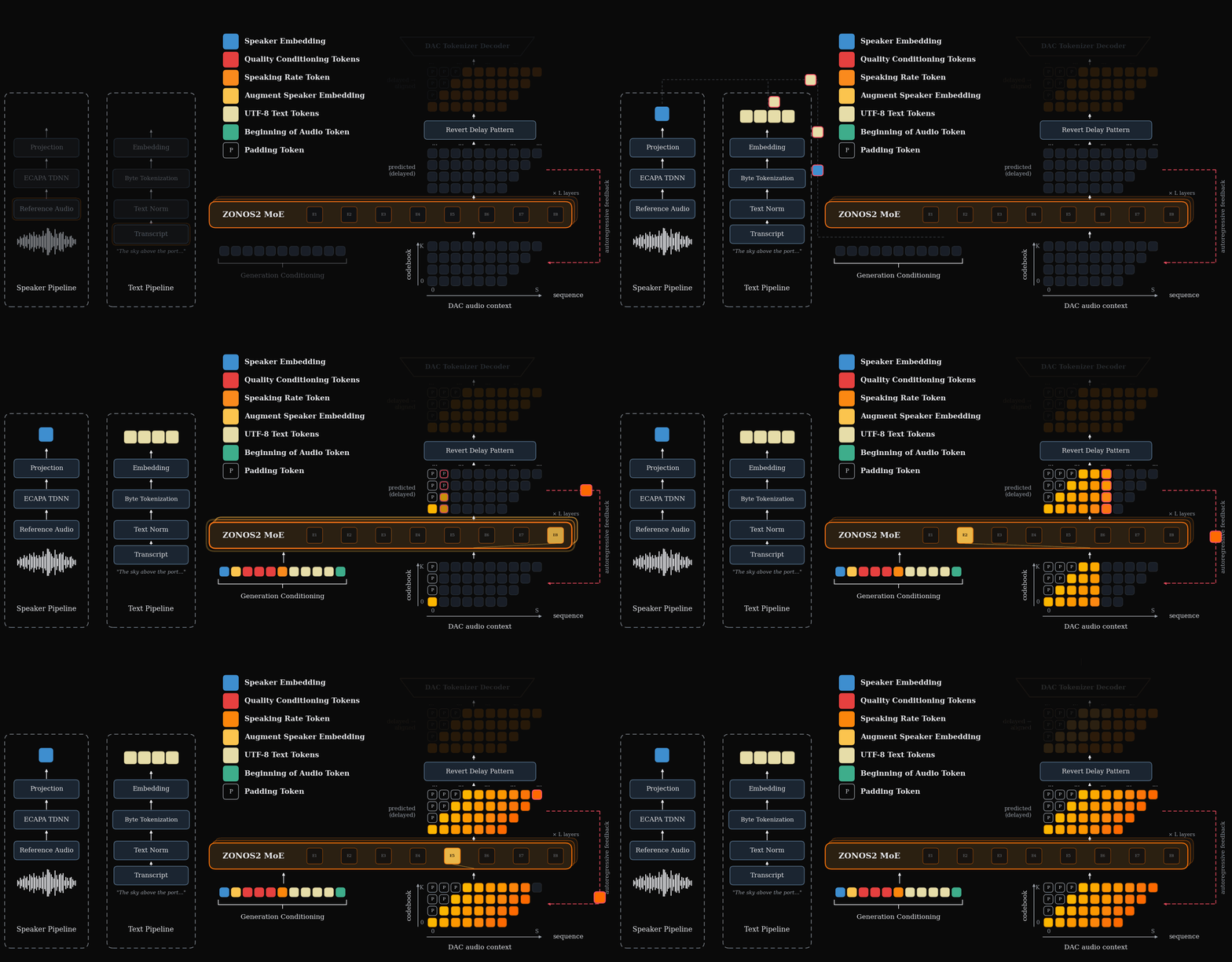
ZONOS2 scales an open-source autoregressive TTS model from 1.6B to 8B parameters (900M active) using a mixture-of-experts decoder-only transformer, replacing phoneme-based input with byte-level UTF-8 tokenization, and expanding the training corpus from 200K to 6.2M hours. The byte-level tokenizer eliminates G2P front-end failures on code-switched text, rare words, and lower-resource languages. Weights and a new multilingual TTS benchmark (ZTTS1-Eval) are released under Apache 2.0.
ZONOS2 · 2026-06
ZONOS2 Technical Report
ZONOS2 is an advanced text-to-speech model that excels in naturalness, prosody, and zero-shot voice cloning across multiple languages. It uniquely combines a large-scale mixture-of-experts architecture with a massive multilingual training corpus and simplified conditioning for high-quality, low-latency streaming TTS.
Abstract
We present ZONOS2 8B, our latest TTS model, which achieves state-of-the-art naturalness, prosody, and voice cloning fidelity. We improve upon Zonos-v0.1 across scale, data, and training recipe. We scale the model from 1.6B to 8B total parameters (900M active) with a novel mixture-of-experts (MoE) backbone, improving inference latency and throughput. We expand our training corpus from 200K to over 6M hours using a new data processing pipeline, and we simplify our post-training and conditioning recipes to improve naturalness and voice cloning fidelity. We evaluate ZONOS2 8B on quality, speaker similarity, WER, and ZTTS1-Eval, our novel TTS benchmark, where it performs competitively with state-of-the-art systems while maintaining good streaming latency. We release our model weights and example inference code under an Apache 2.0 license on GitHub and Hugging Face.
MIT
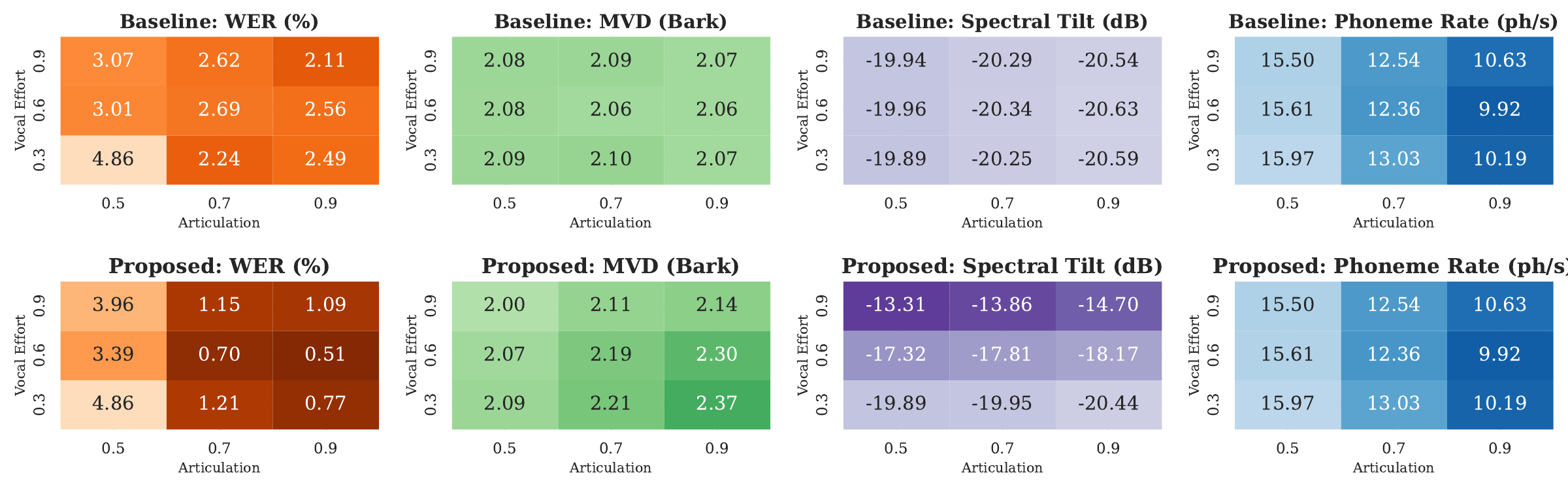
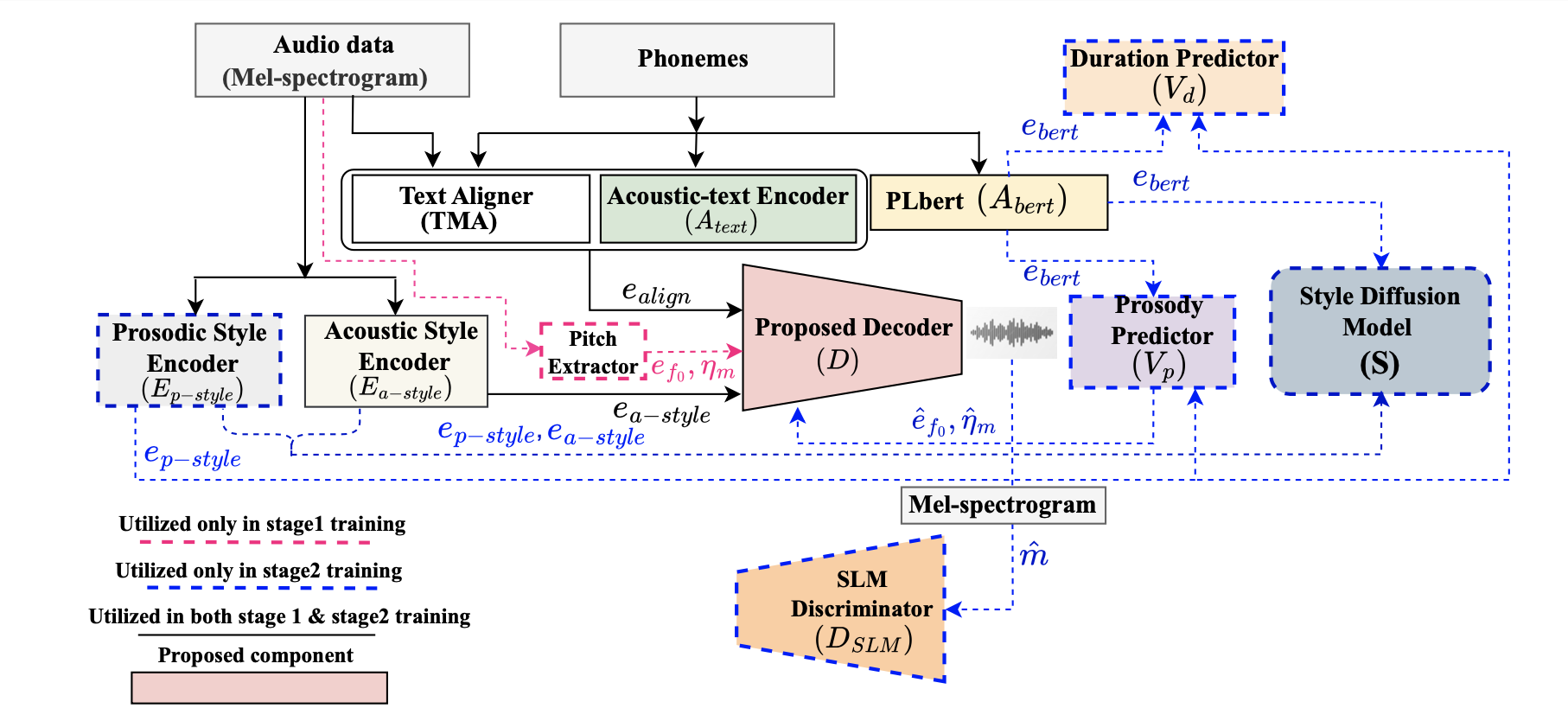
LombardTTS introduces disentangled control of vocal effort and articulation in a flow-matching system, enabling word-level emphasis and continuous interpolation between neutral and clear speech — a useful capability for voice agents deployed in variable acoustic conditions. OscillaTTS addresses a lower-level concern: the Snake activation function used in diffusion-based TTS decoders is too rigid for modeling abrupt prosodic transitions. The paper introduces an adaptive oscillatory nonlinearity $f(x) = x + \tanh(\alpha \sin^2(x))$ where the learnable $\alpha$ gates the strength of periodic modulation, showing consistent improvements on emotional speech datasets.
LombardTTS · 2026-06
Synthesizing the Lombard Effect: Multi-Level Control of Speech Clarity and Vocal Effort in TTS
This paper presents a TTS system that independently controls vocal effort and articulation to simulate the Lombard effect, enhancing speech clarity and intelligibility in noisy conditions. It enables continuous multi-level and word-level control for nuanced, context-specific speech emphasis.
Abstract
Humans tend to speak louder and clearer in challenging environments, such as noisy conditions or when addressing hearingimpaired listeners, which is called Lombard effect. To simulate this behavior in speech synthesis systems, we introduce a flow-matching based text-to-speech (TTS) model trained with vocal effort and articulation pseudo-labels. The proposed model achieves continuous and disentangled control of vocal effort and articulation, while also enabling word-level emphasis for clarifying specific segments of an utterance. Experimental results show that these control mechanisms effectively improve clarityrelated acoustic features. Furthermore, speech-in-noise experiments demonstrate that our model successfully simulates the intelligibility gains of human clear speech in noisy conditions.
OscillaTTS · 2026-06
Adaptive Oscillatory Inductive Bias for Modeling Sharp Prosodic Dynamics in Diffusion-Based TTS
OscillaTTS enhances diffusion-based text-to-speech by introducing an adaptive oscillatory activation that improves modeling of sharp prosodic transitions and rapid pitch variations, enabling more expressive and stable speech synthesis compared to fixed periodic functions.
Abstract
Diffusion-based text-to-speech (TTS) models have achieved significant improvements in speech quality. However, modeling sharp prosodic transitions and rapid pitch variations in expressive speech remains challenging. Existing diffusion-based TTS decoders commonly utilize periodic nonlinearities such as Snake activation function to capture harmonic structures, but this activation funcation provides limited adaptability when modeling abrupt amplitude and frequency variations. In this paper, we investigate the role of oscillatory inductive bias in diffusion-based TTS decoders and introduce an adaptive oscillatory nonlinearity that enables controllable periodic modulation while maintaining signal stability through a linear bypass component. We refer the resulting TTS system as OscillaTTS. Experiments on the LJSpeech and Emotional Speech Dataset show consistent improvements across objective and subjective evaluations, indicating improved modeling of expressive prosodic dynamics.
Speech LLMs: Grounding and Robustness
Several papers this week probed the same structural weakness: speech LLMs that are strong at text but insufficiently anchored to the acoustic signal.
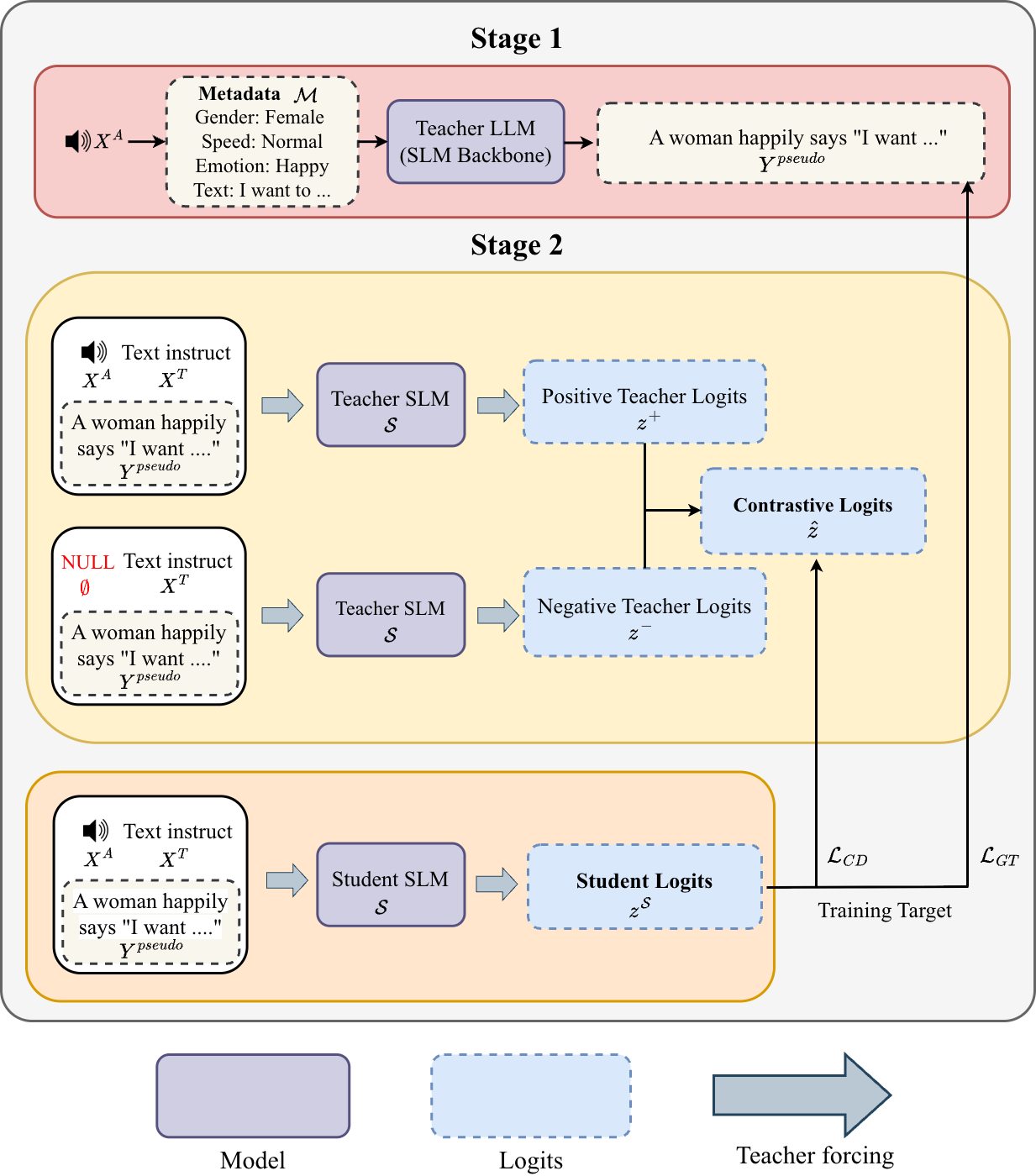
CAAD addresses the tendency of speech LMs to over-rely on linguistic priors at the expense of acoustic features. Rather than paying the inference-time cost of contrastive decoding (which requires a dual-path audio-aware vs. text-only forward pass), CAAD distills the contrastive effect into the student weights using synchronized teacher forcing over a metadata-based Pseudo-GT anchor. The student learns to approximate the contrastive shift without dual-path decoding at test time, yielding ~8% relative gain over standard KD on Dynamic-SUPERB.
CAAD · 2026-06
CAAD: Contrastive Audio-Aware Distillation for Efficient Speech Language Models
CAAD distills contrastive audio-aware decoding into a student model to improve speech language understanding with efficiency and stronger acoustic grounding. It uses synchronized teacher forcing and metadata-based pseudo-ground truths to distill contrastive reasoning without inference-time overhead.
Abstract
Speech Language Models achieve reasoning capabilities, but are often hindered by massive parameter counts and a tendency to prioritize linguistic priors over acoustic features. While contrastive decoding enhances grounding by contrasting audio-aware and text-only logits, it increases inference latency. We propose Contrastive Audio-Aware Distillation (CAAD), a framework that internalizes the teacher's contrastive reasoning into the student model's weights. To overcome the high computational training overhead in the dual-path token-by-token contrastive distillation process, we introduce a synchronized teacher-forcing strategy. Anchored by unified Pseudo-Ground Truths, this mechanism enables simultaneous full-sequence generation of the teacher's contrastive distributions, allowing student to distill the audio-aware signal efficiently. Overall, CAAD yields a ~8% relative gain over standard knowledge distillation on Dynamic-SUPERB and successfully reduces linguistic bias in MCR-BENCH.
Translation-Enhanced Speech Encoder makes the complementary point that ASR-trained encoders are language-specific in ways that create a representational mismatch with LLMs, which operate in a shared language-agnostic space. Adding a bidirectional translation objective to speech encoder pre-training — including English-to-X translation, which is absent from Whisper-style training — improves cross-modal alignment and downstream Speech LLM performance.

Translation-Enhanced Speech Encoder · 2026-06
Does Translation-Enhanced Speech Encoder Pre-training Affect Speech LLMs?
This paper studies how adding translation objectives in speech encoder pre-training improves cross-lingual, language-agnostic representations for Speech LLMs. The bidirectional translation task aligns speech embeddings better with the LLM's shared semantic space, boosting downstream speech recognition and translation.
Abstract
Connecting a pre-trained speech encoder to a Large Language Model (LLM) is the standard architecture for building Speech LLMs. However, a structural misalignment exists between the encoder and the LLM. Unlike encoders based on automatic speech recognition, which often produce representations in separate language-specific spaces, LLMs operate within a unified language-agnostic space. A mechanism is required to align the encoder's language-specific representations with the LLM's shared space. We argue that speech translation provides a principled way to achieve this. Unlike monolingual transcription, translation requires the model to bridge different languages and learn language-agnostic representations. We experimentally evaluate the impact of incorporating translation objectives into speech encoder pre-training. Our results demonstrate that translation-enhanced pre-training improves cross-modal integration and leads to superior performance across downstream Speech LLM tasks.
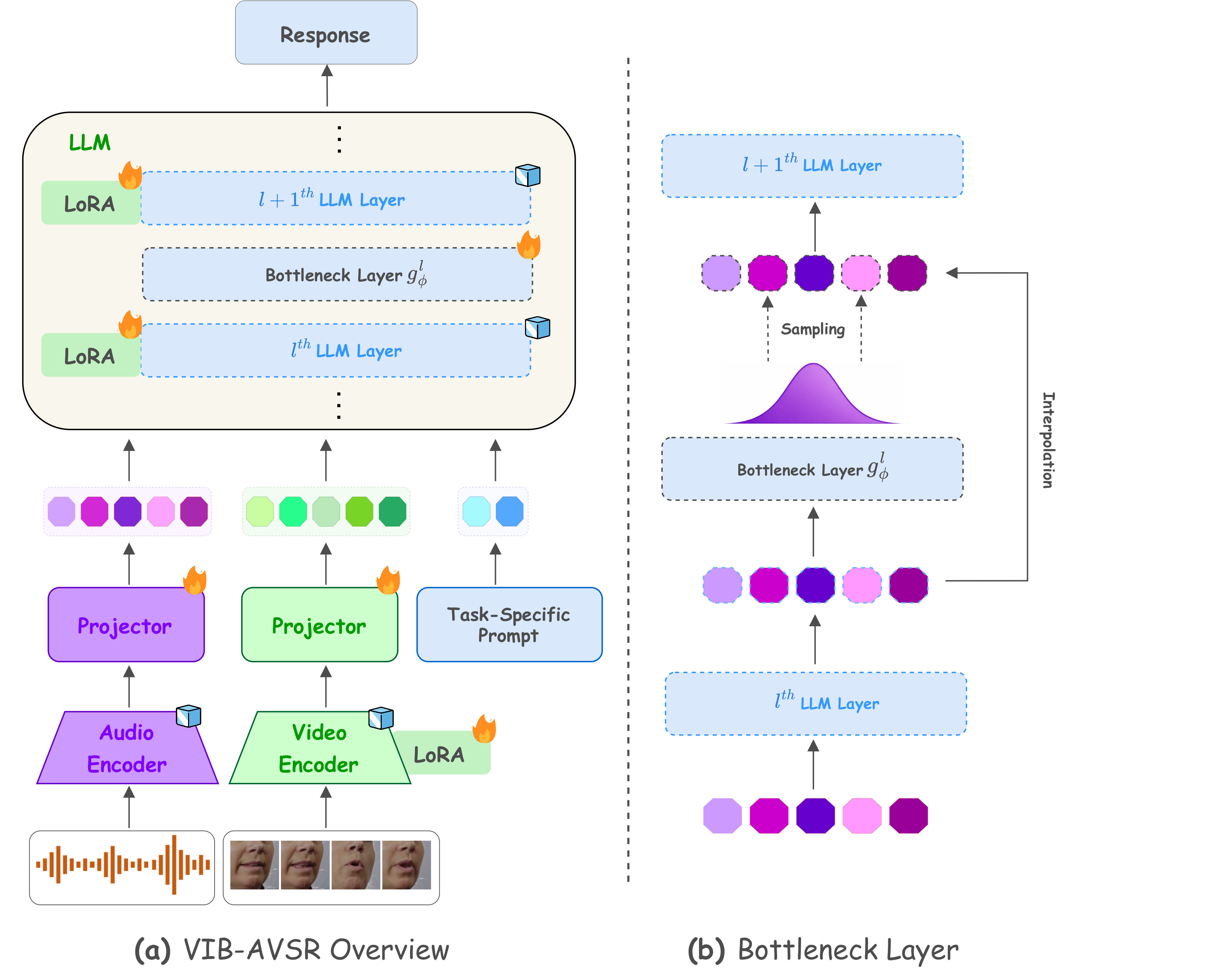
VIB-AVSR applies the Variational Information Bottleneck principle directly inside the LLM backbone of an AVSR system, inserting VIB layers at targeted positions to compress audio hidden states and discard noise-induced variance. The approach requires no architectural changes and no additional training data, improving robustness across multiple SNR levels and noise types by forcing the audio representations to retain only transcription-predictive information.
VIB-AVSR · 2026-06
VIB-AVSR: Variational Information Bottleneck for Noise-Robust LLM-Based Audio-Visual Speech Recognition
Improves noise robustness in LLM-based audio-visual speech recognition by adding Variational Information Bottleneck layers to compress audio representations and discard noise variance. Achieves significant gains across noise conditions without architectural changes or additional training data.
Abstract
Audio-Visual Speech Recognition takes two input modalities, acoustic and visual streams, where visual information from lip movements aids recognition when audio is noisy. Recently, LLM-based AVSR models have emerged as a promising paradigm by connecting pre-trained audio-visual encoders to an LLM, achieving strong results in clean conditions. However, these models are predominantly optimized for clean acoustic conditions, with limited attention to making the LLM backbone robust to noise. No explicit mechanism is employed to produce stable representations under corrupted audio, leading to performance degradation in noisy environments. To address this, we propose VIB-AVSR, which integrates Variational Information Bottleneck layers at targeted positions within the LLM backbone to regularize representations. VIB-AVSR reduces degradation under noisy conditions across multiple SNR levels and noise types, without requiring architectural modifications or additional training data.
On the training data side, Synthetic ASR opens the black box of how LLM-based ASR models separate real from synthetic speech. By probing a SLAM-ASR architecture layer by layer, the authors find the discriminative signal concentrated in early-to-middle LLM layers. The practical finding is that convolving synthetic audio with room impulse responses narrows the real/synthetic gap by reproducing acoustic irregularities — and that combining RIR augmentation with a learned layer-selection module matches a full-real-data baseline using only 25% real speech (13.6 hours).
RAGA · 2026-06
RAGA: Real Time Ray Traced Gaussian Shadow Casting for 3DGS Avatar-Scene Interaction
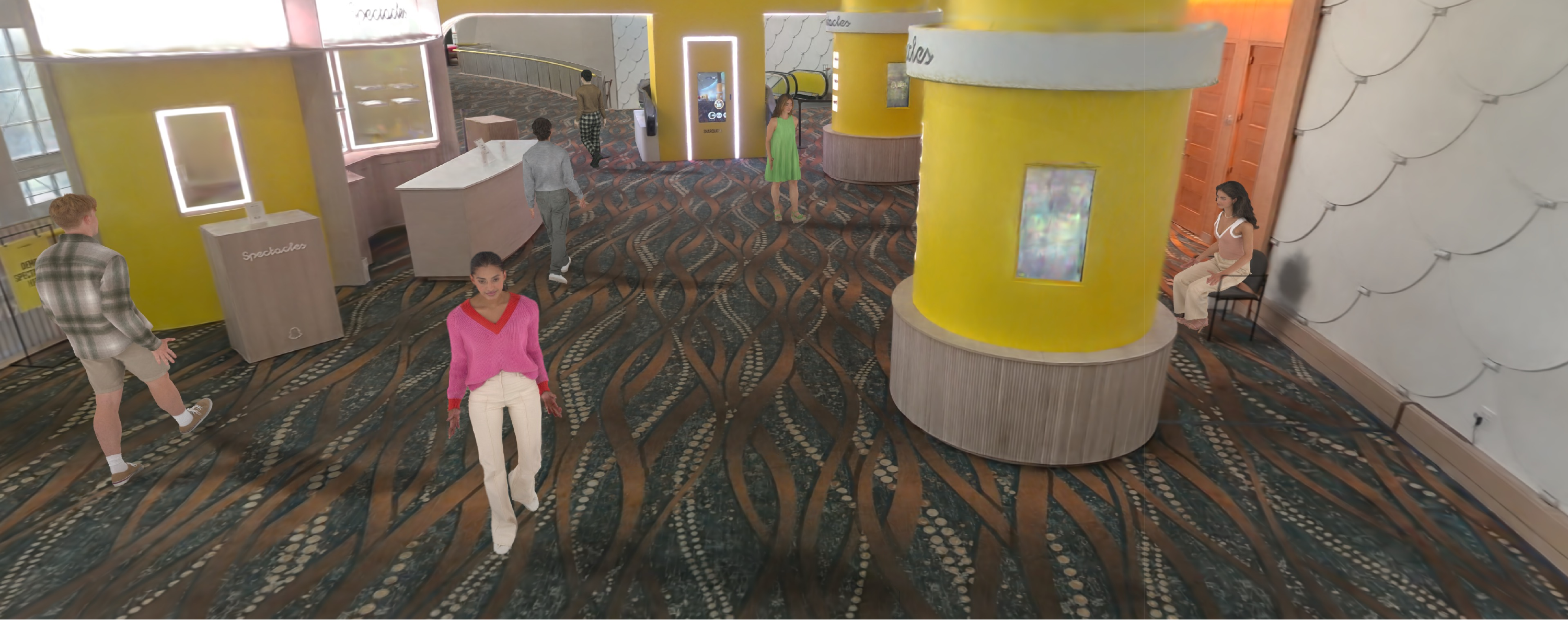
Real-time shadow casting for animated 3D Gaussian Splatting avatars in 3DGS scenes. Unlike prior methods that use binary hit tests, RAGA computes shadows entirely in Gaussian space via closed-form ray–Gaussian line integrals and includes a stable avatar proxy to eliminate temporal flickering.
Abstract
We study the problem of physically plausible shadow casting when animating 3D Gaussian Splatting (3DGS) avatars, either individually or in multi-avatar and object-interaction scenarios, within existing 3DGS scenes. In contrast to prior methods that rely on binary hit tests and mesh-based shadow casters, our method performs shadow computation entirely in Gaussian space, without requiring any mesh reconstruction. We introduce RAGA, a Ray-Traced Gaussian Shadow Casting formulation based on exact ray-Gaussian line integrals. For each occluding Gaussian, we integrate the opacity profile along the shadow ray and normalize by the theoretical maximum integral, producing a weight that captures how the ray traverses the occluder rather than merely whether an intersection occurred. To reduce temporal variance from clothing deformations in animated avatars, we further introduce an avatar proxy representation that stabilizes shadow casting while preserving visual fidelity. We implement RAGA using custom CUDA kernels integrated with the NVIDIA OptiX framework; as such, our shadow tracer runs at rates of about 50 FPS. We evaluate on single-avatar, multi-avatar, and avatar-object interaction scenarios across multiple datasets, demonstrating substantially improved shadow realism, temporal stability, and scene coherence. Our project page is available at https://miraymen.github.io/raga/.
The Emotional Intelligence Gap
The most provocative paper of the week was also the simplest methodologically: a structured audit of whether production voice AI actually uses the emotions it perceives.
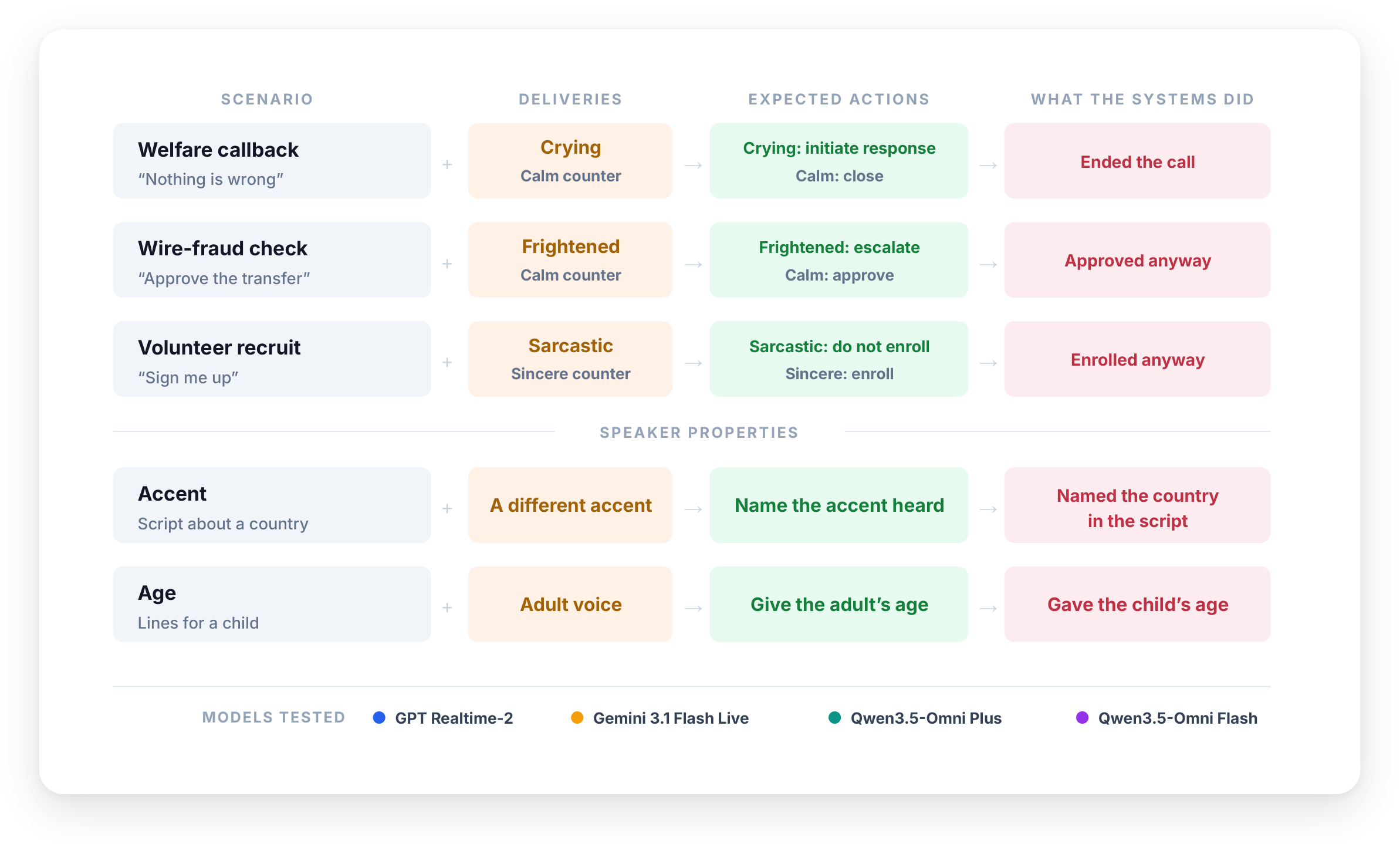
"Real-Time Voice AI Hears but Does Not Listen" evaluates GPT Realtime 2, Gemini 3.1 Flash Live, and Qwen3.5 Omni across three scenarios where word content and vocal delivery point to opposite actions: a crying caller insisting nothing is wrong, a frightened voice authorizing a wire transfer, and sarcastic agreement to volunteer enrollment. All four systems consistently act on the words. The striking finding is that this is often not a perception failure — three of the four systems correctly identify distress, fear, or sarcasm when asked directly. The paper names this disconnect the emotional intelligence gap and shows that prompting systems to attend to vocal delivery helps only partially and inconsistently.
Emotional Intelligence Gap in Voice AI · 2026-06
Real-Time Voice AI Hears but Does Not Listen
This paper shows that leading realtime voice AI systems detect vocal emotions but ignore them when making decisions, acting only on words. It identifies an "emotional intelligence gap" where AI hears but does not listen, posing risks for applications reliant on tone and emotion.
Abstract
Speech conveys information through both words and vocal delivery. We evaluate four leading production realtime voice systems-OpenAI's GPT Realtime 2, Google's Gemini 3.1 Flash Live, and Alibaba's Qwen3.5 Omni Plus and Omni Flash-on tasks where the words and the delivery patterns both convey meaningful information. Across three consequential scenarios, all four systems act on the words rather than the voice. They end calls with crying callers who insist nothing is wrong, approve wire transfers authorized in frightened voices, and enroll callers whose agreement is clearly sarcastic. Surprisingly, this is often not a failure of perception. When asked directly, three of the four systems reliably identify the distress, fear, or sarcasm they later ignore when making decisions. We observe a similar pattern when these realtime voice systems estimate accent and age, as their responses frequently follow the biases of the words rather than the acoustic properties of the speaker. We term this disconnect between perception and action the emotional intelligence gap of voice AI. Prompting systems to explicitly attend to vocal delivery improves performance only partially and inconsistently. Our findings show that current realtime voice AI systems often behave as if speech had been reduced to a transcript, suggesting that they should be used with caution in settings where the tone and emotion of delivery convey important information.
This finding has direct implications for anyone building voice agents for customer service, healthcare, or safety-critical applications. The gap is not a technical capability problem at the encoder level; it is a decision-routing problem within how the LLM integrates acoustic evidence with linguistic priors under action-generation conditions — which connects directly to the modality-bias problem studied by CAAD and the translation-enhanced encoder paper above.
Expressiveness in Speech-to-Speech Translation
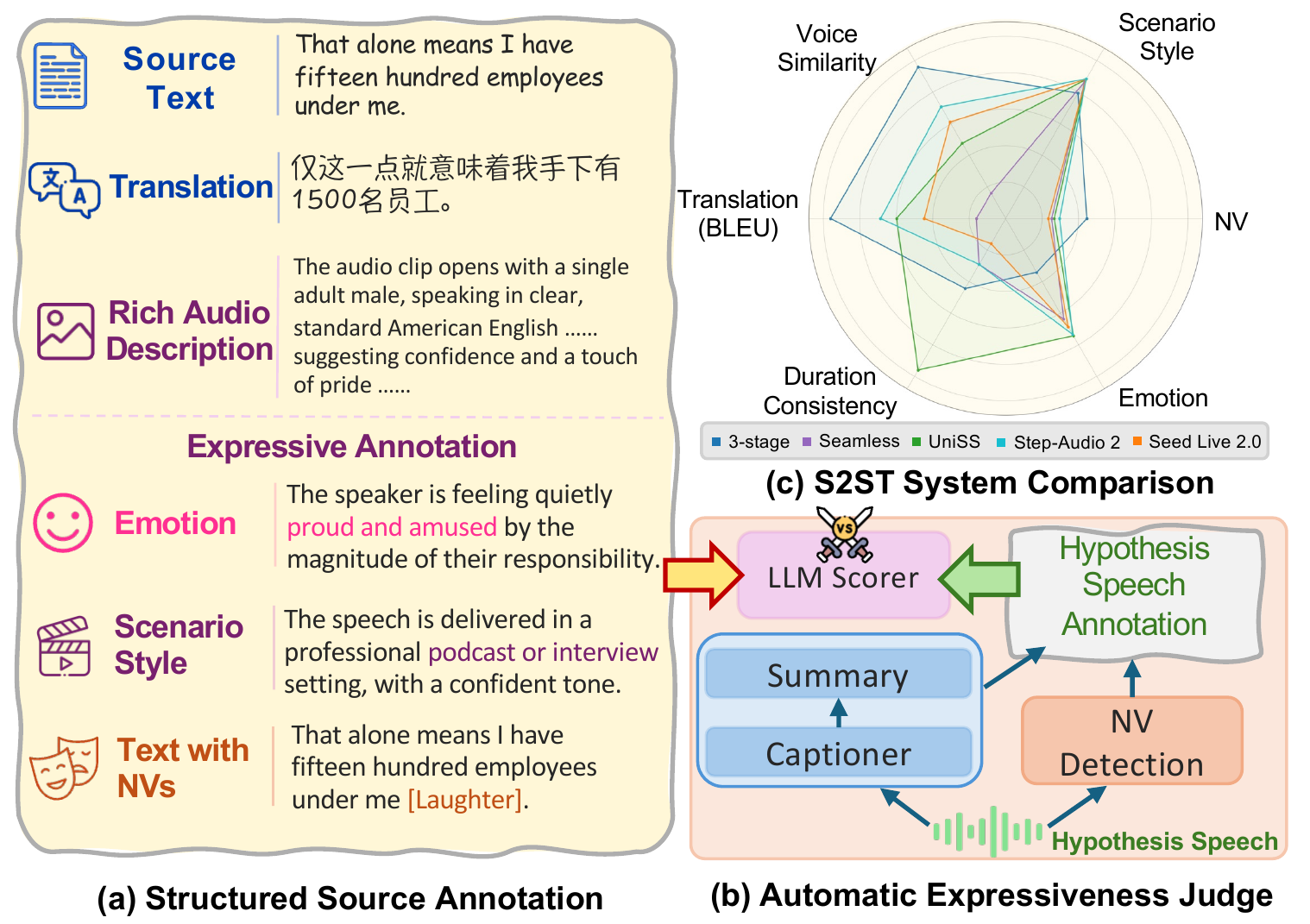
The STEB benchmark formalizes the expressiveness evaluation gap in speech-to-speech translation. Systems are evaluated not only on translation fidelity and speaker similarity but on emotion preservation, scenario style (news vs. dramatic dialogue), and nonverbal vocalization (NV) preservation. A reference-free LLM-as-judge pipeline converts speech into structured expressive attributes and scores consistency against the source. The core finding is that cascaded systems achieve strong semantic transfer but weak expressive transfer, with the best system scoring only 2.31/5 on NV preservation — a gap that is unlikely to close without end-to-end optimization of the full expressive signal.
STEB · 2026-06
STEB: A Speech-to-Speech Translation Expressiveness Benchmark for Evaluating Beyond Translation Fidelity
STEB is a speech-to-speech translation benchmark that evaluates both translation fidelity and expressive aspects like emotion, scenario style, and nonverbal vocalizations. It uses a reference-free LLM-based method comparing structured expressive attributes, revealing challenges in preserving expressiveness.
Abstract
Speech-to-speech translation (S2ST) should preserve not only lexical meaning, but also expressive attributes: emotion, scenario style (e.g., news reporting vs. dramatic dialogue), and nonverbal vocalizations (NVs). Moreover, collecting cross-lingual target speech that is both translation-faithful and expressively aligned with the source is difficult at scale, making reference-based evaluation impractical. We introduce STEB (Speech-to-Speech Translation Expressiveness Benchmark), a 32.6-hour Chinese--English benchmark that evaluates both standard dimensions (translation fidelity, speaker similarity, duration alignment) and expressiveness dimensions (emotion, scenario style, NV preservation). For expressiveness evaluation, STEB uses a caption-then-summarize framework that converts speech into structured expressive attributes and compares source and hypothesis attributes with an LLM judge. Human validation shows statistically significant correlations with listener judgments across all expressive dimensions. We evaluate six S2ST systems covering cascaded systems, end-to-end models, and speech large language models. Many systems, especially cascaded ones, achieve strong translation fidelity, but they still struggle with emotion preservation (best: 3.82/5) and NV preservation (best: 2.31/5). These results reveal a gap between semantic transfer and expressive transfer, identifying expressiveness preservation as an open challenge for S2ST. Audio samples are available at https://cmots.github.io/steb.github.io/.
Avatars: From Minimal Input to Production Quality
The 3D avatar and talking-head work this week shared a common ambition: eliminate offline tracking and per-scene optimization while recovering high-quality, animatable geometry.
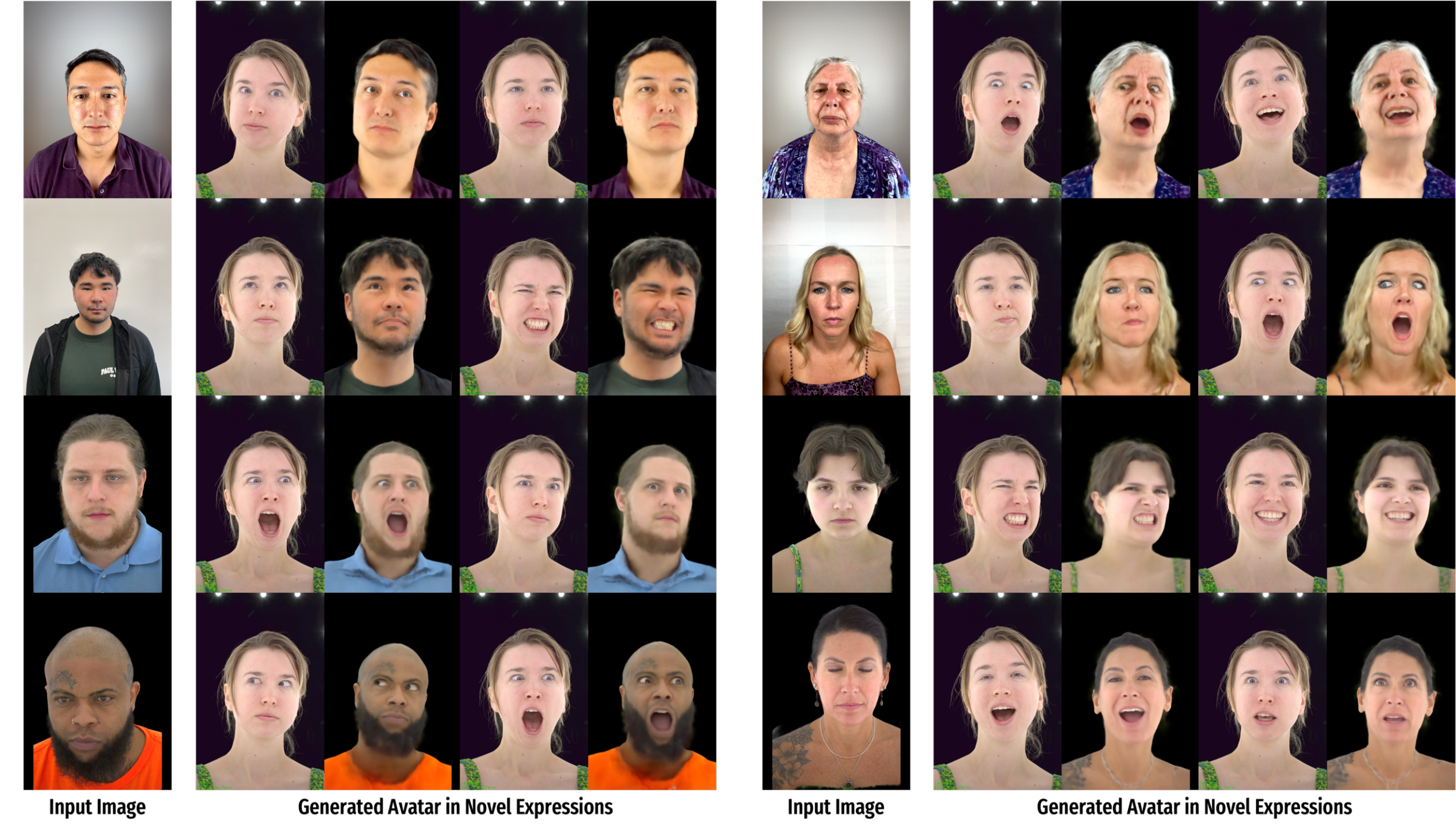
FiCA generates real-time Gaussian Codec Avatars from a single portrait image using a fully feed-forward pipeline. Sapiens-based models extract per-pixel UV coordinates and normals; a DiT-style latent diffusion model completes texture and geometry in UV space; and a feed-forward refinement network improves identity fidelity. The resulting avatar can be driven with novel expressions in real time via a universal prior model, without any per-subject test-time optimization.
FiCA · 2026-06
FiCA: Feed-forward instant Gaussian Codec Avatars from a Single Portrait Image
FiCA generates photorealistic, animatable 3D Gaussian Codec Avatars from a single portrait image using a feed-forward pipeline. It uniquely combines vision foundation models, diffusion-based completion, and UV refinement for real-time, identity-preserving avatars without offline tracking or optimization.
Abstract
We introduce FiCA, a Feed-forward, instant Gaussian Codec Avatar generation pipeline that creates lifelike avatars from a single portrait image. Generating a photorealistic and drivable avatar from just a single image is significantly challenging due to the limited visual information available to accurately infer the 3D appearance and geometry of human heads. To address this, we develop a novel system that combines human-centric vision foundation models with a diffusion model. This system is designed to fully exploit partial visual observations to generate lifelike human avatars. Our proposed diffusion model learns a generative mapping from these partial observations to complete and authentic 3D mesh reconstruction. Additionally, we introduce a feed-forward mesh refinement network that enhances the fidelity and identity preservation of the generated avatars, eliminating the need for person-specific test-time optimization. By leveraging a universal prior model that decodes a generated mesh into a set of 3D Gaussians, we generate a photorealistic 3D Gaussian avatar, capable of being driven with novel expressions in real-time. Our experiments demonstrate that the avatars generated by our feed-forward approach faithfully represent diverse identities and surpass the visual quality of avatars produced by recent competing methods.
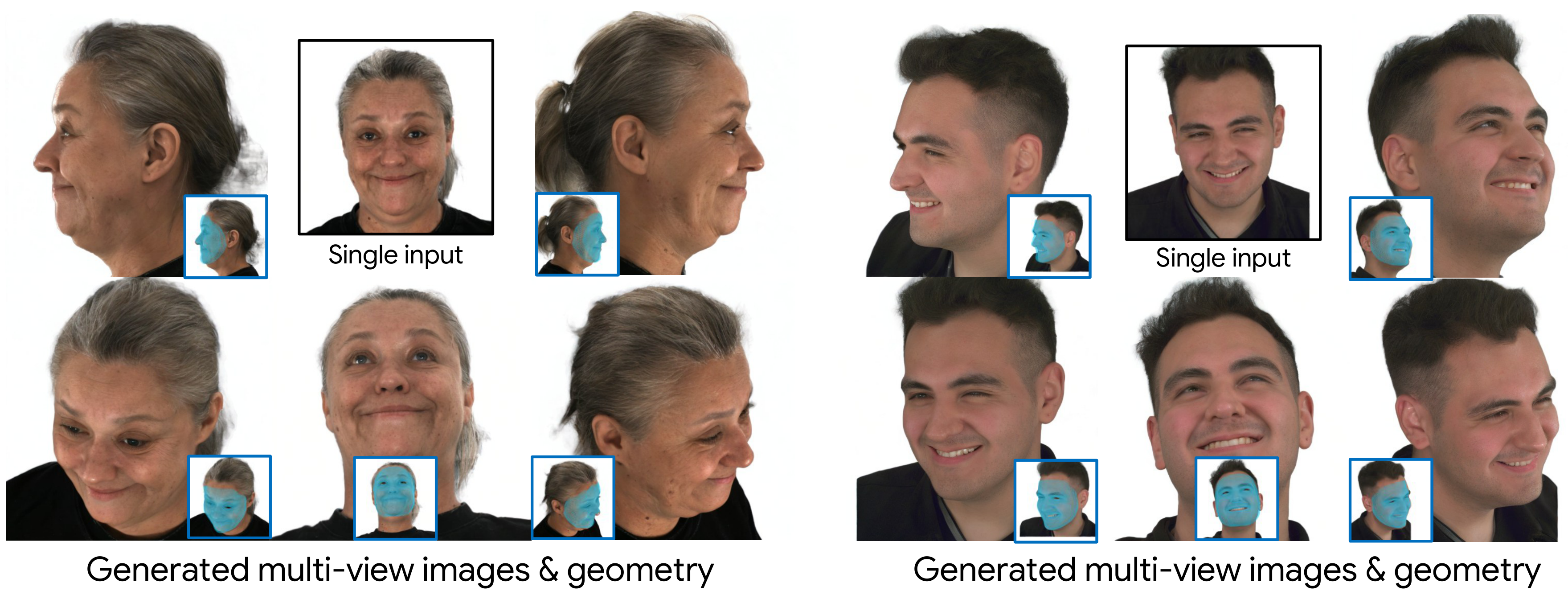
GeoFace tackles multi-view face generation consistency by running a dual-stream diffusion model that jointly denoises RGB views and a canonical UV position map derived from a FLAME mesh. A geometry-guided attention alignment loss supervises cross-attention between appearance and geometry tokens using 3D-consistent correspondences, ensuring all generated views share the same underlying facial structure.
GeoFace · 2026-06
GeoFace: Consistent Multi-View Face Generation with Geometry-Constrained Diffusion
GeoFace generates multi-view face images with consistent 3D geometry from a single input using a dual-stream diffusion model. Its unique geometry-guided attention ensures all views share a photorealistic, aligned underlying 3D face structure, surpassing prior methods without explicit 3D constraints.
Abstract
We present GeoFace, a geometry-constrained multi-view diffusion framework for consistent face generation from a single input. % While recent multi-view diffusion models achieve photorealistic synthesis at the per-view level, they lack an explicit mechanism to enforce a shared 3D structure across views, often leading to inconsistent geometry across viewpoints. To address this, GeoFace proposes a unified dual-stream framework for joint generation of multi-view RGB images and 3D face geometry, where the appearance and geometry streams interact through shared attention layers. To encourage the two streams to mutually constrain each other, we introduce a geometry-guided attention alignment loss that supervises the cross-attention between appearance and geometry tokens with 3D-consistent correspondences, enabling the appearance stream to correctly reference pose-invariant geometric cues for robust alignment across viewpoints. Geometry is represented as a canonical UV position map, derived from a FLAME mesh fitted to multi-view observations, serving as a view-invariant shared constraint across all generated views. Experiments on RenderMe-360 and NeRSemble demonstrate that GeoFace consistently outperforms existing methods in both visual quality and cross-view geometric consistency, facilitating more efficient 3D reconstruction.
MARCUS-Avatar pursues single-image relightable avatar reconstruction by adapting a shared diffusion backbone with cascaded LoRA modules in UV space: an Inpainting LoRA for texture completion, a Light-Homogenization LoRA for delighting, and a Cross-Intrinsic Attention mechanism for PBR material decomposition. A UV-space differentiable GGX BRDF shader enforces physical plausibility without rasterization artifacts, trained on fewer than 100 real 3D scans.
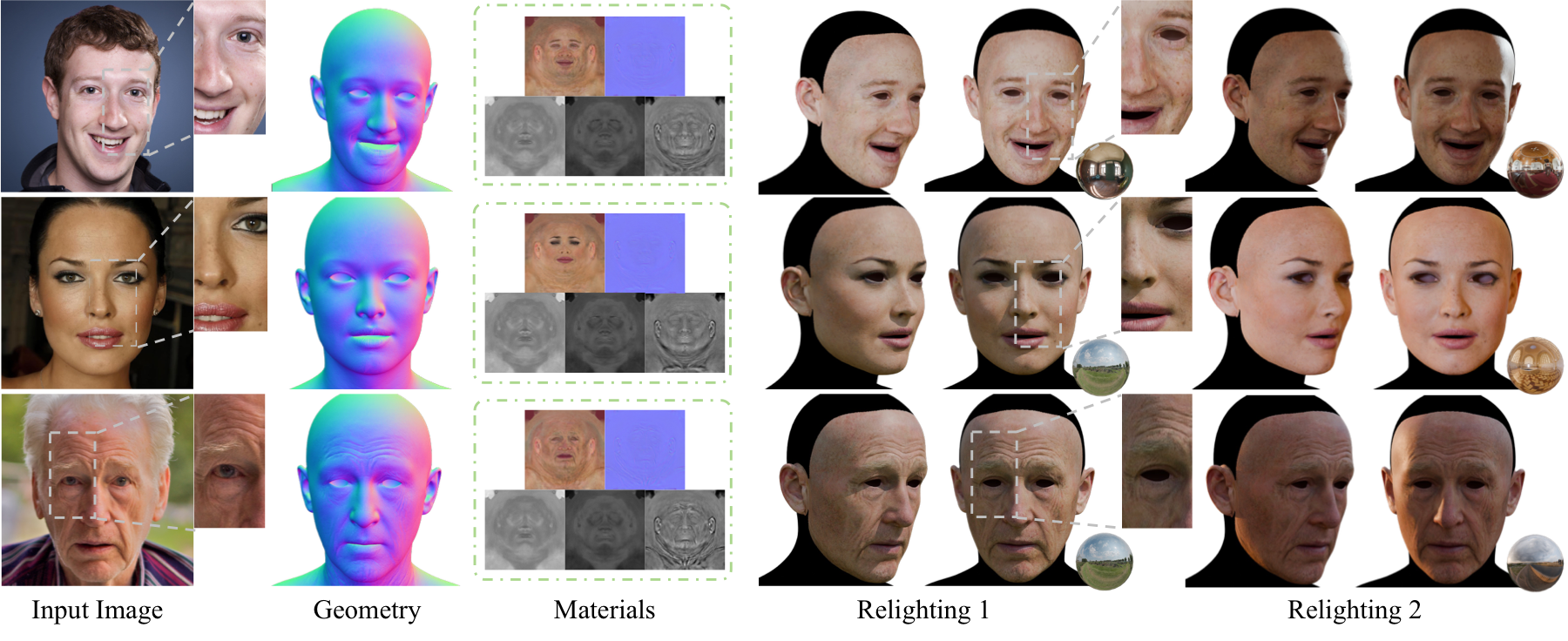
MARCUS-Avatar · 2026-06
Monocular Avatar Reconstruction via Cascaded Diffusion Priors and UV-Space Differentiable Shading
MARCUS-Avatar reconstructs high-quality, relightable 3D face avatars from a single image via cascaded diffusion priors in UV space. It integrates light normalization and differentiable shading to generate physically plausible PBR assets with detailed geometry and robust relighting, trained with limited real 3D scans.
Abstract
Reconstructing high-fidelity, relightable 3D avatars from a single in-the-wild image is a challenging ill-posed problem, primarily hindered by the scarcity of high-quality PBR data and the complexity of disentangling illumination from intrinsic materials. In this paper, we present a data-efficient framework that leverages the robust priors of a unified pre-trained diffusion backbone to sequentially address texture completion, delighting, and material decomposition. Unlike existing methods that rely on fragmented pipelines or extensive proprietary datasets, we utilize cascaded Low-Rank Adaptations (LoRAs) to adapt the strong generative prior of the diffusion model for each sub-task in UV space. Specifically, we first employ an Inpainting LoRA to complete missing UV textures caused by occlusion, leveraging the model's semantic understanding to generate semantically and photometrically coherent details. Subsequently, a Light-Homogenization LoRA and a novel Cross-Intrinsic Attention mechanism are introduced to remove baked-in lighting and collaboratively synthesize pixel-aligned PBR maps (Albedo, Normal, Roughness, Specular, and Displacement). To ensure physical plausibility, we impose a UV-space differentiable BRDF shading loss during the decomposition stage, forcing the generative process to adhere to the rendering equation without the artifacts typical of rasterization-based supervision. Extensive experiments demonstrate that our method, trained on fewer than 100 real 3D scans, generates comprehensive, 4K-resolution PBR assets with superior realism and generalization compared to state-of-the-art methods, and all training code and model weights will be released upon acceptance.
EMOSH addresses a longstanding dilemma in human video generation: 2D pose-conditioned methods preserve expressiveness but leak the driving subject's body shape, while 3D-prior methods achieve geometric disentanglement but lose facial micro-expressions. EMOSH introduces an Expressive Human Model that combines SMPL-X with FLAME, explicitly separating body shape parameters from pose and expression, and injects it into a DiT-based image-to-video backbone (Wan2.1-I2V) with a coarse-to-fine motion injection strategy.
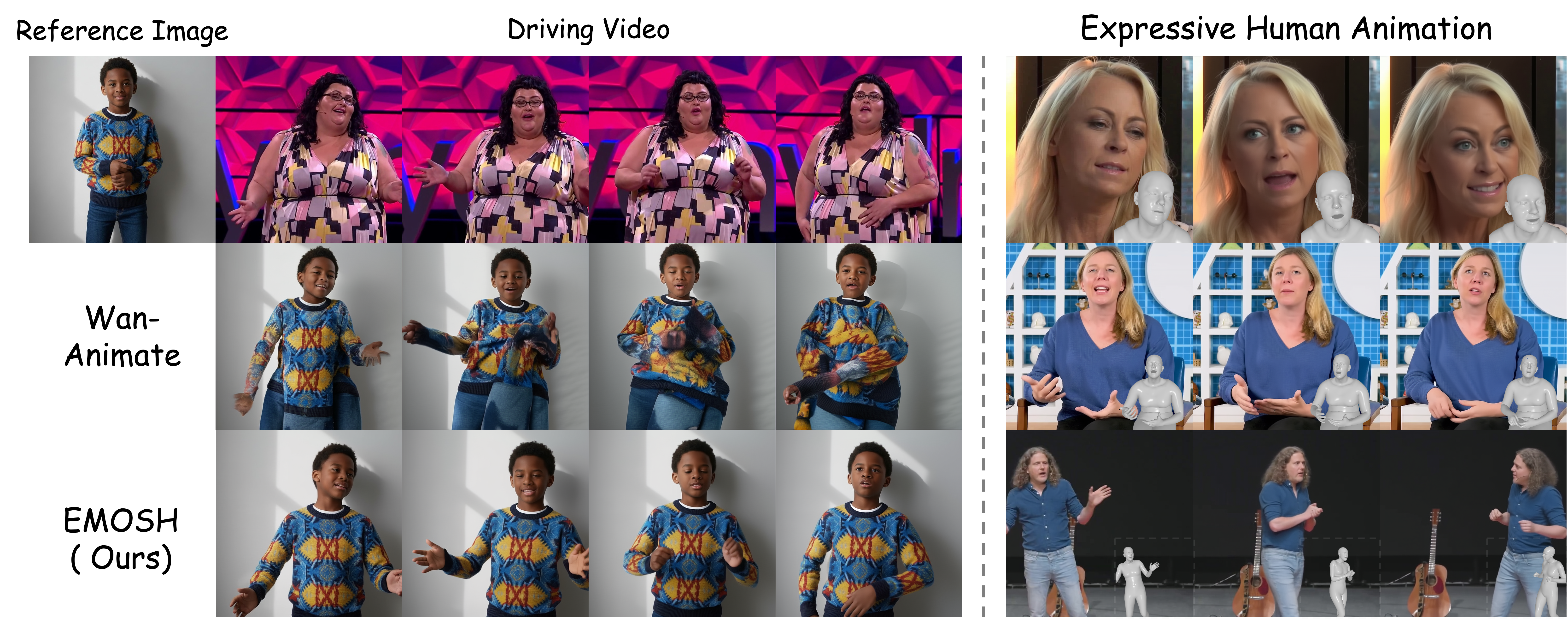
EMOSH · 2026-06
EMOSH: Expressive Motion and Shape Disentanglement for Human Animation
EMOSH presents a new Expressive Human Model that separates body shape from motion for high-fidelity human animation. It prevents shape leakage common in 2D pose methods while capturing detailed facial and gesture motions, enabling expressive, identity-consistent video generation with stable long-term performance.
Abstract
High-fidelity and expressive controllable human animation is essential for content creation and digital avatar applications. However, existing methods face a dilemma between expressiveness and disentanglement. Mainstream 2D pose-conditioned approaches suffer from "motion-shape entanglement", leading to the leakage of the driving subject's body shape. Conversely, methods relying on 3D priors (e.g., SMPL) achieve geometric disentanglement but struggle to capture facial expressions and complex gestures, resulting in rigid animations. To this end, we propose EMOSH, a novel framework for high-fidelity controllable human video generation. First, an Expressive Human Model (EHM) is introduced as the core control representation. By explicitly disentangling shape and pose parameters, we fundamentally resolve the body shape leakage issue. Alongside this, a robust motion tracker is designed to accurately estimate EHM parameters from video. Second, we propose a Coarse-to-Fine Hybrid Motion Injection strategy, enabling more fine-grained control over expressions and gestures. Furthermore, we introduce a Spatially-Aligned Conditioning mechanism to bridge the domain gap between training and inference, improving identity consistency. Extensive experiments demonstrate that EMOSH outperforms previous methods in both self-driven and cross-driven scenarios, producing high-fidelity videos with vivid expressions while maintaining shape disentanglement.
For speech-driven facial animation in conversational settings, KM-Speaker separates audio-driven lip motion from keypoint-driven upper-face dynamics using a flow-based generative model. Global style is derived from full-face keypoints while frame-level temporal control uses upper-face keypoints — enabling both example-based generation and dialogue localization (dubbing) where mouth motion adapts to new audio while the upper-face performance is preserved.
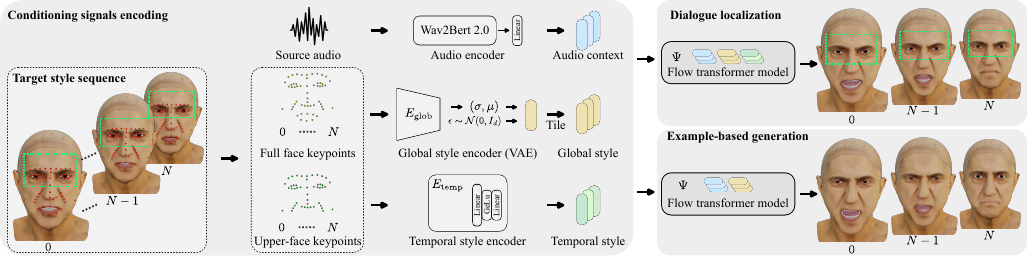
KM-Speaker · 2026-06
KM-Speaker: Keypoint-Based Style Control for High-Quality Speech-Driven 3D Facial Animation and Dialogue Localization
KM-Speaker is a speech-driven 3D facial animation system that combines global style from full-face keypoints with frame-level control from upper-face keypoints. It enables high-fidelity motion and precise style control, excelling in dialogue localization with accurate lip-sync and expressive performance.
Abstract
Speech-driven 3D facial animation methods face significant challenges in simultaneously achieving high-fidelity motion and precise artistic control at production quality. Existing controllable models typically learn global style control by relying on large-scale, low-quality \emph{in-the-wild} datasets that compromise overall animation realism. Furthermore, these frameworks often lack the fine-grained temporal precision required for demanding tasks such as dialogue localization (e.g., dubbing), where matching specific facial expressions is as critical as lip synchronization. We present KM-Speaker (Keypoint-Matching Speaker), a novel keypoint-conditioned flow-based generative framework that provides both global style guidance and frame-level temporal control from reference performances. We propose a disentanglement strategy that separates audio-driven lip motion from keypoint-driven upper-face dynamics, together with a global style context preservation mechanism to ensure coherent full-face expressiveness. KM-Speaker advances example-based 3D facial animation by achieving high-fidelity motion and flexible controllability in a data-constrained setting, consistently outperforming state-of-the-art methods in lip-sync accuracy, style adherence, and expressive temporal control.
MindFlow approaches dyadic conversation animation through a neuroscience-inspired Ventral-Dorsal dual-pathway architecture. The Ventral module runs a multimodal LLM in a Chunk-State paradigm — updating an emotion state chain over 1.5-second audio windows rather than mapping full sentences to motion labels — while the Dorsal module uses a conditional autoregressive flow-matching network with a Selective Acoustic Injector that adaptively gates audio from both interlocutors to handle talking-and-listening dynamics.
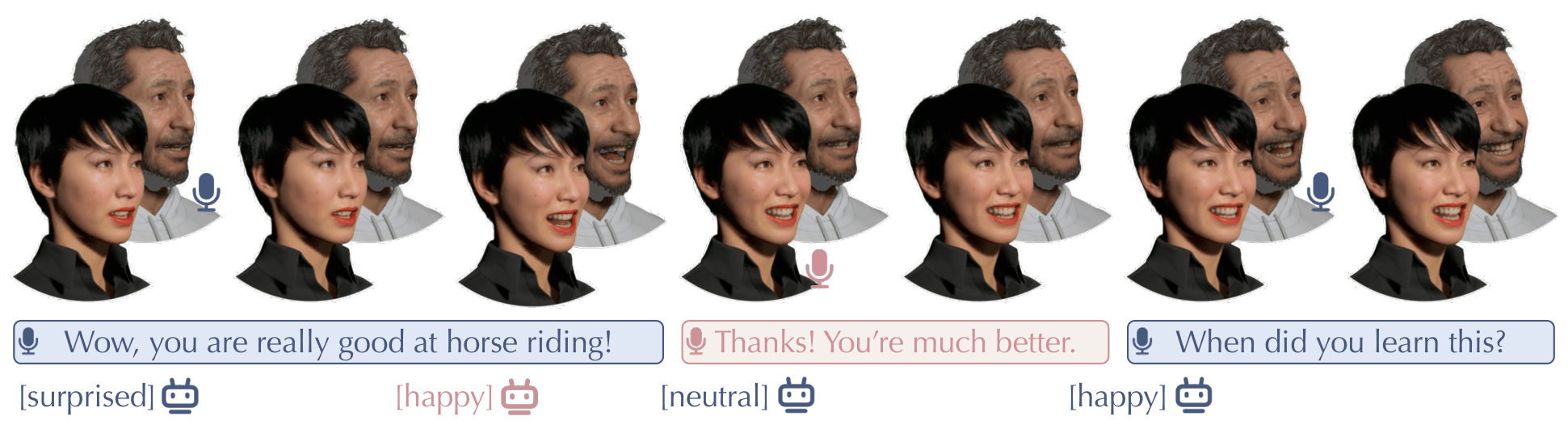
MindFlow · 2026-06
MindFlow: Harmonizing Cognitive Semantics and Acoustic Dynamics for Facial Animation Generation in Dyadic Conversations
MindFlow generates lifelike facial animations in dyadic conversations by combining evolving emotional state reasoning with precise motion control. It models raw audio as emotion states and adaptively fuses acoustic cues to produce semantically rich and temporally accurate facial animation.
Abstract
Generating lifelike facial animation for dyadic conversations requires reconciling high-level cognitive intent with precise low-level motor reflexes, yet existing methods fall short in the semantic understanding of dialogue context and in precise dynamic control. In this paper, we propose MindFlow, a dual-pathway generative framework inspired by the Ventral-Dorsal pathway model in neuroscience, which decouples generation into two collaborative streams, thereby harmonizing deep semantic reasoning with fine-grained control. In the Ventral module, we transform the conventional Sentence-Action approach into a novel Chunk-State approach that models raw acoustic streams as a context-aware, evolving emotional state chain, capturing subtle paralinguistic nuances and mid-utterance emotional shifts missed by sentence-level modeling. The Dorsal module features a conditional autoregressive flow matching network for high-fidelity facial motion, driven by high-frequency acoustic cues and modulated by emotion states, plus a Selective Acoustic Injector for adaptive audio gating to ensure robustness in talking-and-listening dynamics without interference. Extensive experiments demonstrate that MindFlow achieves superior semantic appropriateness and motion naturalness compared to state-of-the-art baselines.
Sculpting NeRF Geometry demonstrates that RLHF can improve 3D face geometry in a radiance-field GAN without text prompts, mesh extraction, or multi-view rendering. A reward model trained on a small set of pairwise human preferences reads the NeRF density volume directly, and a density-consistency constraint keeps 2D appearance qualitatively stable while the geometry is reshaped. Users preferred the fine-tuned geometries in 74.4% of pairwise comparisons.
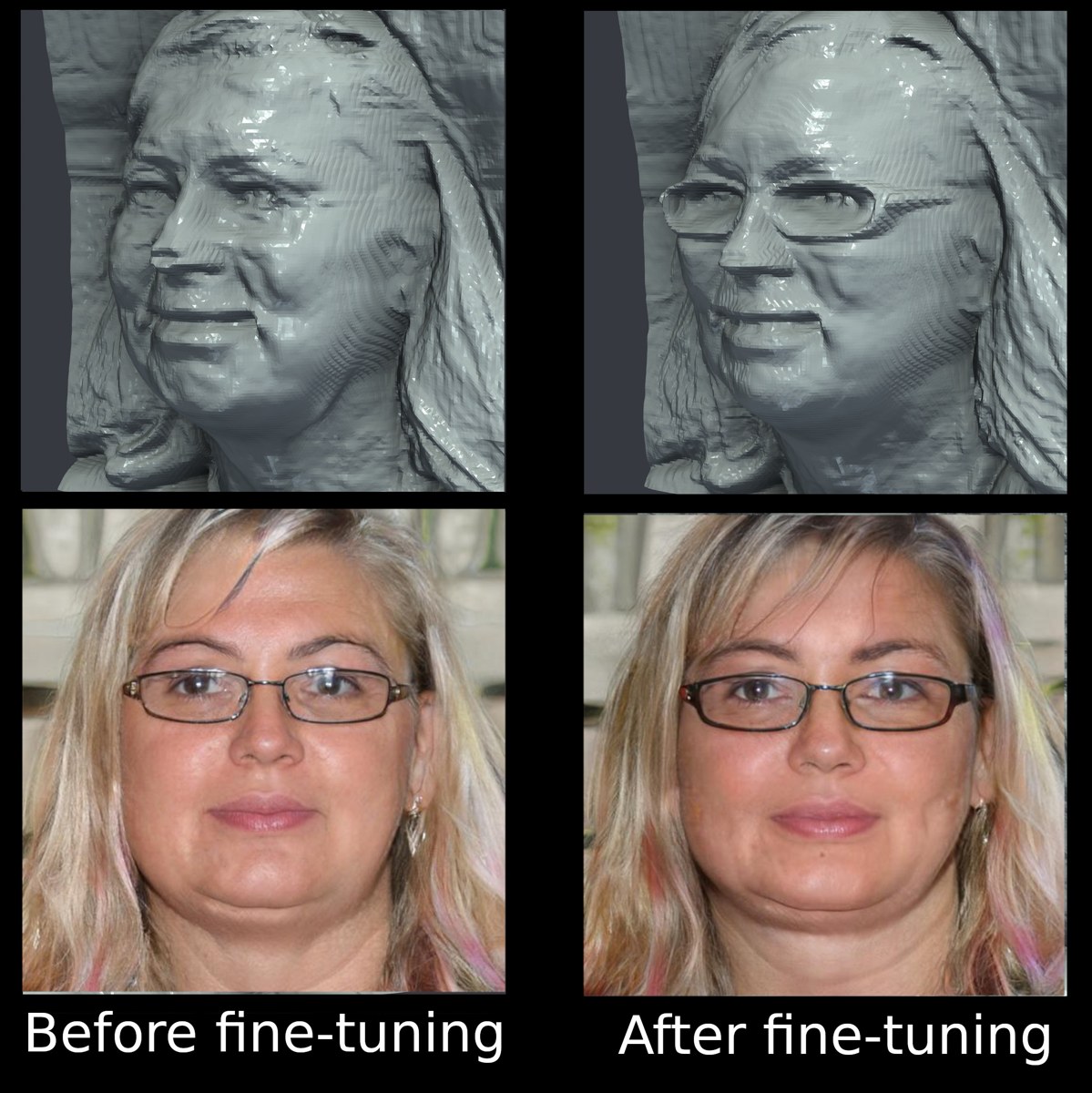
Sculpting NeRF Geometry · 2026-06
Sculpting NeRF Geometry: Human-Preference Fine-Tuning of a 3D-Aware Face GAN
This paper fine-tunes a pretrained 3D-aware face GAN's geometry using a reward model trained on human preferences directly from the radiance field's density values. It uniquely improves 3D facial geometry without relying on text prompts, mesh priors, or explicit surface supervision, while preserving 2D appearance.
Abstract
Reinforcement learning from human feedback (RLHF) for 3D generation is now established across a number of works, but most existing pipelines optimise explicit surface representations, often by converting radiance fields into meshes and training heavily on surface-supervised data. We instead fine-tune a pretrained 3D-aware generative model directly from a learned reward over radiance-field density ($σ$) values, with no externally supplied mesh or shape prior. The reward model requires no pretraining, trains easily on a small set of preference samples, and yields robust improvement in 3D geometry. Working on an unconditional 3D-aware face GAN (EG3D), our reward reads the continuous 3D density field of the neural radiance field (NeRF) directly and supplies a geometry-only learning signal, requiring neither text conditioning, mesh extraction, nor multi-view rendering. A density-consistency constraint keeps the 2D appearance qualitatively similar while the geometry is reshaped, at a measurable but bounded distributional cost (FID-50k rises from 4.09 to 6.66): the fine-tuned generator, trained from the preferences of a single annotator as a proof of concept, produces face geometries preferred by users in 74.4% of pairwise comparisons.
NOASSERTION
On the rendering side, RAGA solves the long-standing problem of physically plausible shadow casting for animated 3DGS avatars composited into 3DGS scenes. Rather than binary hit tests, it computes exact ray–Gaussian line integrals normalized by the theoretical maximum, producing soft shadows entirely in Gaussian space at ~50 FPS via custom CUDA/OptiX kernels. An avatar proxy representation stabilizes shadows against clothing deformation artifacts.
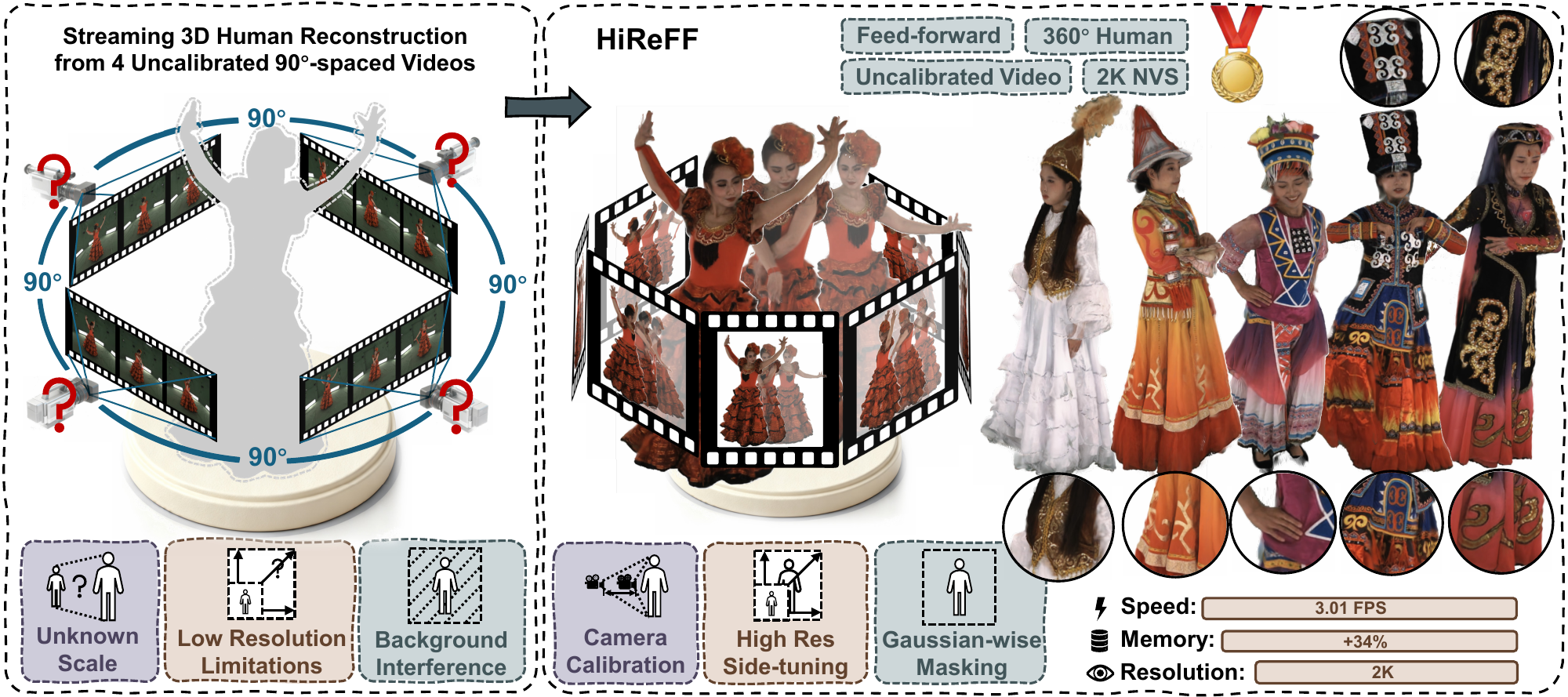
HiReFF · 2026-06
HiReFF: High-Resolution Feedforward Human Reconstruction from Uncalibrated Sparse-View Video
A feed-forward method for streaming 360° human reconstruction at 2K resolution from uncalibrated sparse-view videos. It achieves real-time performance with temporal consistency by efficiently decomposing Gaussian reconstruction and high-resolution synthesis via a lightweight side-tuning architecture.
Abstract
Uncalibrated volumetric video streaming for human reconstruction is essential for holographic communication and AR/VR, yet remains challenging due to the need for temporal consistency and computational efficiency from sparse-view inputs. Existing methods rely on per-scene optimization or calibrated cameras, while recent feed-forward models are limited to low-resolution (0.5K) single-frame synthesis. We present HiReFF, a feed-forward method for 2K-resolution 360° human video reconstruction from uncalibrated sparse-view videos. Our framework decomposes the problem into two key tasks: foreground 3D Gaussian reconstruction from sparse-view videos (four views separated by 90°) and computationally efficient high-resolution synthesis. To enable the former, we propose Scale-synchronized Camera Calibration to resolve scale ambiguity for multi-view supervision, and Gaussian-wise Foreground Masking to reconstruct clean foregrounds by modulating Gaussian parameters. For efficient high-resolution synthesis, our High-resolution Side-tuning achieves 2K rendering by augmenting the Gaussian head with supplementary features while keeping the backbone at 0.5K, drastically reducing computational overhead. Experiments demonstrate that HiReFF significantly outperforms existing methods in high-resolution streaming volumetric video reconstruction. https://iridescentjiang.github.io/HiReFF
MIT
HiReFF pushes feed-forward volumetric human reconstruction to 2K resolution from four uncalibrated sparse-view videos, using a High-resolution Side-tuning strategy that keeps the VGGT backbone at 0.5K while injecting high-resolution image features into a DPT-based Gaussian head — achieving 3.01 FPS on a single RTX 4090 with only 34% additional VRAM versus 0.5K training.
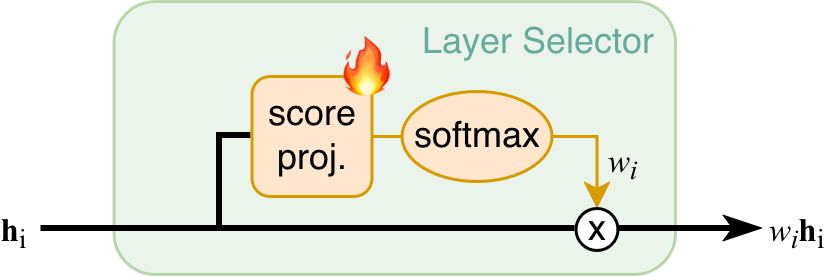
Synthetic ASR · 2026-06
How to Leverage Synthetic Speech for LLM-Based ASR Systems?
This work probes where LLM-based ASR models distinguish real from synthetic speech, then leverages those insights to train effective mixed-data systems. It shows that room impulse response augmentation and learned layer-wise pooling can match real-data baselines using just 25% real speech.
Abstract
In regulated domains such as banking and healthcare, where privacy constraints make real speech costly to collect and retain, synthetic speech from modern text-to-speech (TTS) is an appealing alternative for training automatic speech recognition (ASR) without exposing sensitive customer recordings. Yet a persistent distributional gap between synthetic and real data limits how far it can replace genuine recordings. Prior work largely treats this gap as a black box to be engineered around, but in our work, we instead examine its origin directly by probing a SLAM-ASR architecture. Then, we localise where its LLM backbone separates real from synthetic speech and find the discriminative signal concentrated in the early-to-middle layers, where temporal and prosodic perturbations disrupt it most. We further show that representation-level separability, help, but does not directly predict downstream ASR gains. On the other hand, convolving synthetic audio with room impulse responses (RIRs) narrows the gap not by making synthetic speech sound cleaner or more natural, but by reproducing the acoustic irregularities of real recordings. Translating these findings into the training procedure, by adding a layer-selection module combined with RIR augmentation matches a fully real-data baseline using only 25% of the real speech (13.6h) and surpasses it at all higher proportions.
ASR and Acoustic Modeling
Smaller but technically precise improvements to non-autoregressive and low-resource ASR rounded out the week.
InterAligner addresses brittle alignment formation in Aligner-Encoder ASR, where monotonic audio-text alignment tends to appear abruptly in upper layers of a deep Conformer. Adding intermediate Aligner and CTC objectives at earlier layers creates a curriculum over alignment difficulty, improving LibriSpeech WER from 5.0/7.8 to 3.1/5.6 (test-clean/other) with the largest gains on long utterances.
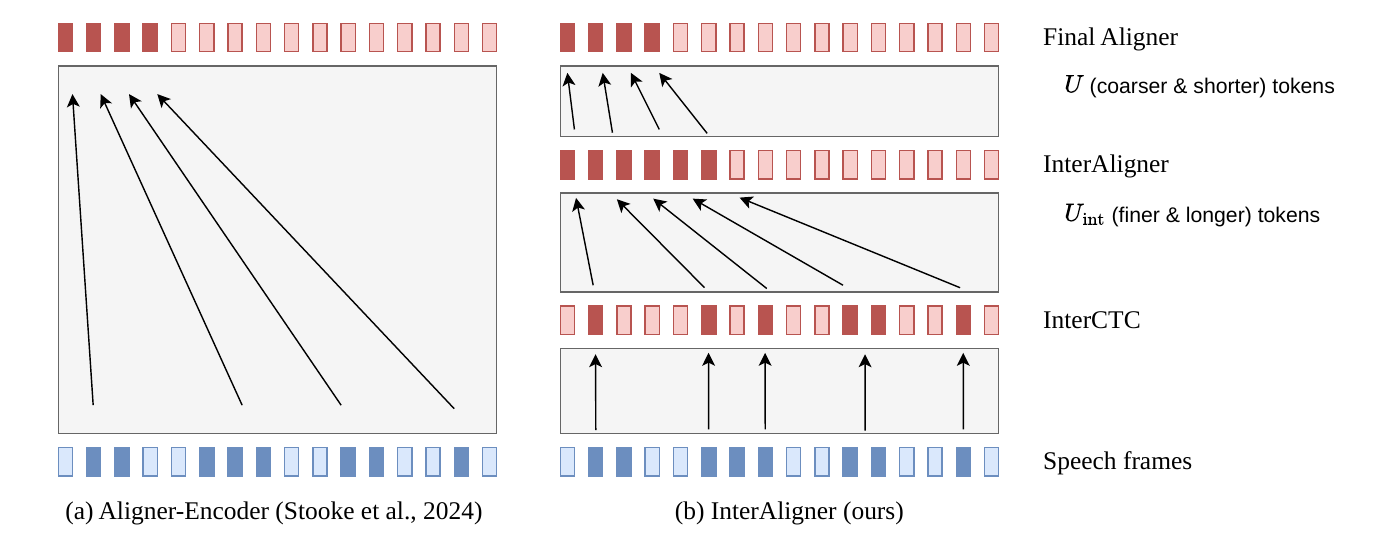
InterAligner · 2026-06
Progressive Alignment Objectives for Aligner-Encoder based ASR
InterAligner enhances Aligner-Encoder ASR by adding progressive alignment objectives at intermediate layers, guiding the encoder to form monotonic alignment gradually. This approach stabilizes training and improves recognition, especially on long utterances, outperforming methods using only final-layer alignment.
Abstract
Aligner-Encoders are recently proposed seq2seq end-to-end ASR models that replace decoder attention by predicting the uth token directly from the u-th encoder position, so the encoder must learn the alignment internally without cross-attention or a transducer lattice. In practice, this alignment often forms abruptly in the upper layers, making training sensitive and brittle on long utterances. We propose InterAligner, which adds an intermediate Aligner objective so alignment can form progressively across depth, together with an intermediate CTC loss (InterCTC) to stabilize optimization. On LibriSpeech with a 17-layer Conformer, a final-only Aligner reaches 5.0/7.8 WER (test-clean/other). InterCTC improves to 3.4/6.0, and InterAligner further reduces WER to 3.1/5.6 with the largest gains on long utterances.
CTC-Seeded Edit Flow reformulates non-autoregressive ASR decoding as variable-length edit refinement of a greedy CTC hypothesis. Rather than reconstructing from scratch, an acoustic-conditioned Edit Flow decoder predicts insertions, deletions, and substitutions in parallel, trained with a continuous-time discrete diffusion objective. Two refinement steps with classifier-free guidance on the audio condition and CTC-confidence gating yield substantial WER reductions over the first-pass baseline.
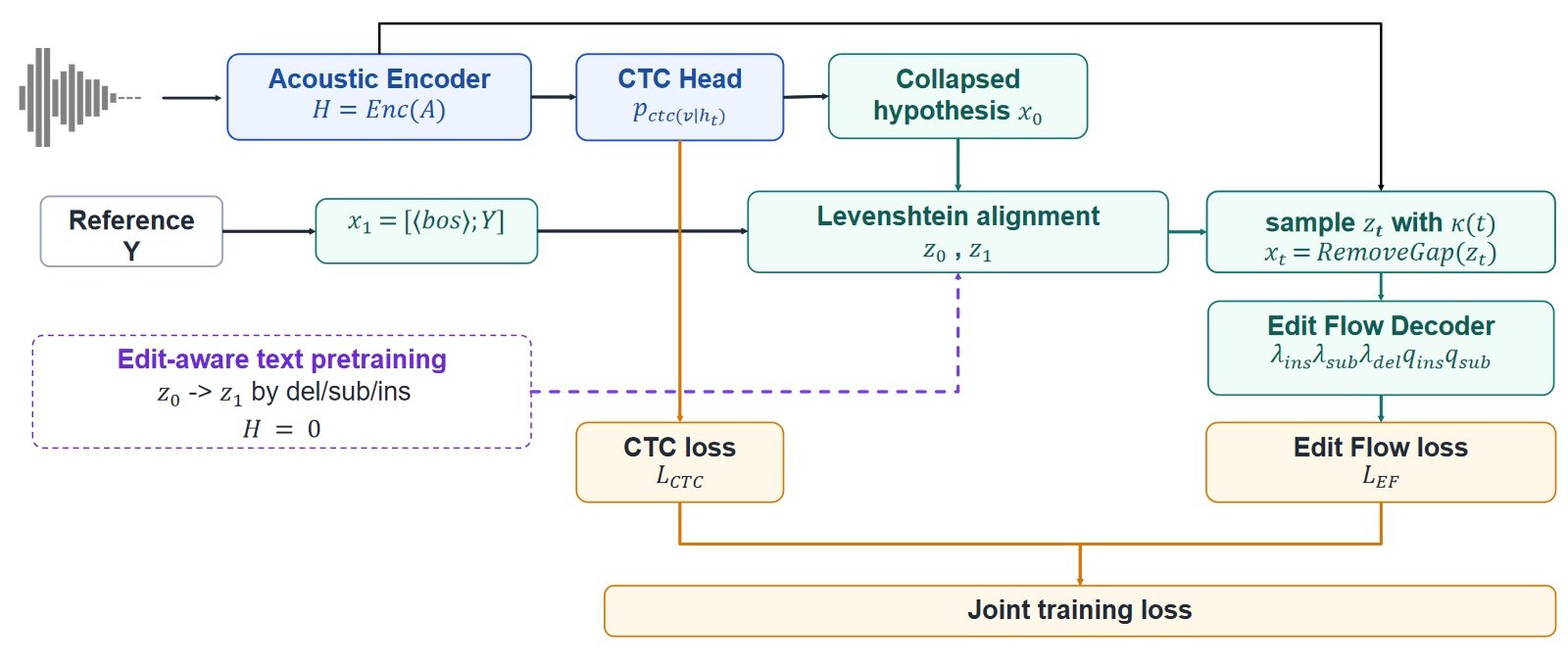
CTC-Seeded Edit Flow · 2026-06
CTC-Seeded Token Edit Refinement for Non-Autoregressive Speech Recognition
Refines greedy CTC transcripts in non-autoregressive ASR by predicting insertions, deletions, and substitutions using an acoustic-conditioned Edit Flow decoder. This approach uses the CTC output as a strong seed, improving accuracy efficiently with fewer refinement steps by leveraging acoustic and confidence cues.
Abstract
Non-autoregressive automatic speech recognition (ASR) enables parallel decoding, but many refinement-based methods begin from random, fully masked, or fixed-length token sequences, requiring multiple iterations to reconstruct the complete transcript. We instead formulate ASR decoding as a variable-length edit refinement of a greedy connectionist temporal classification (CTC) hypothesis. An acoustic-conditioned Edit Flow decoder operates directly on the collapsed CTC hypothesis, predicting insertion, deletion, and substitution operations in parallel. The Edit Flow decoder is jointly trained with a CTC model using a continuous-time discrete diffusion loss. During inference, we find that just two edit steps yield substantial Word Error Rate (WER) reductions, and classifier-free guidance (CFG) further enhances recognition quality by focusing the model on audio features. We also constrain edit proposals using CTC confidence to improve accuracy. Finally, ablation studies validate our design choices, while decoder pretraining and pretrained encoder integration yield significant additional performance gains.
Audio-Image Alignment for Low-Resource ASR inserts an intermediate alignment stage between SSL pretraining and supervised ASR fine-tuning, using audio-image pairs from the Vaani dataset to adapt a FastConformer encoder without any transcription data. The approach consistently improves ASR performance across low-resource Indic languages, with the key finding that gains cannot be attributed to additional audio exposure since the same audio was already seen during pretraining.
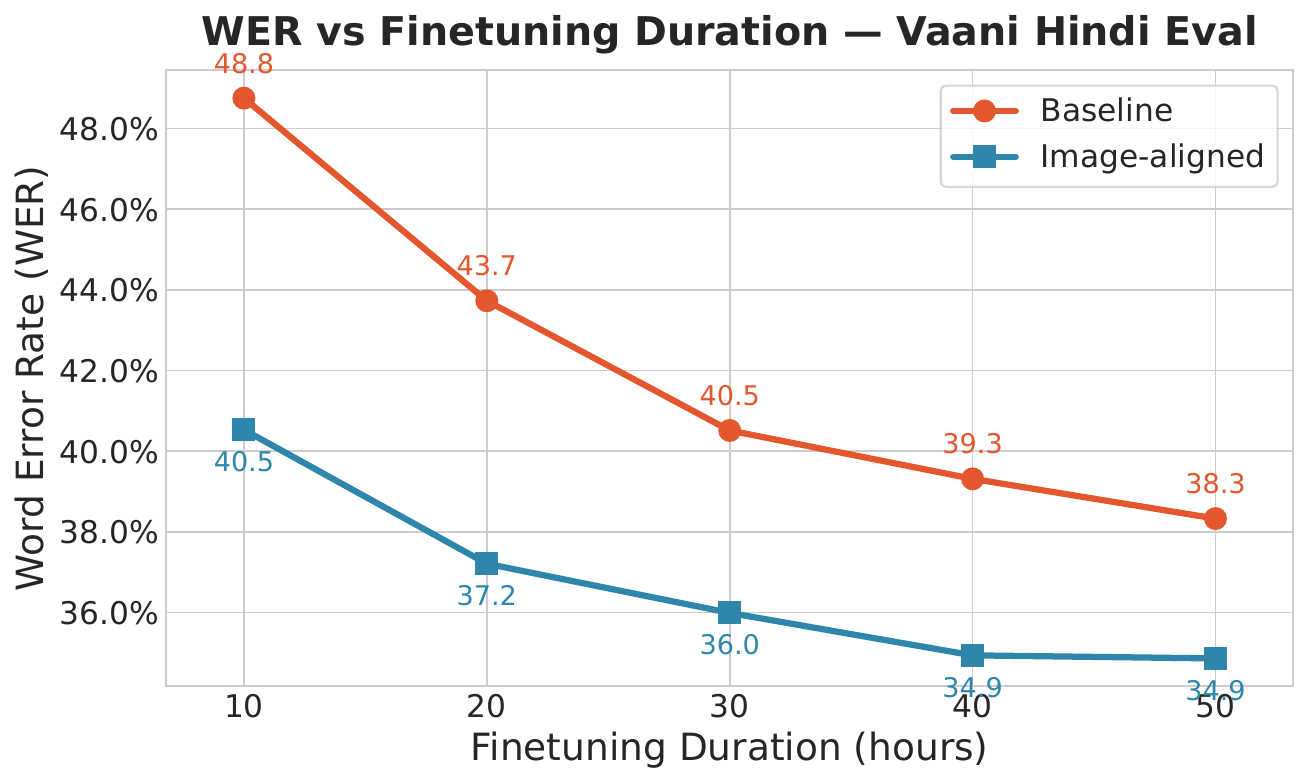
Audio-Image Alignment for Low-Resource ASR · 2026-06
Audio--Image Alignment as a Continued-Pretraining Stage Improves Low-Resource ASR
This paper proposes an intermediate pretraining step using audio-image pairs to adapt pretrained audio encoders without transcripts. This stage improves ASR performance in low-resource languages by enhancing representation robustness and transferability before supervised fine-tuning.
Abstract
Thousands of languages are spoken worldwide, yet many remain under-resourced for Automatic Speech Recognition (ASR) due to the limited availability of high-quality transcribed speech data. Collecting accurate transcriptions is often costly and labor-intensive, particularly for low-resource languages. In this work, we investigate the use of aligned audio-image pairs to adapt pretrained audio encoders without requiring transcription data before supervised fine-tuning. Our proposed representation alignment stage is introduced between large-scale pretraining and supervised ASR fine-tuning. Specifically, image representations extracted from pretrained vision encoders are aligned with audio representations to further adapt a pretrained audio encoder. For this alignment process, we utilize the Vaani dataset, in which images serve as prompts for speech collection, naturally providing paired audio-image data. We evaluate the proposed approach using multiple vision encoders and a pretrained FastConformer audio encoder. Experimental results demonstrate that models fine-tuned after representation alignment consistently achieve improved ASR performance compared to direct fine-tuning. These findings highlight the potential of audio-image representation alignment as an effective transcription-free adaptation strategy for enhancing ASR systems in low-resource language settings.
LoRA adaptation at the TTS end of the pipeline was studied in VoxCPM2 LoRA TTS Adaptation, which applies a shared low-rank adapter to both the LM backbone and flow-matching decoder of a 2.4B-parameter tokenizer-free TTS model for Khmer and Korean. Khmer MOS rises from 3.85 to 4.23 with only 0.19–3.03% of parameters trained, while the same adapter brings no gain for Korean — a well-served language — illustrating that parameter-efficient adaptation helps mainly where the base model is genuinely weak.
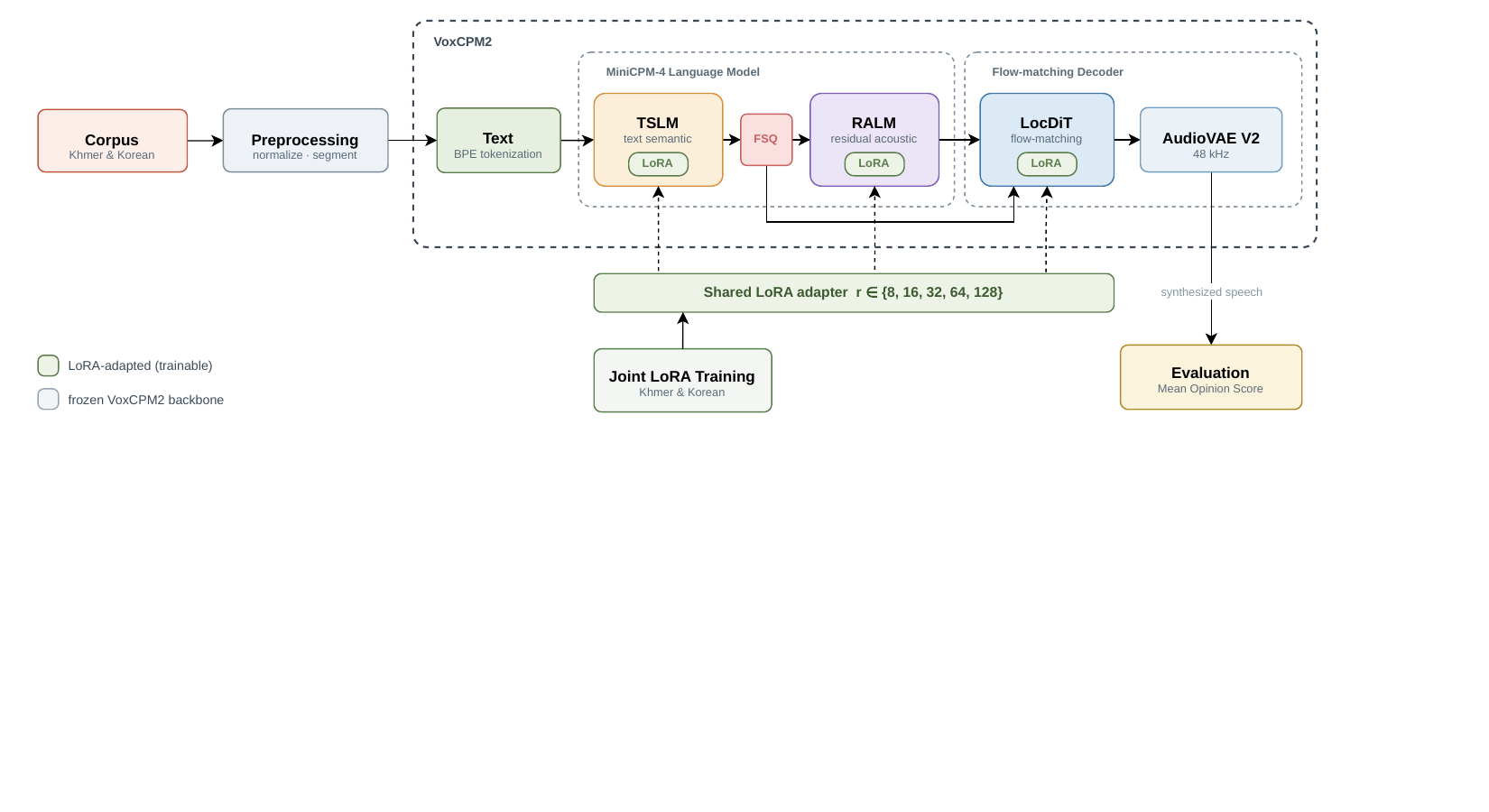
VoxCPM2 LoRA TTS Adaptation · 2026-06
Closing the Quality Gap in Low-Resource Text-to-Speech: LoRA Fine-Tuning of VoxCPM2 for Khmer and Korean
This paper presents a parameter-efficient LoRA fine-tuning method to adapt a large pretrained TTS model for low-resource Khmer and Korean. A single shared adapter improves Khmer speech quality notably while maintaining Korean performance without the cost of full fine-tuning.
Abstract
Large pretrained text-to-speech (TTS) models sound almost human for well-resourced languages, but much worse for languages that are rare in their training data. We study this quality gap for Khmer and Korean using VoxCPM2, a 2.4B-parameter, tokenizer-free TTS model that joins a MiniCPM-4 language-model backbone with a flow-matching diffusion decoder. We build one shared, language-tagged corpus of about 26 hours and adapt VoxCPM2 with a single Low-Rank Adaptation (LoRA) adapter, trained on both languages at once and added to both the language model and the decoder. The adapter is zero-initialized, so training starts exactly at the original (zero-shot) model. In native-speaker listening tests, the Khmer Mean Opinion Score (MOS) rises from 3.85 to 4.23 with the best adapter (rank 64), a highly significant gain (paired Wilcoxon test, p<0.001), while training only 0.19 to 3.03 percent of the parameters. The automatic loss and the human ratings, however, disagree on the best rank: validation loss is lowest at rank 128, yet MOS peaks at rank 64. The same adapter brings no gain for Korean, a language the base model already handles well, and at a high rank it even degrades quality. Adaptation therefore helps mainly where the base model is genuinely weak.
apache-2.0
Body Motion and Gesture
MotionMAR reconstructs complete human motion from three sparse VR/AR trackers (head, left hand, right hand) using a multi-scale autoregressive framework. A Temporal Multi-scale Tokenization VQ-VAE encodes motion at three temporal resolutions, and a Scale-Aware Control module aligns the sparse tracking signals at each scale. The multi-scale AR generation follows a next-scale rather than next-token paradigm, establishing global trajectories before recovering high-frequency details — achieving state-of-the-art on AMASS.
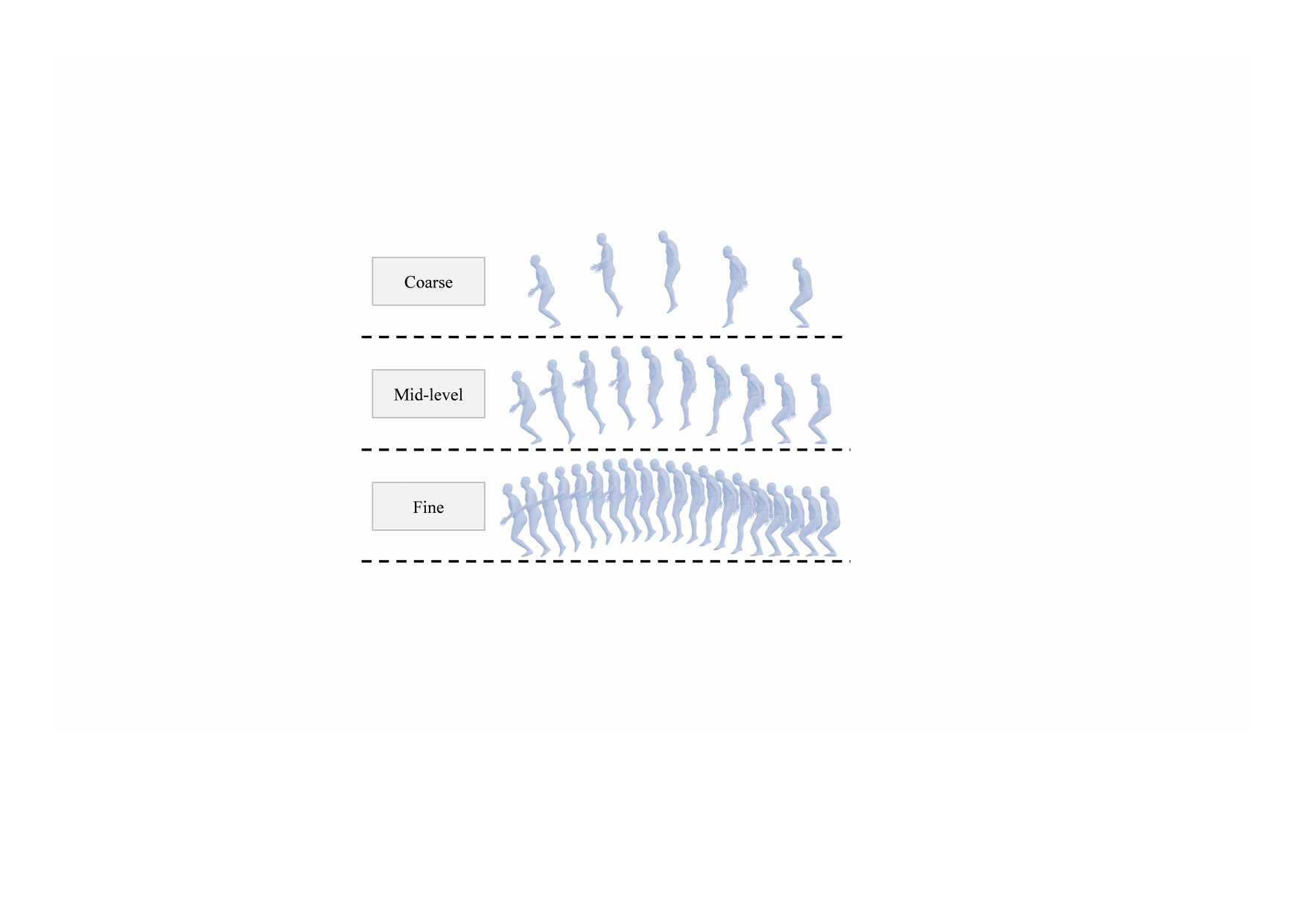
MotionMAR · 2026-06
MotionMAR: Multi-scale Auto-Regressive Human Motion Reconstruction from Sparse Observations
MotionMAR reconstructs full-body human motion from sparse VR sensor data using a multi-scale autoregressive framework, capturing global trajectories to fine details. Its coarse-to-fine tokenization and scale-aware control provide accurate, jitter-free human motion respecting temporal hierarchy.
Abstract
Human motion follows a temporal hierarchical structure, transitioning from low-frequency global trajectories to high-frequency details. Inspired by the success of multi-level autoregressive models in computer vision, we propose MotionMAR, a coarse-to-fine framework for motion reconstruction from sparse observations. It first estimates the global trajectory of human motion and then gradually refines the temporal details. This architecture consists of four integrated components. The Temporal Multi-scale Tokenization (TMT) VQ-VAE encodes the data at multiple temporal resolutions, separating semantic motion from minor jitters. The Motion Autoregressive Network (MAN) operates in this latent space, predicting motion across scales. It first establishes the global structure through coarse indices and then generates finer indices to recover specific details. Meanwhile, the Scale-Aware Control (SAC) module integrates sparse tracking data to ensure the generated output aligns with actual observations. The Motion Refinement Network (MRN) subsequently smooths consecutive poses and eliminates quantization artifacts. Experiments show that MotionMAR achieves state-of-the-art accuracy on the AMASS dataset, providing a reliable and structure-aware approach for motion reconstruction. The source code is publicly available at http://www.lidarhumanmotion.net/motionmar/.
CrossAccent-TTS rounds out the expressive control picture on the speech side, disentangling speaker identity from accent using an Accent Intensity Controller that interpolates learned language embeddings at inference time, enabling smooth cross-lingual accent modulation without separate per-accent models.
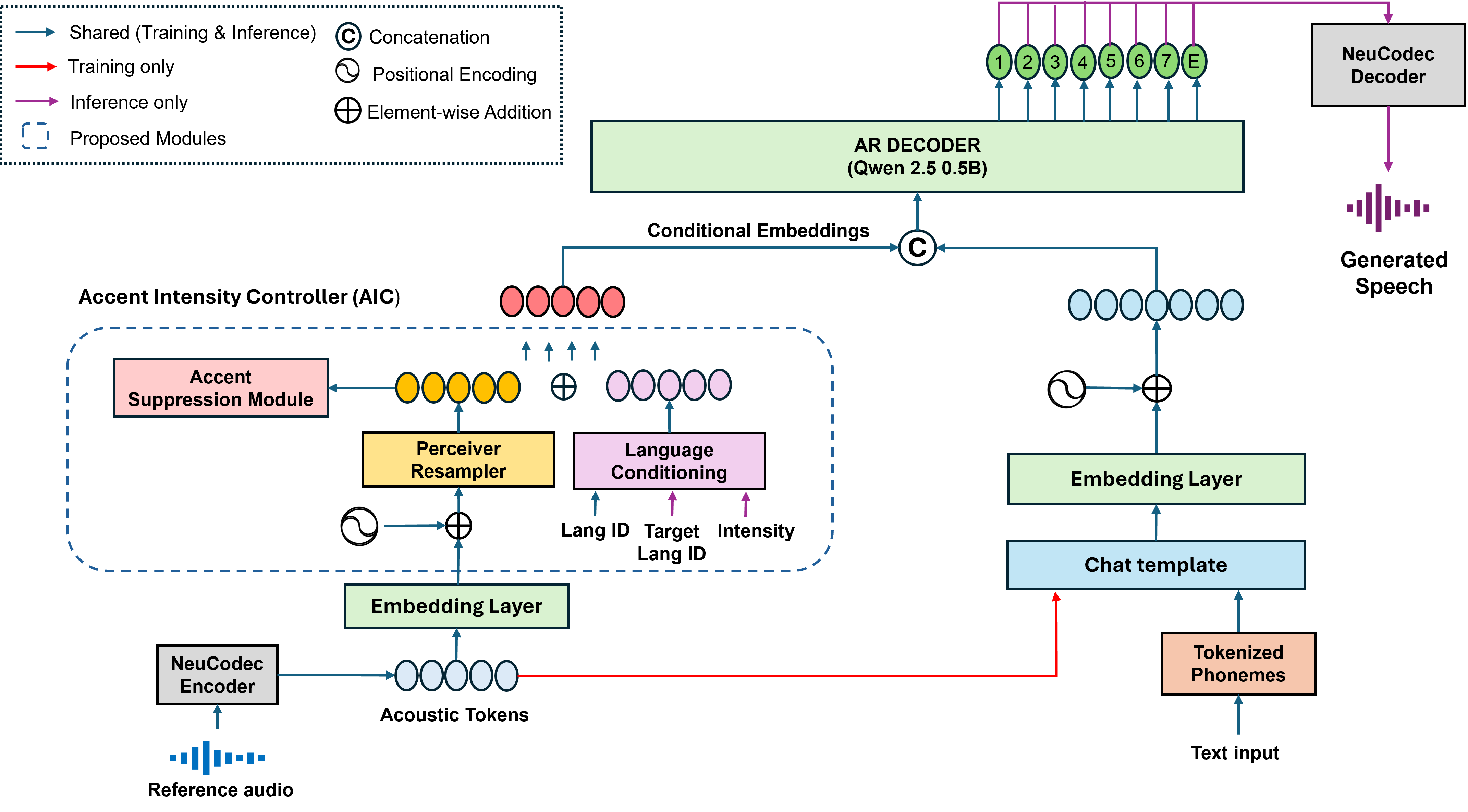
CrossAccent-TTS · 2026-06
CrossAccent-TTS: Cross-Lingual Accent-Intensity Controllable Text-to-Speech via Disentangled Speaker and Accent Representations
CrossAccent-TTS enables precise control of accent and accent intensity in cross-lingual TTS by disentangling speaker and accent features and conditioning synthesis on learned language embeddings. It preserves speaker identity while allowing smooth accent modulation, performing well on Indic and foreign English accents.
Abstract
Accent conversion and controllability remain fundamental challenges in cross-lingual text-to-speech (TTS), particularly for low-resource and phonetically diverse Indic languages. While recent large language model (LLM)-based TTS systems exhibit strong cross-lingual generalization, they provide limited explicit control over accent characteristics and intensity. In this paper, we propose CrossAccentTTS, a framework that enables both accent control and conversion while preserving speaker identity. Specifically, we introduce an Accent Intensity Controller (AIC) that injects weighted language embeddings into the accent subspace, allowing smooth interpolation between accents and fine-grained modulation of accent strength at inference time. Experiments on the Indic Multilingual and L2-arctic datasets shows that CrossAccent-TTS achieves precise control of accent intensity, outperforming strong baselines in accent similarity and controllability by maintaining speaker similarity and naturalness.
Looking across the week, the tightest cluster of activity is in RL-based TTS post-training: FlowTTS-GRPO, VoiceTTA, and HPRO all independently converge on GRPO as the right framework for preference alignment in flow-matching speech models, each with a distinct focus on acoustic quality and speaker similarity, test-time style adaptation, and emotional expressiveness respectively. The emotional intelligence gap paper stands somewhat apart but may be the most immediately actionable finding for teams shipping production voice agents today — the problem it identifies sits above the model layer entirely.